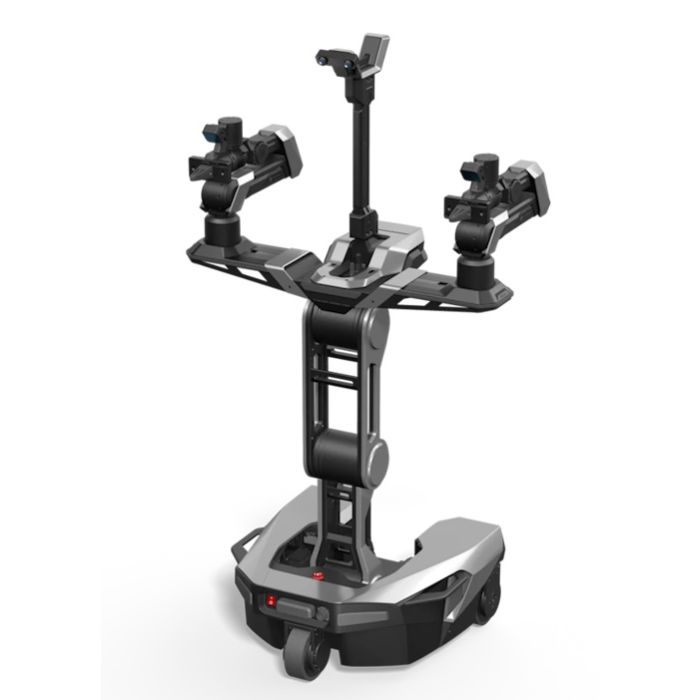
Galaxea R1 Lite Wheeled Humanoid Robot (R1 Lite)
In stock
- BRAND:
- GALAXEA
- PART #:
- R1 Lite
- ORIGIN:
- China
- AVAILABILITY:
- SUBJECT TO AVAILABILITY
- SKU:
- Galaxea-R1-Lite
R1 Lite Wheeled Humanoid Robot (R1 Lite)
On the company’s product storefront, R1 Lite is positioned as a “6-DOF General Mobile Manipulation Platform” intended to support embodied foundational model development and extensible integration through sensors, teleoperation tools, and software interfaces.
R1 Lite is part of the broader Galaxea “R1 series” of wheeled humanoid robots, where different models target different performance tiers and development needs. In contrast to full-size wheeled humanoids that emphasize human-scale reach and higher compute budgets, R1 Lite is marketed as a more compact platform focused on repeatable mobile manipulation with a standardized sensor suite and documented ROS 2 control stack.
Design and Features
Dual-arm mobile manipulation layout
R1 Lite uses a wheeled base with an upper-body manipulation frame, carrying two robotic arms and two grippers. Official documentation states the platform is equipped with two Galaxea A1X robotic arms and two Galaxea G1 grippers, intended for grasping and manipulation tasks.
A recurring detail in Galaxea’s documentation is the way “degrees of freedom” are counted. The product page specifies 6 DoF per arm and 1 DoF per gripper, while the hardware guide describes “7 degrees of freedom per arm,” which is consistent with interpreting “arm + gripper” as a combined chain.
Omnidirectional chassis for indoor maneuvering
The R1 Lite chassis is described as “6, 360° omnidirectional” in the product specifications, indicating a base designed for agile repositioning in tight spaces—an important requirement for mobile manipulation where small alignment errors can prevent reliable grasps or insertions.
Standard perception suite for navigation and manipulation
The base configuration includes multiple cameras, inertial sensing, and LiDAR. Galaxea lists the standard sensors as:
-
Head: 1× stereo-ready dual camera system
-
Wrist: 2× depth cameras
-
Platform: 1× IMU
-
Chassis: 5× monocular RGB cameras + 1× 360° LiDAR + 1× IMU
This configuration reflects a common embodied AI pattern: multi-view vision for near-field manipulation, combined with range sensing (LiDAR) and inertial measurements for navigation stability and state estimation.
Teleoperation-ready by design
R1 Lite is explicitly positioned as teleoperation-capable. The storefront lists teleoperation options including a master teleoperation end-effector and VR device compatibility, while the documentation includes a dedicated teleoperation usage tutorial that recommends an Ubuntu 22.04 + ROS 2 Humble “upper computer” for teleop workflows.
Technology and Specifications
Galaxea publishes an unusually detailed parameter table for R1 Lite on its storefront, describing mechanical dimensions, payload, motion limits, sensors, and onboard compute.
Dimensions and mechanical configuration
-
Height: 1281 mm
-
Chassis width: 596 mm
-
Torso platform width: 670 mm
-
Weight: 75 kg (including battery)
-
Total DoF: 23 (including chassis, torso, arms, and grippers)
Manipulation performance (arms and grippers)
-
Single-arm DoF: 6
-
Torso DoF: 3
-
Gripper: force-controlled parallel gripper; 1 DoF
-
Gripping range: 0–100 mm
-
Gripping force: 150 N rated, 350 N peak
-
Repeatability: ±1 mm (as listed in the parameter table)
Payload is described at both system and per-arm levels:
-
Dual-arm payload: 6 kg rated, 10 kg maximum (dual-arm)
-
Single-arm payload (kg @ 0.6 m): 3 kg rated, 5 kg maximum
Mobility
-
Chassis: 6 DoF, 360° omnidirectional
-
Chassis speed: 1.5 m/s
Onboard compute
-
Computing: Intel Core i9-12900HK, 32 GB RAM (listed as the computing unit configuration)
Software architecture and ROS 2 interfaces
Galaxea’s ROS 2 documentation describes the R1 Lite control stack as a “mobiman” (mobile manipulation) package with six major interface areas:
-
arm joint control, 2) arm pose control, 3) gripper control, 4) torso velocity control, 5) torso joint control, and 6) chassis control.
This structure is consistent with typical robotics middleware separation: low-level joint control, mid-level pose/cartesian control, base motion control, and the glue logic required to coordinate them safely.
Applications and Use Cases
R1 Lite is most commonly aligned with indoor mobile manipulation, where a robot must move through an environment and perform “hands-on” tasks. Based on the published feature set (dual arms, force-controlled grippers, multi-camera sensing, LiDAR, and teleop + ROS 2 interfaces), typical application areas include:
Embodied AI research and dataset generation
The combination of teleoperation support and structured software interfaces makes R1 Lite suitable for collecting manipulation demonstrations, testing learned policies, and iterating on perception-to-action pipelines. The product positioning explicitly frames the platform as a development tool for embodied models.
Lab automation and repetitive handling
With rated payload, gripper force control, and omnidirectional mobility, the platform can be used for controlled handling in labs: moving items between benches, picking objects from known locations, or performing repeated “pick-place” routines under supervision.
Prototype deployment in structured facilities
R1 Lite’s sensor stack and chassis speed support indoor traversal, while its dual arms enable basic workcell-style operations—especially where tasks can be simplified by fixtures, markers, or staged bins.
Advantages / Benefits
Balanced hardware for mobile manipulation
R1 Lite’s published specification targets the practical “middle” of embodied robotics: enough payload for real objects, enough sensing for navigation and grasping, and a form factor sized for indoor development environments.
Teleoperation options for faster iteration
Teleoperation is often used to bootstrap data collection and validate task feasibility before full autonomy. Galaxea’s inclusion of teleop workflows (and documentation that targets ROS 2 Humble environments) supports this iterative development cycle.
Documented ROS 2 interface boundaries
By publishing interface-level documentation (joint, pose, gripper, torso, chassis), R1 Lite reduces integration ambiguity for teams building planning stacks, perception pipelines, and learned controllers on top of a stable driver layer.
FAQ Section
What is the Galaxea R1 Lite Wheeled Humanoid Robot?
The Galaxea R1 Lite is a dual-arm wheeled mobile manipulation platform designed for embodied AI development and indoor manipulation tasks, featuring a multi-camera + LiDAR sensor suite and ROS 2 software interfaces.
How does the Galaxea R1 Lite work?
R1 Lite combines an omnidirectional wheeled chassis with two robotic arms and force-controlled grippers, using vision, IMUs, and 360° LiDAR for perception. Control is exposed through ROS 2 interfaces covering arm joints, arm poses, grippers, torso control, and chassis motion.
Why is the Galaxea R1 Lite important?
Platforms like R1 Lite help teams prototype and validate mobile manipulation workflows—often faster than building custom hardware—while providing a standardized base for data collection, teleoperation, and autonomy development.
What are the benefits of the Galaxea R1 Lite?
Key benefits include 23 total DoF, an omnidirectional base, dual-arm manipulation with force-controlled grippers, a standard multi-camera + 360° LiDAR sensor set, and a documented ROS 2 “mobiman” control architecture suitable for research and prototyping.
Summary
The Galaxea R1 Lite is a wheeled humanoid-style dual-arm mobile manipulation platform aimed at embodied AI development, teleoperation-driven iteration, and indoor manipulation prototypes. With 23 DoF, an omnidirectional chassis, a multi-camera + 360° LiDAR sensor set, and a documented ROS 2 control stack organized around mobile manipulation (“mobiman”), R1 Lite is positioned as a practical foundation for research teams and applied robotics developers building real-world manipulation systems.