
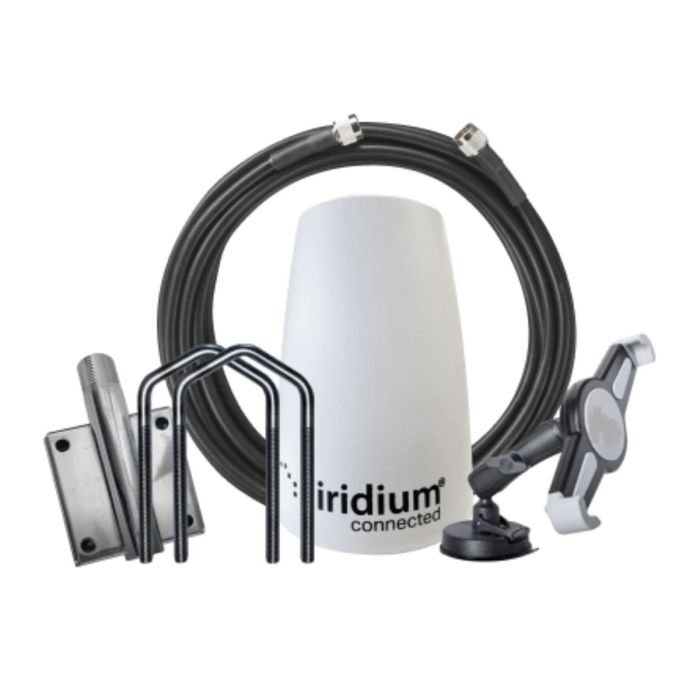
BSN NAL 70M LMR400, Iridium Active Antenna Kit, GPS Antenna, And Mounts (ASE-DA70)
In stock
- PART #:
- ASE-DA70
- AVAILABILITY:
- SUBJECT TO AVAILABILITY
- SKU:
- BSN NAL-ASE-DA70
BSN NAL 70M LMR400, Iridium Active Antenna Kit, GPS Antenna, And Mounts (ASE-DA70)
Within BSN/NAL and ASE (Applied Satellite Engineering) product families, “DA” models are commonly used for dual Iridium/GPS installations tied to docking stations, fixed voice terminals, and resiliency systems—especially in maritime, remote facility, and fleet contexts where long cable routing is unavoidable. The 70-meter length class targets large vessels, tall structures, and remote comms rooms where a 12–40 m kit cannot reach, but where a standardized, engineered kit is preferred to custom RF builds.
Design and Features
Dual-antenna architecture (Iridium + GPS)
ASE-DA70 is designed around a two-channel RF architecture:
-
an Iridium L-band antenna path to support satellite voice/data, and
-
a GPS antenna path to provide positioning for GPS-enabled docks, terminals, or location-aware applications.
The kit name explicitly calls out inclusion of both an Iridium active antenna and a GPS antenna, making it suitable for installations where GPS is required alongside Iridium connectivity. (satellitephonestore.com)
Long-run cabling with LMR-400
The core of the DA70 kit is the 70 m (≈230 ft) LMR-400 run, a coax type widely used for longer RF feeder distances due to its attenuation and handling characteristics compared with thinner cables. In the ASE kit family tables, 70 m is commonly paired with LMR-400 for balancing loss, durability, and installation practicality.
Active Iridium antenna concept
The DA70 is described as including an Iridium active antenna, meaning the antenna system is designed to be powered (via an in-line power approach or interface hardware depending on the specific kit architecture) to support longer runs and improve link reliability versus purely passive systems. In the ASE ecosystem, active antenna approaches are often used when cable distances become large enough that a passive-only solution would struggle.
Mounting hardware (“mounts”) for professional installs
The kit title explicitly includes mounts, which reflects a typical ASE design practice: providing brackets or fixtures required to mount antennas in a stable, safe, and repeatable way (roof, mast, rail, or structure mounting). This is especially important in maritime environments where vibration, salt exposure, and clearance constraints matter.
Technology and Specifications
Cable length and type
The DA70 kit is identified by:
-
Cable length: 70 meters (≈230 feet)
-
Cable type: LMR-400 (as stated in the product title and consistent with kit-family references)
Functional kit content (as described by product naming and catalogs)
The full product title indicates the kit includes:
-
Iridium active antenna kit
-
GPS antenna
-
Mounts
-
70 m LMR-400 cable (for the Iridium path and/or overall kit cable system, depending on the exact packaging)
Because “dual mode” kits often include two cable runs (one for Iridium, one for GPS) in shorter-length families (e.g., DA12, DA20), procurement teams typically confirm whether DA70 is packaged as one long run with split-outs or two parallel runs for Iridium and GPS in the dealer’s packing list. (The catalog identifies dual-mode kits as Iridium/GPS systems, but not every listing spells out “2×” for every length class.)
Trade classification (commonly published for ASE/BSN kits)
BSN resiliency catalogs frequently list standardized compliance fields for antenna kits, including:
-
HTS: 8517.70.0000
-
ECCN: EAR99
Installation best-practice constraints
ASE premium antenna documentation warns that using an incorrect cable type/length or modifying a supplied cable (for example, shortening it) can risk damage and invalidate warranty coverage for certain kit families. Long-run systems are especially sensitive to this because cable type and length are chosen to meet RF and power-feed constraints.
Applications and Use Cases
Large vessels and maritime superstructures
A primary use case for 70 m antenna kits is maritime installation on larger vessels where the best antenna location may be on a mast or superstructure far from the bridge or comms room. The DA70’s 70 m routing distance supports shipboard cable trays and protected interior terminal placement.
Remote facilities and multi-story buildings
In critical infrastructure sites, antenna placement is often constrained to rooftops or towers, while satellite terminals are kept in secure telecom rooms. A 70 m kit supports routing through risers and interior pathways.
Iridium docking stations requiring GPS integration
Some Iridium docks or fixed terminals incorporate GPS inputs for features like emergency reporting, location stamping, or external system integration. DA70 is positioned for scenarios where both Iridium and GPS antennas must be placed correctly while the equipment stays indoors.
RF-dense environments
Industrial and maritime environments frequently include multiple radios (VHF/UHF, Wi-Fi, LTE routers, navigation electronics). The use of engineered cable types and active antenna approaches is intended to preserve satellite link reliability in such conditions.
Advantages / Benefits
Enables proper antenna placement at long distances
The major benefit is operational: 70 meters of engineered cabling allows the antenna(s) to be mounted in the best sky-view location without relocating the terminal to an inconvenient or exposed area.
Supports dual Iridium + GPS requirements
By bundling Iridium and GPS antenna elements and mounts, DA70 reduces procurement complexity compared to sourcing separate antenna systems and then matching connectors/cables in the field. (satellitephonestore.com)
Standardized kit reduces integration errors
Long RF runs are prone to field mistakes—incorrect cable, wrong connectors, inadequate mounting, poor strain relief. A pre-engineered kit helps improve repeatability and reduces troubleshooting time.
Active Iridium antenna design for longer installations
Active antenna approaches are often used to compensate for longer runs and maintain usable link margins, which is critical for reliable Iridium voice/data from an indoor terminal.
FAQ Section
What is the BSN NAL ASE-DA70?
The ASE-DA70 is a 70-meter LMR-400 dual-mode antenna kit that includes an Iridium active antenna, a GPS antenna, and mounting hardware to support long-run Iridium + GPS installations.
How does ASE-DA70 work?
The antennas are mounted outdoors in a clear-sky location, and the long LMR-400 cable routing carries the Iridium and GPS RF paths back to the indoor terminal, dock, or fixed station, enabling satellite communications and GPS reception while keeping the equipment protected indoors.
Why is ASE-DA70 important?
It solves long-distance antenna placement problems—common on large vessels and facilities—by providing a standardized kit for both Iridium and GPS, reducing the installation risk associated with custom long-run RF builds.
What are the benefits of ASE-DA70?
Benefits include 70 m installation reach, dual Iridium + GPS antenna provisioning, LMR-400 long-run cabling, standardized mounts, and an active Iridium antenna approach suited to longer installations.
Summary
The BSN NAL ASE-DA70 is a professional 70-meter LMR-400 dual-mode Iridium + GPS antenna kit intended for installations where antennas must be placed far from the terminal—common in maritime, remote facility, and large-structure deployments. By bundling an Iridium active antenna, GPS antenna, and mounts with engineered long-run cabling, it supports reliable indoor Iridium operation while providing GPS reception for location-aware applications and standardized, repeatable field installation outcomes.
Specifications
| PART # | ASE-DA70 |
|---|