
Jotron RAC2 Ricochet Audio Converter (104527)
In stock
- AVAILABILITY:
- SUBJECT TO AVAILABILITY
- SKU:
- Jotron-104527
Jotron Ricochet Audio Converter ()
In current product documentation, the “Ricochet Audio Converter” name is most closely associated with the RAC2 (Ricochet Audio Converter) expansion unit, which is designed to host multiple PCIe interface cards (such as RACIF, RACIF-8, and RETIF). Together, these modules scale audio acquisition from small deployments to very large, multi-channel recording systems.
Design and Features
Scalable, chassis-based converter architecture (RAC2)
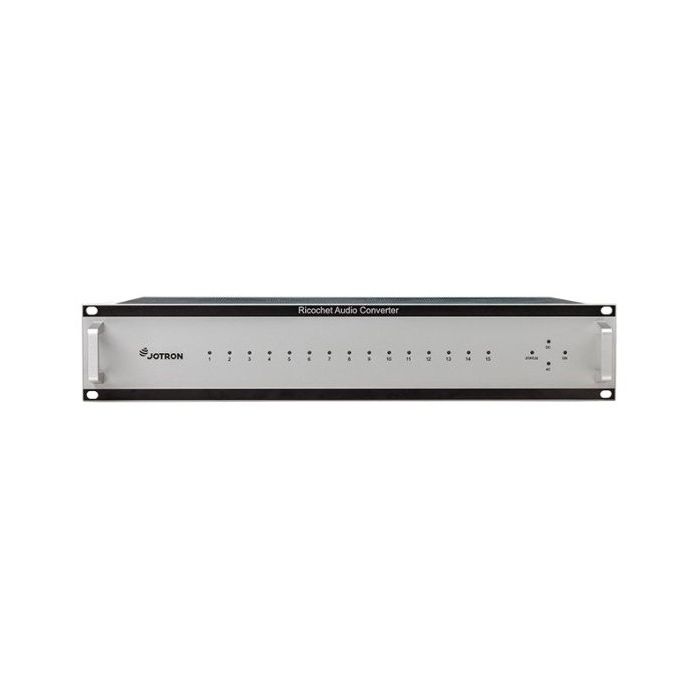
At the center of the system is RAC2, described by Jotron as an expansion unit for Ricochet Audio Converter Interfaces. The RAC2 chassis is a 19-inch wide, 2U high subrack designed to host multiple add-in cards that perform the actual audio acquisition and conversion.
A single RAC2 can host up to 15 add-in cards, enabling high-density conversion capacity in a compact rack footprint.
High channel density: up to 240 audio lines per unit
Jotron’s RAC2 brochure highlights that the unit can convert up to 240 lines per RAC2, reflecting the chassis’ ability to aggregate many interface cards in one enclosure.
This density is aimed at environments where many simultaneous audio sources must be recorded—such as multi-position ATC centers, large airports, or distributed communication hubs with numerous radios, intercoms, and operational circuits.
VoIP output aligned to ED-137
RAC2 and its interface cards are designed to output audio as VoIP according to ED-137, an interoperability framework commonly used for VoIP in ATM/ATC environments. Jotron explicitly states that the PCIe interfaces convert 16 or 8 audio lines and output the audio as VoIP per ED-137.
Interface card ecosystem: analogue and trunk options
Jotron describes multiple interface card types used with RAC2:
-
RACIF (Ricochet Audio Converter Interface): a PCIe module for converting up to 16 analogue audio signals to VoIP (ED-137).
-
RACIF-8: an 8-channel acquisition module for analogue input signals intended to adapt and isolate line inputs before sending them to a recorder.
-
RETIF (Ricochet E1/T1 Interface): an E1/T1 trunk recorder card; Jotron notes that a single card can stream up to 16 arbitrary channels within the trunk, and two cards can be used in daisy chain to cover a full 32-line trunk requirement.
This modular approach allows system designers to mix and match interface types depending on whether the source is analogue line audio or trunked digital circuits.
Expansion beyond RAC2: compact ambient-audio acquisition (RAAI)
Jotron also offers complementary “Ricochet” audio acquisition products such as the RAAI (Ricochet Ambient Audio Interface). RAAI is described as a compact interface containing two AD converters and capable of converting up to six differential audio lines to VoIP streams—typically sent to a recorder service.
Technology and Specifications
Physical and system scalability
-
Form factor (RAC2): 19-inch rack width, 2U subrack.
-
Card capacity (RAC2): up to 15 add-in cards.
-
Maximum line conversion per RAC2: up to 240 lines per unit (as stated in RAC2 materials).
Jotron further notes that its Ricochet recording system can handle multiple RAC2 units to build “very large systems,” supporting scaling across multiple racks or sites.
Conversion method: PCIe acquisition to ED-137 VoIP streams
RAC2 relies on PCI Express add-in cards to ingest multiple audio lines and convert them to ED-137 VoIP. In the RAC2 brochure, Jotron describes these add-in cards as converting 16 or 8 audio lines each, outputting the audio as VoIP.
Interface specifics (publicly described)
-
RACIF: supports 16 analogue input lines; described as a PCIe card inserted into a server or into RAC2.
-
RACIF connectorization (brochure): Jotron describes a 40-pin Mini D Ribbon connector with a Krone adapter for convenient connection of audio lines, and transfer to an external switch via Ethernet.
-
RETIF: an E1/T1 interface card; supports daisy-chaining for higher channel counts, and is described as featuring four RJ45 connectors.
Because system designs vary (analogue lines vs trunk circuits vs mixed environments), actual deployment specifications typically depend on the selected interface card set and recorder/network architecture.
Applications and Use Cases
ATC/ATM recording and replay systems
The Ricochet Audio Converter is commonly paired with Ricochet recorder deployments, where many audio sources must be recorded in parallel for operational oversight, compliance, and incident review. Jotron positions Ricochet as a synchronized record-and-replay system for ATM and marine markets, with modular deployment options from small recorders to nationwide solutions.
Multi-channel capture for radio, intercom, and operational circuits
In facilities with many simultaneous voice channels—tower positions, approach/departure sectors, operations rooms, dispatch centers—the converter architecture supports consolidating diverse audio inputs into standardized IP audio streams that can be routed, recorded, and monitored centrally.
Hybrid environments: analogue lines plus E1/T1 trunk sources
Where legacy circuit audio remains in service, RETIF enables acquisition from E1/T1 trunks (with daisy-chain expansion to cover larger trunk channel counts). This helps organizations migrate toward IP recording while still supporting older circuit-based sources.
Ambient and facility audio capture (RAAI)
The RAAI interface targets scenarios where a smaller number of differential audio lines must be captured—often for ambient or localized audio monitoring—then delivered as VoIP streams to the recorder service.
Advantages / Benefits
High-density conversion in a compact rack footprint
A single RAC2 chassis can host up to 15 interface cards and convert up to 240 lines, enabling dense deployments without excessive rack space.
Standards-oriented VoIP output (ED-137)
By outputting audio as ED-137 VoIP, the converter family supports IP-based recording architectures aligned with ATC/ATM VoIP interoperability practices.
Modular growth path
Organizations can start with a small number of interface cards and expand capacity over time, and scale further by deploying multiple RAC2 units into larger systems supported by Ricochet recording infrastructure.
Mixed-source compatibility
The combination of analogue acquisition (RACIF / RACIF-8) and trunk capture (RETIF) supports mixed environments that are common during modernization programs.
FAQ Section
What is the Jotron Ricochet Audio Converter?
It is a modular conversion system—centered around RAC2—that converts multiple audio lines into ED-137 VoIP streams for delivery to recording and monitoring solutions such as the Ricochet recorder.
How does the Jotron Ricochet Audio Converter work?
RAC2 hosts PCIe interface cards (such as RACIF, RACIF-8, and RETIF) that ingest analogue audio lines or E1/T1 trunk channels and output the audio as VoIP per ED-137, typically over Ethernet toward a recorder server.
Why is the Ricochet Audio Converter important?
Large ATC/ATM and critical-communications environments often need simultaneous recording of many audio sources. RAC2 is designed to scale to up to 240 lines per unit and to support very large systems by combining multiple units with Ricochet recording infrastructure.
What are the benefits of the Ricochet Audio Converter?
Key benefits include high channel density (up to 240 lines per RAC2), modular scalability, support for ED-137 VoIP output, and a card ecosystem that covers both analogue and E1/T1 trunk acquisition.
What is the difference between RACIF and RETIF?
RACIF is an analogue audio interface card that converts up to 16 analogue audio signals to ED-137 VoIP, while RETIF is an E1/T1 trunk recorder card that can stream up to 16 channels within a trunk and can be daisy-chained to cover larger trunk requirements.
Summary
The Jotron Ricochet Audio Converter—most notably the RAC2 platform—serves as a scalable acquisition and conversion layer for high-channel-count voice environments, converting analogue lines and selected trunk sources into ED-137 VoIP streams for centralized recording and monitoring. With a 2U, 19-inch chassis, support for up to 15 interface cards, and capacity figures quoted at up to 240 lines per unit, RAC2 is engineered for large and expandable deployments in ATM/ATC and other mission-critical communications settings.