
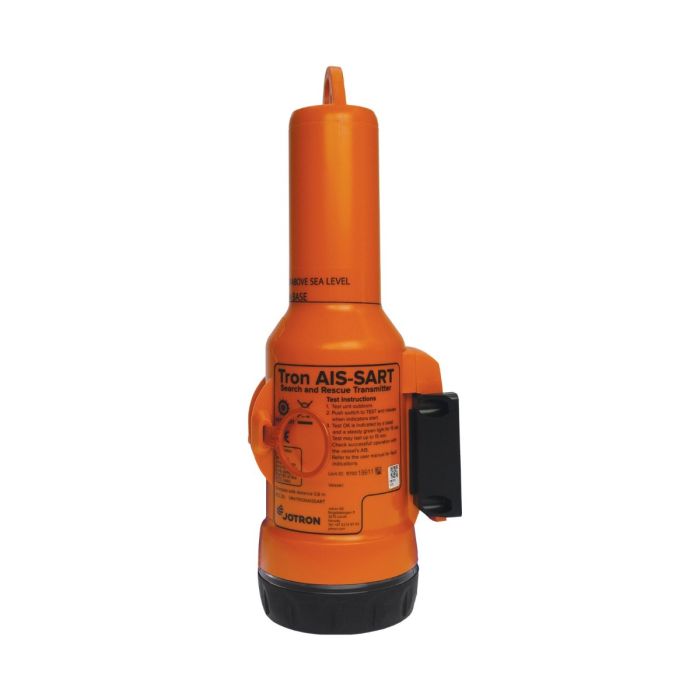
Jotron Tron AIS-SART (3200093)
In stock
- PART #:
- 3200093
- AVAILABILITY:
- SUBJECT TO AVAILABILITY
- SKU:
- Jotron-3200093
Jotron Tron AIS-SART (3200093)
Jotron’s AIS-SART product is commonly supplied as Tron AIS-SART with bulkhead bracket, identified by Jotron part number 85037 in manufacturer and distributor catalogs.
AIS-SART devices were adopted into international carriage requirements as an alternative to radar SARTs, and Tron AIS-SART is widely described as aligned with this regulatory framework and the operational goal of improving rescue efficiency through more precise position reporting.
Design and Features
Compact housing shared with Jotron’s radar SART platform
A notable design feature of the Tron AIS-SART is that its housing is identical to Jotron’s radar SART (Tron SART20) form factor. Jotron states a total height of 251 mm and a unit weight around 450 g, emphasizing portability for lifeboats and liferafts where space and weight are tightly constrained.
AIS distress transmission on standard AIS receivers
Tron AIS-SART is intended to be detected on both AIS Class A and AIS Class B receivers. In a real incident, this increases the likelihood that commercial vessels, workboats, and SAR craft equipped with modern AIS can see the distress target quickly, often as a dedicated AIS distress symbol and message (implementation varies by receiver).
Integrated GNSS positioning for superior positional accuracy
AIS-SART technology is designed to broadcast distress messages containing a precise position derived from an internal GNSS receiver. Jotron’s product literature frames this as “superior position accuracy,” supporting faster and less time-consuming SAR operations compared with older approaches that rely on radar-only patterns or imprecise last-known positions.
Emergency-only activation and long operating duration
Jotron’s user manual emphasizes that the Tron AIS-SART should be used only in an emergency, and states a battery duration of 96 hours from activation—a key design requirement for survival craft equipment that may need to remain active during extended searches or severe weather.
Accessory ecosystem shared with Tron SART20
Tron AIS-SART and Tron SART20 share common mounting accessories, including bulkhead bracket, lifeboat bracket, and liferaft mounting pole, plus other mounting options such as a lanyard. This shared ecosystem supports standardized outfitting across fleets that carry both AIS-SART and radar SART devices or that want the same bracket sets across vessel classes.
Technology and Specifications
The following specifications are drawn from manufacturer brochures and user manuals. Exact performance in an incident depends on antenna height, sea state, interference, and receiver characteristics.
Radio channels and operational principle
AIS-SART operates by transmitting AIS messages on the international AIS channels used by maritime AIS systems. Public dealer specifications commonly list the AIS VHF channels as 161.975 MHz and 162.025 MHz, which correspond to AIS channels A and B (often referred to as AIS 1 and AIS 2).
Range and detection performance
Jotron’s product brochure highlights “proved performance” including up to 10 nautical miles from a SOLAS ship equipped with an AIS Class A transponder (a practical, line-of-sight dependent figure). Older documentation also discusses typical surface ranges around 7–10 nautical miles from a vessel AIS Class A receiver and longer detection from an airborne AIS receiver (under favorable conditions).
Activation workflow and GNSS acquisition
The user manual describes activation using an activation ring that moves the switch to ON, followed by audible and LED indications. It also documents that both LEDs may flash while the unit searches for a GNSS position fix, with a stated maximum acquisition time (example: up to 15 minutes in some manual revisions).
Mounting guidance and height-above-sea importance
AIS-SART performance depends strongly on antenna height. Jotron’s manual recommends securing the unit vertically and as high as possible, including the use of a telescopic pole or lanyard to position the device around 1 meter above sea level within a liferaft canopy structure.
Physical characteristics (compact and buoyant)
Tron AIS-SART is designed as a compact survival craft unit and is described as buoyant, with best performance achieved in an upright position. The compact physical envelope is intended to fit within standard lifeboat and liferaft equipment stowage practices.
Applications and Use Cases
SOLAS/GMDSS survival craft equipment
AIS-SART devices are carried on SOLAS-regulated vessels and survival craft as part of GMDSS search-and-rescue equipment. Tron AIS-SART is specifically described as a GMDSS search and rescue transmitter and is widely supplied in configurations intended for lifeboat and liferaft deployment (bulkhead bracket, lifeboat bracket, raft pole).
Merchant shipping and offshore support operations
On commercial ships and offshore support vessels, AIS-SART improves the probability that nearby traffic and SAR units will receive distress signals on standard AIS equipment, helping to speed up the “last-mile” localization once rescue assets are in the general area.
Passenger vessels and high-density traffic corridors
In sea lanes with dense AIS usage, an AIS-SART distress target may be noticed quickly by surrounding vessels. This can be operationally relevant for rapid assistance—particularly when a dedicated SAR response is still mobilizing.
Training, inspection, and fleet standardization
Because Tron AIS-SART shares accessories with Jotron’s radar SART (Tron SART20), operators and service partners can standardize brackets, poles, and protective accessories across multiple safety devices, simplifying inspections, drills, and spare-parts planning.
Advantages / Benefits
Faster localization via explicit AIS distress targets
AIS-SART messages can provide a direct plotted position on AIS receivers, which can be faster to interpret than radar SART arc patterns—especially for crews accustomed to AIS chart overlays and target lists. Jotron explicitly frames AIS-SART as improving effectiveness and reducing time in SAR operations due to superior position accuracy.
Compatibility with AIS Class A and Class B
Because the signal is designed to be received on both Class A and Class B AIS receivers, Tron AIS-SART can be detected by a wide range of vessels and responders, from SOLAS ships to smaller craft with Class B installations.
Long emergency operating duration
The stated 96-hour operating time from activation supports extended search windows and adverse conditions, aligning with survival craft equipment expectations.
Compact, standardized mounting ecosystem
The shared housing and accessories with Tron SART20 make deployment, bracket selection, and training more consistent across vessel types.
FAQ Section
What is Jotron Tron AIS-SART (3200093)?
It is a GMDSS AIS-SART search and rescue transmitter that broadcasts AIS distress messages with GNSS position so nearby AIS-equipped vessels and SAR units can quickly locate survival craft. It is commonly listed as Jotron 85037 in catalogs.
How does Jotron Tron AIS-SART work?
When activated, the unit transmits AIS distress messages on the AIS VHF channels so that AIS receivers can display a distress target, while the device’s internal GNSS provides accurate position information for the transmissions.
Why is Tron AIS-SART important?
AIS-SART can improve SAR efficiency by providing a clear, accurate plotted distress target on AIS systems, often enabling faster “last-mile” localization compared with search methods that rely on less explicit signals.
What are the benefits of Tron AIS-SART?
Key benefits include detection on AIS Class A and B, compact design (~251 mm height and ~450 g weight), accessory compatibility with Tron SART20, and a stated 96-hour operating duration after activation.
How far can an AIS-SART be detected?
Jotron cites “proved performance” of up to ~10 nautical miles from a SOLAS ship with AIS Class A, with real-world range depending on antenna height, sea state, and receiver installation; airborne AIS receivers may detect at longer ranges under favorable conditions.
Summary
The Jotron Tron AIS-SART (3200093 / Jotron 85037) is a compact, survival-craft-focused AIS search and rescue transmitter that broadcasts AIS distress messages with GNSS-derived position so nearby AIS-equipped vessels and SAR units can localize a distress situation quickly. With a housing shared with the Tron SART20 platform, broad AIS Class A/B detectability, a stated 96-hour operating duration after activation, and multiple mounting options for lifeboats and liferafts, it is engineered to improve the practical speed and clarity of maritime rescue operations once responders are within regional range.
Specifications
| PART # | 3200093 |
|---|