Husarion ROSbot XL UGV
In stock
- BRAND:
- HUSARION
- MODEL:
- ROSbot XL
- ORIGIN:
- Poland
- Warranty:
- 12 MONTHS
- AVAILABILITY:
- SUBJECT TO AVAILABILITY
- SKU:
- Husarion-ROSbot-XL
Husarion ROSbot XL UGV
Husarion ROSbot XL UGV
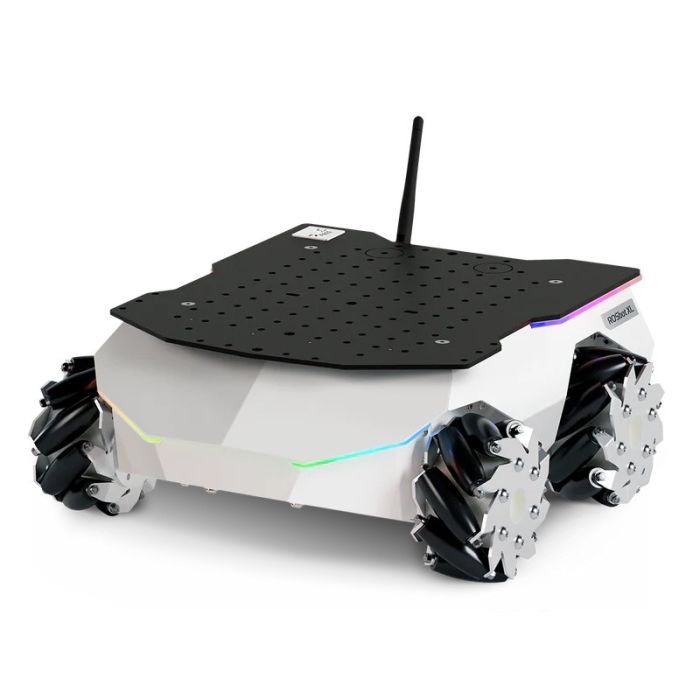
Built around an aluminum chassis and a 4-wheel drive base, it is intended as a general-purpose mobile platform for researchers, integrators, and developers who want a small robot that can be expanded with common perception and manipulation components—such as 2D LiDAR, RGB-D/stereo cameras, and lightweight manipulators—while working within the ROS/ROS 2 ecosystem.
A defining characteristic of the ROSbot XL positioning in the Husarion lineup is its role as a modular indoor platform that sits below heavier outdoor UGVs (e.g., Lynx and Panther) and emphasizes ease of sensor/compute configuration and software reproducibility through reference projects and documentation.
Design and Features
Chassis and mobility
ROSbot XL uses an aluminum chassis with a 4×4 drive and is typically delivered with two wheel sets—a standard wheel set and mecanum wheels, enabling both conventional driving and holonomic-like maneuvers (useful in tight indoor spaces).
The platform is commonly described as compact and bench-friendly, with published third-party specifications listing dimensions around 332 × 284 × 131 mm, weight around 5.38 kg, and payload up to 10 kg, reflecting its focus on indoor payload experimentation rather than outdoor hauling.
Power and expansion
A frequently highlighted part of the design is its integrated power and expansion approach. ROSbot XL includes a built-in USB hub, a 3S Li-ion battery specified as 11.1 V, 7800 mAh, 86 Wh, and an onboard power board supporting USB-C Power Delivery along with protection circuitry. It also supports selectable supply rails for the onboard computer (commonly 5 V / 12 V / 19 V), reflecting the platform’s intent to accommodate different compute modules and peripheral loads.
Onboard control electronics
ROSbot XL integrates an IMU (Bosch BNO055) and quadrature encoders on its drive motors, and it uses an STM32F4-based controller for low-level functions, with Ethernet-based communication between the main computer (SBC) and the controller. The platform also includes programmable perimeter LEDs and a speaker, which are often used for status signaling and human-robot interaction experiments.
Technology and Specifications
Compute configurations and packages
ROSbot XL is sold as a configurable platform, commonly offered with multiple compute options (e.g., Raspberry Pi 5, Intel/ASUS NUC, or NVIDIA Jetson Orin Nano, depending on the package). Husarion also offers pre-configured bundles oriented toward telepresence, autonomy, and manipulation workflows, with accompanying reference projects.
Packages published by Husarion include (names may vary slightly by store listing):
-
Basic configurations (compute-focused)
-
Telepresence configurations (remote operation + camera)
-
Autonomy configurations (navigation/mapping sensors such as LiDAR + depth/AI camera)
-
Manipulation configurations (mobile base + arm, typically paired with navigation sensors)
Motion, endurance, and payload (commonly cited figures)
Because ROSbot XL is offered in multiple configurations and distributors may present slightly different figures, specifications are often cited as ranges. Commonly published values include:
-
Max speed: about 3 km/h (≈0.83 m/s)
-
Runtime: roughly 2–6 hours, depending on load and configuration
-
Payload: up to 10 kg
The platform’s design goal is typically less about maximizing raw speed and more about enabling repeatable indoor experiments in SLAM, navigation, perception, and mobile manipulation using ROS/ROS 2.
ROS 2 software ecosystem and simulation
Husarion maintains documentation and tutorials around ROSbot XL workflows, including examples involving SLAM and autonomous navigation. In the ROS 2 ecosystem, a common architecture pairs LiDAR-based mapping (e.g., Slam Toolbox) with the Navigation2 stack, often validated first in simulation (e.g., Webots) before deployment to hardware. Husarion publishes ROSbot XL–specific guidance for Webots simulation and navigation workflows that reflect typical development practice in the ROS 2 community.
Applications and Use Cases
Education and curriculum robotics
ROSbot XL is widely positioned as a teaching and lab platform for courses covering ROS 2 fundamentals, mobile robot kinematics, sensor integration, mapping, localization, and navigation. Its modularity—paired with common sensors such as 2D LiDAR and depth cameras—supports structured lab assignments where students progressively add autonomy capabilities.
Research and rapid prototyping
In research settings, ROSbot XL is used as a controllable baseline for experiments in:
-
SLAM and localization in indoor environments
-
Navigation and obstacle avoidance using ROS 2 Navigation stacks
-
Perception pipelines using stereo/RGB-D cameras or AI cameras
-
Human-robot interaction prototypes leveraging LEDs, status signals, and teleoperation
Mobile manipulation
With optional manipulation packages, ROSbot XL can serve as a small-scale mobile manipulation platform, combining autonomous navigation with a lightweight arm for pick-and-place demonstrations, lab automation prototypes, or academic experiments in task planning and perception-driven grasping.
Advantages / Benefits
A major advantage of ROSbot XL is its ROS 2–centric productization: the platform is sold not only as hardware, but also with documentation and reference projects aimed at making it easier to reproduce mapping, navigation, telepresence, and manipulation setups.
Other commonly cited benefits include:
-
Modular sensor/compute selection, enabling developers to scale from education to more compute-heavy autonomy experiments.
-
Integrated power management (battery + USB-C PD + selectable rails), helpful for powering cameras, LiDARs, and edge AI compute within a compact form factor.
-
Indoor-friendly maneuvering options via alternate wheel sets (including mecanum), which can simplify navigation experiments in constrained spaces.
FAQ Section
What is the Husarion ROSbot XL UGV?
The Husarion ROSbot XL is a compact ROS 2–native indoor mobile robot platform (UGV/AMR base) designed for building and testing autonomous robotics applications such as mapping, navigation, telepresence, and mobile manipulation.
How does the ROSbot XL work?
ROSbot XL combines a 4-wheel drive base with onboard sensing (IMU and wheel encoders) and a configurable main computer (e.g., Raspberry Pi/NUC/Jetson options). Developers typically add sensors such as LiDAR and cameras, then use ROS 2 software stacks (e.g., SLAM and Navigation) to enable mapping, localization, and autonomous movement.
Why is the ROSbot XL important?
It provides a repeatable, integrated platform for ROS 2 robotics development, lowering the barrier to prototyping autonomy by bundling power management, compute options, and documented reference workflows that mirror common research and product development pipelines.
What are the benefits of the ROSbot XL?
Common benefits include its modular expandability (LiDAR/cameras/arms), ROS 2–ready documentation and reference projects, and an integrated power system (battery, USB-C PD, and selectable rails) that supports typical autonomy sensor stacks in a compact indoor robot.
Summary
The Husarion ROSbot XL UGV is a compact, ROS 2–native indoor mobile robotics platform built for education, research, and rapid product prototyping. Its modular compute and sensor ecosystem, integrated power management, and supported autonomy/manipulation configurations make it a practical foundation for building SLAM, navigation, telepresence, and mobile manipulation applications within the modern ROS 2 development workflow.