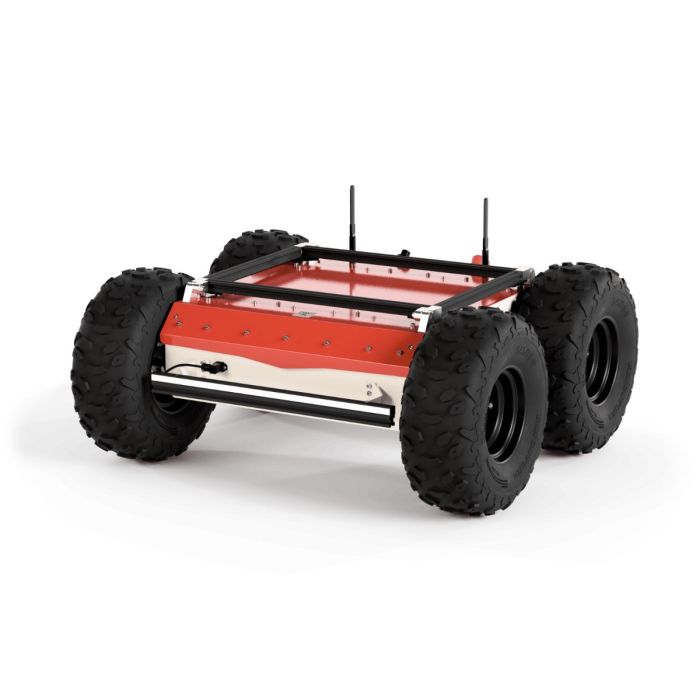
Husarion Panther Industrial Grade Indoor / Outdoor UGV (PTH12)
In stock
- BRAND:
- HUSARION
- MODEL:
- PANTHER
- PART #:
- PTH12
- ORIGIN:
- Poland
- AVAILABILITY:
- SUBJECT TO AVAILABILITY
- SKU:
- Husarion-Panther-PTH12
Husarion Panther Industrial Grade Indoor / Outdoor UGV (PTH12)
Husarion Panther Industrial Grade Indoor / Outdoor UGV (PTH12)
Built as a rugged mobile base for research and commercial prototyping, Panther is commonly used as a platform for autonomy development, sensor integration, and field robotics tasks such as inspection, mapping, and material transport. The platform is frequently associated with modern robotics workflows—particularly ROS/ROS 2, navigation stacks, and simulation—because it is supported by publicly available software packages for mobile robot control and autonomy.
Design and Features
Rugged chassis and outdoor-ready construction
Panther is engineered for demanding environments where vibration, dust, and incidental water exposure are expected. The platform is commonly described as suitable for both indoor and outdoor operations, reflecting its positioning as an industrial UGV rather than a light educational rover. Core design goals typically include a robust frame, sealed electronics, and serviceable mechanical components that can be maintained over a deployment lifecycle.
Payload-oriented mobile base
A defining characteristic of the Panther class of UGVs is its use as a payload carrier for sensors (LiDAR, stereo/depth cameras, GNSS), compute (x86/ARM edge PCs), and mission hardware (manipulators, inspection tools, payload boxes). In Husarion’s ROS ecosystem, Panther is supported alongside similar UGV platforms used for navigation, docking, and outdoor autonomy workflows.
Technology and Specifications
Mobility and drive system
Industrial UGVs such as Panther are typically designed around stable traction, controllable acceleration, and repeatable odometry—key for SLAM, Nav2-based navigation, and outdoor path planning. Husarion’s UGV software repositories explicitly target “Panther and Lynx mobile robots,” indicating ongoing support for control, simulation tags (e.g., Gazebo), and ROS 2 integrations used in autonomous mobility pipelines.
Environmental protection
Rugged UGV platforms commonly incorporate enclosure sealing and protected connectors to support outdoor deployments. Panther’s market positioning as an “industrial grade indoor/outdoor UGV” aligns with typical requirements for perimeter inspection, industrial sites, warehouses, and mixed terrain campuses.
ROS 2 software stack availability
A major differentiator for robotics platforms is the availability of maintained software:
-
husarion_ugv_ros: ROS packages for Panther and Lynx mobile robots (updated regularly) -
husarion_ugv_autonomy_ros: ROS 2 package for Panther/Lynx docking and navigation with Nav2
These repositories signal that Panther is intended to be used with standard robotics tooling: teleoperation, state estimation, Nav2 navigation, and simulation-driven development.
Applications and Use Cases
Industrial inspection and patrol robotics
Panther-class UGVs are commonly deployed for:
-
Perimeter patrol of facilities and depots
-
Routine inspection routes in industrial yards
-
Condition monitoring with thermal, optical, or gas sensors
The combination of rugged mobility and payload capacity supports multi-sensor payloads that would overwhelm smaller hobby-grade robots.
Autonomous mapping and navigation (SLAM / Nav2)
Robotics teams often select a rugged UGV when they need reliable baseline mobility for autonomy work:
-
Indoor mapping (warehouses, factories)
-
Outdoor mapping (campuses, industrial sites)
-
Navigation stack development using Nav2, custom planners, and mission management
Husarion’s autonomy repository explicitly references docking and navigation with Nav2 for Panther/Lynx, which aligns with these workflows.
Research and academic field robotics
Universities and R&D labs often require platforms that can be repeatedly modified, repaired, and instrumented. An industrial mobile base like Panther can serve as a “workhorse” chassis for experiments in:
-
Multi-sensor fusion and localization
-
Outdoor autonomy under varying lighting and terrain
-
Human-robot interaction (UGV escort, guided tours, logistics support)
-
Robotics middleware benchmarking (ROS 2 QoS profiles, compute acceleration, and perception stacks)
Warehouse logistics and material transport prototypes
In warehouse-like environments, UGVs are used to prototype:
-
Autonomous cart and pallet transport concepts
-
Inventory scanning payloads
-
“Follow-me” or route-based delivery inside facilities
A platform marketed as industrial grade is often favored when payloads include heavier batteries, compute, and safety sensors.
Advantages / Benefits
Built for integration, not just demonstration
Industrial UGV platforms are valuable when the goal is sustained development rather than short demos. The existence of multiple maintained Husarion repositories supporting Panther suggests an ecosystem oriented toward real robotics engineering workflows (drivers, autonomy templates, navigation/docking tooling).
Faster autonomy development with existing ROS 2 components
With ROS 2 packages explicitly maintained for Panther and Nav2-based autonomy/docking, teams can focus on mission logic and payload development instead of building the mobility stack from scratch.
Outdoor readiness for real-world pilots
An indoor/outdoor UGV is typically selected when testing must move beyond lab floors to practical sites—yards, campuses, and industrial grounds—where durability and serviceability are critical.
FAQ Section
What is the Husarion Panther (PTH12)?
The Husarion Panther (PTH12) is an industrial-grade indoor/outdoor unmanned ground vehicle (UGV) used as a rugged mobile base for robotics applications such as inspection, mapping, and autonomy development.
How does the Husarion Panther work?
Panther operates as a mobile robot platform that carries power, drive hardware, and onboard electronics, while users add sensors and compute for perception and autonomy. It is supported by ROS/ROS 2 software packages that provide mobile robot control and autonomy building blocks (including Nav2-based navigation).
Why is the Husarion Panther important?
Industrial UGVs like Panther help teams move from lab prototypes to field pilots by offering a durable base that can carry real payloads and run real autonomy stacks. The availability of maintained ROS 2 packages accelerates integration and reduces engineering time.
What are the benefits of the Husarion Panther (PTH12)?
Key benefits include industrial-grade positioning for indoor/outdoor use, payload-oriented design for sensors and compute, and a ROS 2-friendly ecosystem with dedicated repositories for Panther/Lynx control and Nav2-based autonomy/docking.
Summary
The Husarion Panther (PTH12) is positioned as a rugged industrial indoor/outdoor UGV intended for real-world robotics deployments, from inspection and mapping to research-grade autonomy development. Its relevance is strengthened by a maintained ROS 2 software ecosystem—including Panther/Lynx control packages and Nav2-oriented autonomy and docking tooling—making it a practical choice for teams building field-capable mobile robot solutions.