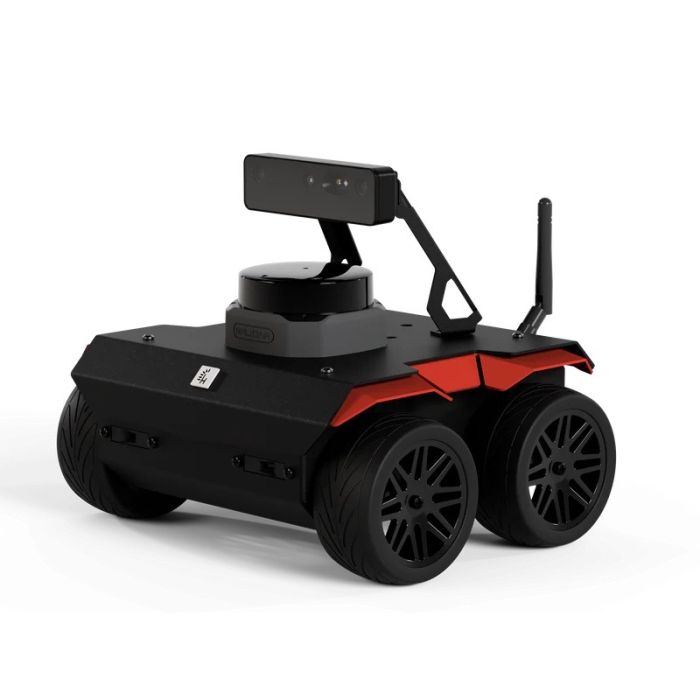
Husarion ROSbot 3 PRO UGV
In stock
- BRAND:
- HUSARION
- MODEL:
- ROSbot 3
- ORIGIN:
- Poland
- Warranty:
- 12 MONTHS
- AVAILABILITY:
- SUBJECT TO AVAILABILITY
- SKU:
- Husarion-ROSbot-3-PRO
Husarion ROSbot 3 PRO UGV
Husarion ROSbot 3 PRO UGV
It is positioned as a ready-to-use development robot that combines a small 4-wheel drive mobile base with an onboard computer, wheel odometry, inertial sensing, and a perception stack aimed at indoor autonomy tasks such as SLAM (Simultaneous Localization and Mapping), localization, obstacle avoidance, and navigation.
Within the ROSbot 3 family, the “PRO” designation refers to an upgraded perception configuration: Husarion specifies that ROSbot 3 PRO includes a Slamtec RPLIDAR S2 and a Luxonis OAK-D Pro RGB-D camera, intended to deliver stronger perception and SLAM capabilities compared with the standard ROSbot 3 (which uses an RPLIDAR C1 and OAK-D Lite).
ROSbot 3 PRO is commonly used as a standardized indoor platform where teams can focus on ROS 2 software development and experiments—often starting with teleoperation and sensor visualization, then progressing to mapping, navigation, and higher-level autonomy behaviors.
Design and Features
Chassis and form factor
ROSbot 3 PRO uses a powder-coated aluminum plate chassis (1.5 mm thick) and is sized for indoor labs and classrooms. Husarion lists dimensions of 200 × 233 × 197 mm when equipped with camera and LiDAR (and 200 × 233 × 103 mm without them), with a typical weight around 2.84 kg with camera and LiDAR.
This compact footprint supports repeatable indoor experiments in corridors, classrooms, and small test arenas—an environment where large outdoor UGVs are often impractical.
Drive base and odometry-ready hardware
The platform uses a 4-wheel mobile base driven by DC motors, with independent quadrature encoders on each motor for precise motion feedback.
In ROS 2 autonomy pipelines, encoder-derived wheel odometry is a foundational input for localization and navigation, typically fused with IMU data and corrected using LiDAR-based localization methods.
Integrated sensing (base sensors)
In addition to LiDAR and RGB-D perception (which define the PRO variant), ROSbot 3 PRO integrates common base sensors used in robotics education and research:
-
IMU: Bosch BNO055 (accelerometer + gyroscope)
-
Distance sensors: VL53L0X time-of-flight sensors (used for close-range proximity/edge detection in many mobile robot designs)
These sensors support both basic control (attitude/acceleration feedback) and safety behaviors (short-range proximity cues).
PRO perception stack (key differentiator)
ROSbot 3 PRO is defined by an upgraded perception stack:
-
LiDAR: Slamtec RPLIDAR S2
-
RGB-D camera: Luxonis OAK-D Pro
Husarion explicitly frames this combination as providing “superior perception and SLAM capabilities.”
In practical indoor robotics work, this typically translates into more robust mapping and navigation in environments with variable lighting, reflective surfaces, and dynamic obstacles—especially when combining 2D LiDAR mapping with depth-aware perception and object understanding from the RGB-D camera.
Technology and Specifications
Compute platform and onboard resources
ROSbot 3 PRO is powered by:
-
CPU/SBC: Raspberry Pi 5 (8 GB RAM, VideoCore VII GPU)
-
Storage: 64 GB microSD card
-
Networking: 2.4 GHz / 5 GHz 802.11b/g/n/ac Wi-Fi
This hardware profile targets a common ROS 2 “edge robotics” use case: enough compute for navigation stacks, sensor drivers, moderate perception workloads, and web-based control/monitoring—while keeping costs and power demands reasonable for education and prototyping.
Motion performance
Husarion’s published motion parameters for the ROSbot platform include:
-
Maximum translational velocity: 1.0 m/s
-
Maximum rotational velocity: 420°/s (7.33 rad/s)
These values place ROSbot 3 PRO in the category of agile indoor mobile robots that can demonstrate realistic autonomy behaviors (lane/corridor following, waypoint navigation, recovery behaviors) without requiring a large operating space.
Payload and endurance
Husarion specifies:
-
Maximum load capacity: up to 5 kg (not in continuous work)
-
Battery life: 1.5–5 hours (load and usage dependent)
These specifications are consistent with typical indoor robotics development: enough payload for accessory sensors or lightweight prototypes, and sufficient runtime for lab sessions, demos, or iterative testing.
Power system
The store listing indicates the robot uses three 3500 mAh Li-ion batteries with protection circuits, which aligns with a lab-safe design approach and simplifies battery replacement and maintenance.
ROS 2 software readiness and deployment model
Husarion positions ROSbot 3 / 3 PRO as “out-of-the-box” ROS 2 development platforms, noting that open-source ROS 2 drivers are pre-installed and configured, and that users can start interacting via a web-based interface or gamepad without writing code.
Husarion’s quick start guide describes ROSbot 3/3 PRO as being powered by Raspberry Pi 5 and highlights the PRO sensor upgrades for SLAM, reinforcing that the platform is intended to accelerate bring-up and early experimentation.
For ongoing software management, Husarion also distributes a “rosbot” Snap package described as including essential software components (controller, robot state publisher, and more) and explicitly listing compatibility with ROSbot 3 / 3 PRO.
Applications and Use Cases
Indoor SLAM and autonomous navigation (Navigation2 workflows)
ROSbot 3 PRO is commonly used to build and validate indoor autonomy pipelines:
-
2D LiDAR-based mapping and localization (SLAM and AMCL-style localization workflows)
-
Path planning and obstacle avoidance using ROS 2 navigation stacks
-
Multi-room waypoint navigation and recovery behaviors
The PRO perception stack (RPLIDAR S2 + OAK-D Pro) is especially relevant where teams want a stronger baseline for mapping repeatability and perception robustness in cluttered indoor environments.
Robotics education and curriculum labs
Because the robot integrates compute, sensing, and ROS 2 drivers, it is frequently used in hands-on teaching for:
-
ROS 2 fundamentals (topics, services, TF frames, lifecycle nodes)
-
Odometry/IMU usage and sensor fusion concepts
-
Mapping, localization, and navigation parameter tuning
-
Perception basics using RGB-D streams and depth-derived obstacles
The PRO variant is often selected when course objectives include more demanding perception tasks (e.g., depth-based obstacle layers, object detection demos, or experiments under variable lighting).
Teleoperation, remote inspection, and HRI prototyping
The store listing emphasizes easy initial interaction via web UI or gamepad.
This supports teleoperation-based indoor inspection demos (facility walkthroughs, simple patrol routes) and human-robot interaction prototyping, where stable mobility and reliable perception streams are more important than outdoor ruggedization.
Research prototypes and multi-robot experimentation
Compact indoor robots like ROSbot 3 PRO are frequently used as reproducible research baselines for:
-
Multi-robot mapping demonstrations (shared map building or multi-agent exploration)
-
Navigation benchmarking across different planners and sensor configurations
-
Dataset collection for indoor autonomy (LiDAR scans + RGB-D streams + ground-truth approximations)
The PRO configuration’s upgraded sensors are particularly useful when teams want higher-quality perception signals without moving to larger and more expensive platforms.
Advantages / Benefits
Upgraded perception for SLAM: Husarion explicitly frames ROSbot 3 PRO’s RPLIDAR S2 + OAK-D Pro configuration as improving perception and SLAM capability compared to the standard configuration.
ROS 2-ready, faster time-to-demo: Preinstalled and configured ROS 2 drivers, plus web/gamepad interaction options, reduce initial setup complexity and allow teams to validate sensors and mobility quickly.
Compact and lab-friendly: The published dimensions, speed, and runtime profile fit typical classroom and lab workflows where repeatability and quick iteration matter more than rugged terrain performance.
Clear platform differentiation: The ROSbot 3 vs ROSbot 3 PRO split provides a straightforward path for buyers: choose the base model for introductory autonomy, and the PRO model when stronger LiDAR and RGB-D perception are required.
FAQ Section
What is the Husarion ROSbot 3 PRO UGV?
The Husarion ROSbot 3 PRO is a compact indoor ROS 2 mobile robot (UGV/AMR) built for research and education, featuring a Raspberry Pi 5 compute core and an upgraded perception stack: RPLIDAR S2 and Luxonis OAK-D Pro.
How does the ROSbot 3 PRO work?
ROSbot 3 PRO moves using a 4-wheel DC motor base with encoders for odometry, while an IMU supports inertial feedback. Its LiDAR and RGB-D camera provide environmental sensing for mapping and obstacle understanding. Developers typically run ROS 2 drivers and autonomy nodes (mapping, localization, navigation) that convert these sensor streams into real-time motion decisions.
Why is the ROSbot 3 PRO important?
It serves as a standardized ROS 2 development platform that reduces hardware integration work and strengthens perception for indoor SLAM, enabling teams to prototype navigation and perception workflows more quickly and repeatably.
What are the benefits of the ROSbot 3 PRO?
Key benefits include an upgraded LiDAR + RGB-D stack for stronger indoor SLAM, preconfigured ROS 2 driver availability, compact lab-friendly size, and published performance specs (up to 1.0 m/s, 1.5–5 hours runtime, up to 5 kg payload under non-continuous conditions).
Summary
The Husarion ROSbot 3 PRO UGV is a compact, indoor ROS 2 development robot designed to accelerate autonomy work in research and education. By combining a small 4-wheel base (encoders + IMU) with an upgraded perception stack (RPLIDAR S2 and OAK-D Pro), it targets robust indoor SLAM and navigation workflows while remaining accessible for classroom use and rapid prototyping. Its store-defined configurations, published platform specs, and ROS 2 software readiness make it a practical baseline for teams building repeatable indoor mapping, localization, and autonomous navigation demonstrations.