Husarion ROSbot 3 UGV
In stock
- BRAND:
- HUSARION
- MODEL:
- ROSbot 3
- ORIGIN:
- Poland
- Warranty:
- 12 MONTHS
- AVAILABILITY:
- SUBJECT TO AVAILABILITY
- SKU:
- Husarion-ROSbot-3
Husarion ROSbot 3 UGV
Husarion ROSbot 3 UGV
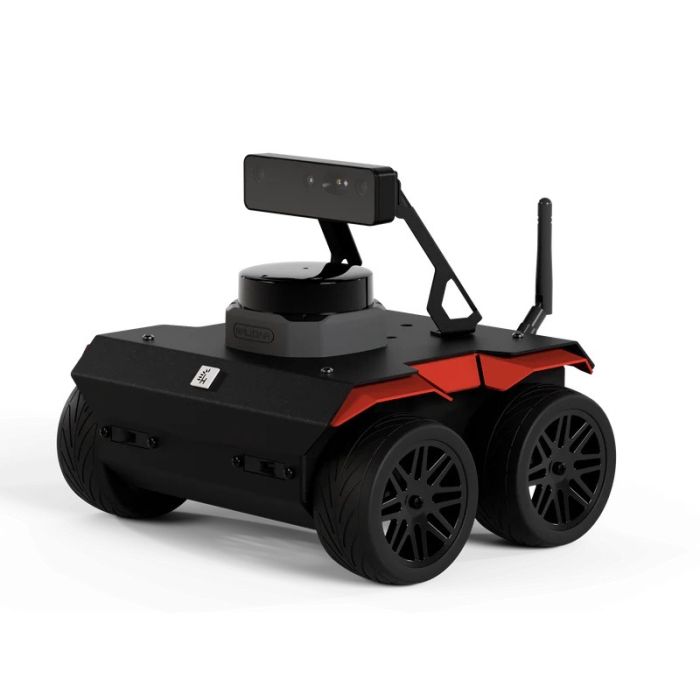
It is marketed as an “out-of-the-box” development robot that integrates core mobility hardware (4-wheel drive, motor encoders, onboard controller), essential perception sensors (LiDAR and RGB-D camera, depending on the variant), and a preconfigured ROS 2 software environment—so teams can focus on autonomy software, sensor fusion, and application development rather than building a mobile base from scratch.
ROSbot 3 is sold in two primary variants: ROSbot 3 and ROSbot 3 PRO. Both are built around a Raspberry Pi 5 compute core and a 1.5 mm alloy/aluminum chassis, while the PRO configuration upgrades the perception stack (LiDAR and camera) for more demanding SLAM and perception workflows.
Design and Features
Chassis and mobility
ROSbot 3 uses a powder-coated aluminum plate chassis (1.5 mm thick) and a small, indoor-friendly footprint. Husarion documents the platform’s dimensions as 200 × 233 × 197 mm (L × W × H) when equipped with camera and LiDAR, and 200 × 233 × 103 mm without both camera and LiDAR. Reported weight is 2.84 kg with camera and LiDAR and 2.45 kg without them.
The base is driven by four DC motors, each paired with independent quadrature (or magnetic) encoders, enabling odometry and closed-loop velocity control—key inputs for ROS 2 localization and navigation stacks.
ROSbot 3 is commonly used with both standard wheels and mecanum wheels (depending on configuration and accessories). Husarion lists parameters for both wheel types, including wheel diameter and clearance (e.g., mecanum clearance around 30 mm and wheelbase 106 mm in the ROSbot 3 spec table).
Integrated sensor suite (base + variants)
At the “base platform” level, ROSbot 3 integrates:
-
IMU: Bosch BNO055 (accelerometer + gyroscope)
-
Time-of-flight distance sensors: VL53L0X (Husarion specifies four IR ToF sensors with up to ~200 cm range in the components list)
-
Onboard microcontroller: STM32F407 (for low-level control)
The primary difference between the ROSbot 3 and ROSbot 3 PRO is the perception hardware:
-
ROSbot 3: Slamtec RPLIDAR C1 + Luxonis OAK-D Lite RGB-D camera
-
ROSbot 3 PRO: Slamtec RPLIDAR S2 + Luxonis OAK-D Pro RGB-D camera
This design choice reflects a common robotics engineering tradeoff: a baseline configuration for learning and general indoor navigation, and an upgraded configuration for more robust depth perception and higher-performance SLAM in cluttered or dynamic environments.
Expansion interfaces
Husarion emphasizes a rear-panel interface concept for adding modules, as well as a general “mobile base” layout intended to accept additional sensors and payloads (e.g., extra cameras, compute accelerators, markers, or custom mounts).
While ROSbot 3 is compact, it is often used as a platform for small payload experiments—such as teleoperation accessories, indoor inspection add-ons, or research prototypes that require a repeatable mobile base.
Technology and Specifications
Compute and connectivity
ROSbot 3’s standard compute configuration centers on:
-
CPU/SBC: Raspberry Pi 5 (8 GB RAM)
-
Storage: 64 GB microSD
-
Networking: dual-band 2.4 GHz / 5 GHz Wi-Fi (802.11b/g/n/ac)
This SBC-first approach is common in education and prototyping UGVs: it supports a large ROS ecosystem, keeps power and thermal requirements manageable, and encourages reproducible deployments (image-based OS + consistent ROS packages).
Motion performance and payload
Husarion publishes the following headline motion parameters for ROSbot 3:
-
Maximum translational velocity: 1.0 m/s
-
Maximum rotational velocity: 420°/s (7.33 rad/s)
-
Maximum load capacity: up to 5 kg (not in continuous work)
-
Battery life: 1.5–5 hours (configuration- and load-dependent)
These specifications place ROSbot 3 in the category of fast, agile indoor robots suitable for Navigation2 demos, corridor/room autonomy, and classroom labs where maneuverability matters more than outdoor ruggedization.
Power system
Husarion specifies three protected Li-ion 18650 batteries (3500 mAh capacity each, 3.7 V nominal), a design that favors modular replacement and protection circuitry for safer operation in lab environments.
ROS 2 software stack and deployment model
Husarion’s quick start documentation indicates ROSbot 3 typically operates on Ubuntu 24.04 with ROS 2 Jazzy preinstalled, and that key drivers (mobile base, LiDAR, camera, and web UI) are delivered as Snaps, enabling streamlined installation and updates.
This packaging strategy aligns with a common operational need in robotics labs: minimizing “environment drift” across multiple robots and multiple student/research machines.
Husarion also maintains open-source ROS packages for ROSbot-class robots (including ROSbot 3), supporting both real-hardware operation and simulation workflows (e.g., Gazebo).
Applications and Use Cases
ROS 2 education and hands-on teaching
ROSbot 3 is often used to teach:
-
ROS 2 basics (nodes, topics, TF frames),
-
sensor integration and calibration,
-
odometry and IMU usage,
-
mapping (SLAM) and navigation concepts using LiDAR and depth sensing.
Because the robot arrives as a complete platform with perception and compute, instructors can spend less time on hardware bring-up and more time on robotics fundamentals and algorithmic understanding.
Indoor autonomy prototyping (SLAM and Navigation2)
As an indoor UGV, ROSbot 3 is a practical base for prototyping:
-
autonomous waypoint navigation,
-
corridor/office traversal,
-
local planning and obstacle avoidance,
-
mapping and localization with 2D LiDAR + RGB-D assistance.
The PRO variant’s enhanced perception stack is typically selected for more challenging environments (reflective surfaces, dynamic obstacles, or higher accuracy expectations), while the standard variant is commonly used for introductory SLAM/navigation development.
Research prototypes and multi-robot experiments
Husarion describes ROSbot as a base for inspection robots and robots working in swarms, reflecting its role as a reproducible platform for multi-robot coordination, indoor exploration experiments, and distributed robotics coursework.
Advantages / Benefits
A key advantage of ROSbot 3 is its balance between compact hardware and a complete perception + compute stack, which reduces the time required to reach “first autonomous demo.” Husarion’s official configuration—Raspberry Pi 5 plus integrated LiDAR and OAK-D family cameras—targets the most common ROS 2 indoor autonomy workflow: wheel odometry + IMU + LiDAR mapping + vision-assisted depth perception.
Additional benefits commonly associated with ROSbot 3’s design and documentation include:
-
Published, lab-friendly specifications (dimensions, speed, payload, runtime) that help teams plan experiments and accessory mounts.
-
Preinstalled ROS 2 environment and driver delivery via Snaps, supporting reproducible setup in classrooms and research groups.
-
Upgradeable perception (standard vs PRO), allowing organizations to standardize on one chassis while choosing sensor capability based on project needs.
FAQ Section
What is the Husarion ROSbot 3 UGV?
The Husarion ROSbot 3 is a compact indoor UGV/AMR platform built for ROS 2 research and education, integrating a Raspberry Pi 5 compute core, LiDAR, RGB-D camera (by variant), IMU, and wheel encoders for SLAM and navigation development.
How does the ROSbot 3 work?
ROSbot 3 combines a four-motor drive base with encoders and an IMU to estimate motion (odometry), while LiDAR and an RGB-D camera provide environmental sensing for mapping and obstacle awareness. Developers typically run ROS 2 nodes that fuse these inputs for localization and autonomous navigation, using preinstalled drivers and tools described in Husarion’s quick start workflow.
Why is the ROSbot 3 important?
It provides a standardized, ready-to-run ROS 2 mobile robot that lowers the cost and complexity of teaching and prototyping autonomy. Published specs (speed, payload, dimensions) and a packaged software environment help teams reproduce results across multiple robots and multiple users.
What are the benefits of the ROSbot 3?
Key benefits include compact indoor maneuverability, integrated LiDAR + RGB-D perception (by variant), ROS 2 Jazzy on Ubuntu 24.04 with driver packaging intended for fast setup, and published performance limits (up to 1.0 m/s and up to 5 kg payload under non-continuous use conditions).
Summary
The Husarion ROSbot 3 UGV is a compact, indoor-focused ROS 2 mobile robotics platform intended to accelerate learning and development in autonomous navigation. By combining a small 4-wheel chassis, encoder-based odometry, an IMU, and an integrated perception stack (LiDAR + Luxonis OAK-D family RGB-D cameras), ROSbot 3 supports common autonomy workflows such as SLAM, localization, and Navigation2-class indoor navigation. Its documented specifications, variant-based perception upgrades (ROSbot 3 vs ROSbot 3 PRO), and preconfigured ROS 2 software environment make it a widely applicable base for robotics education, lab prototyping, and research demonstrations.