
BWSENSING Ultra High Precision Dual-Axis CAN Output Inclinometer (BWS2500)
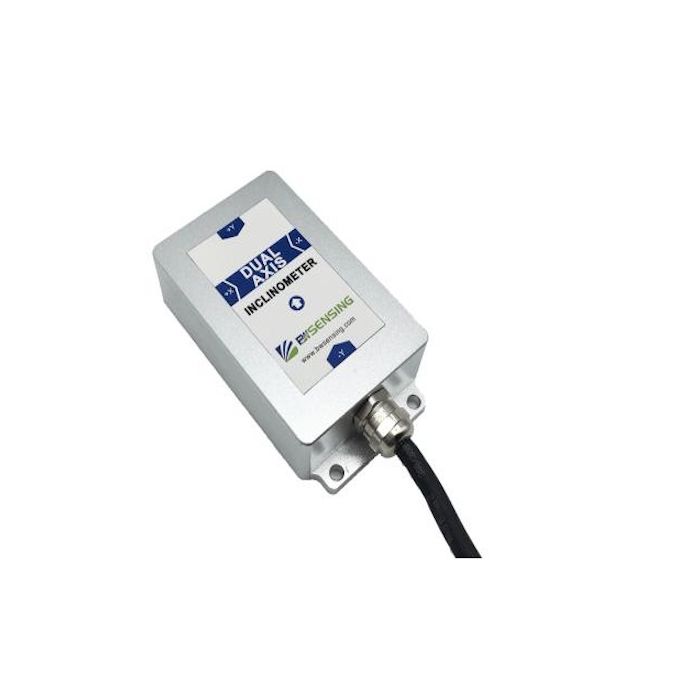
In stock
- BRAND:
- BWSENSING
- PART #:
- BWS2500
- ORIGIN:
- China
- AVAILABILITY:
- SUBJECT TO AVAILABILITY
- SKU:
- BWSENSING-BWS2500
BWSENSING Ultra High Precision Dual-Axis CAN Output Inclinometer (BWS2500)
In vendor specifications, the BWS2500 is positioned as a high-precision model with dual-axis measurement, CAN output, and environmental ruggedness suitable for industrial deployment.
Design and Features
Dual-axis tilt measurement (roll and pitch)
A dual-axis inclinometer measures tilt on two orthogonal axes (commonly labeled X and Y). This allows the BWS2500 to report both roll angle and pitch angle, which is useful for platforms that can tilt in more than one direction (e.g., heavy machinery booms, surveying tripods, industrial frames, and monitoring stations).
Rugged housing and field installation
Industrial inclinometers are typically deployed on equipment that experiences vibration, temperature variation, electrical noise, and occasional impact. Listings for the BWS2500 describe it as compact and intended for industrial use, and manufacturer information commonly highlights features such as filtering/compensation algorithms and environmental suitability.
Digital communication for control systems
A defining feature of the BWS2500 is its CAN interface, a widely used communication standard in industrial and embedded systems. CAN (Controller Area Network) is standardized under the ISO 11898 family and is common in vehicles, mobile machinery, and distributed automation.
Technology and Specifications
How an inclinometer works
An inclinometer measures orientation relative to gravity by sensing the static gravitational field and converting it into an angle output. Many modern industrial inclinometers use MEMS sensing elements and digital processing to produce stable angle readings, sometimes with built-in filtering and temperature compensation.
Core performance (as published)
Public product listings and manufacturer pages commonly describe the BWS2500 with specifications in the following ranges:
-
Measurement range: often listed around ±30° (depending on configuration)
-
Resolution: listed as 0.0005° in at least one industrial marketplace listing
-
Accuracy: listed as 0.001° (max) in multiple published descriptions
-
Temperature drift (example figure): reported as 0.0007°/°C in a published listing
-
Cross-axis error (example figure): reported as 0.001 in the same listing context
Because specifications can differ by variant, calibration level, or measurement range option, it is standard practice to confirm the exact configuration (range, output mapping, filtering, and protocol) before procurement.
Output interface and protocol considerations (CAN)
The BWS2500 is described as having CAN BUS output.
Some product materials also include baud-rate figures. One widely indexed listing shows a baud rate of 2400–115200, while manufacturer materials also reference adjustable communication rates that align more closely with CAN deployments. In practice, CAN systems use network bit-rates selected to match the application and bus length, so confirming the device’s supported CAN bit-rates and higher-level protocol (raw CAN frames vs. CANopen/J1939-style mapping) is important during integration.
Applications and Use Cases
Industrial automation and machine leveling
In factory or mobile automation, a high-precision CAN inclinometer can support tasks such as platform leveling, end-effector tilt control, safety interlocks, and repeatable setup of fixtures and tooling. CAN’s robustness and widespread use in machinery electronics makes it a common choice for these deployments.
Surveying, mapping, and instrumentation
Vendor descriptions commonly associate high-accuracy inclinometers with surveying and mapping workflows, where stable angle measurement can be used in alignment, calibration, and instrument referencing.
Structural and geotechnical monitoring
Tilt sensing is also used in structural health monitoring (SHM) and geotechnical instrumentation—such as monitoring deflection, settlement, or slow angular movement of structures and terrain. While full SHM systems often combine multiple sensors (strain, GNSS, accelerometers), inclinometers remain a standard measurement approach where angular change is a key indicator.
Advantages / Benefits
High precision and fine resolution
With published resolution and accuracy figures in the sub-millidegree range in some listings, the BWS2500 class of sensor targets applications where small angular changes matter (alignment, leveling, monitoring, precision motion platforms).
Digital integration via CAN
CAN is widely adopted, supports robust error handling, and is well supported by industrial controllers and embedded gateways. This simplifies integration into machine networks compared with purely analog tilt sensors, which may require additional filtering, ADC conversion, and noise mitigation.
Stability features (compensation and filtering)
Published product descriptions reference built-in compensation and filtering algorithms intended to reduce error from environmental changes and improve usable stability in real deployments.
FAQ Section
What is the BWSENSING BWS2500 dual-axis inclinometer?
The BWSENSING BWS2500 is a high-precision dual-axis inclinometer that measures tilt (roll and pitch) relative to gravity and provides a digital output, commonly described with a CAN BUS interface.
How does a dual-axis inclinometer work?
A dual-axis inclinometer measures tilt by sensing the gravitational field and converting that measurement into angles on two axes. Product descriptions for the BWS2500 explicitly describe measuring changes in the static gravitational field and outputting roll/pitch angles digitally.
Why is a CAN output inclinometer important?
A CAN output inclinometer integrates well with distributed control systems used in vehicles, mobile machinery, and industrial automation. CAN is standardized and widely supported, enabling robust data exchange between sensors and controllers on a shared bus.
What are the benefits of the BWS2500 compared with basic tilt sensors?
Published descriptions emphasize very fine resolution, high stated accuracy, and built-in filtering/compensation aimed at improving stability under real-world environmental conditions—features that are often reduced in lower-cost tilt sensors.
Summary
The BWSENSING BWS2500 is positioned as an ultra-high precision, dual-axis inclinometer designed for gravity-referenced tilt measurement with digital CAN integration for industrial systems. With published figures emphasizing sub-millidegree-class accuracy and resolution (variant-dependent), it targets demanding applications in automation, surveying, and monitoring where stable, high-quality angle measurement and robust field communication matter.
Specifications
| PART # | BWS2500 |
|---|---|
| BRAND | BWSENSING |