
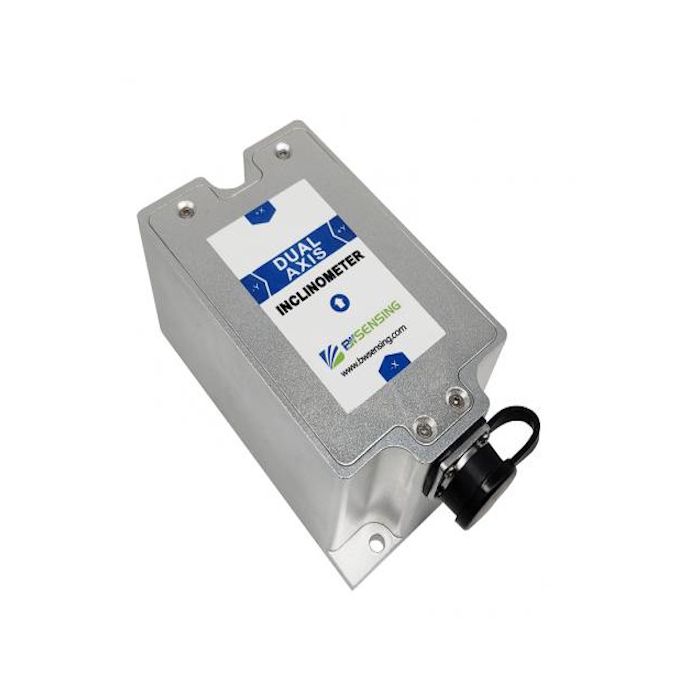
BWSENSING Dual-Axis Digital Output Inclinometer (BWS5000E)
In stock
- BRAND:
- BWSENSING
- PART #:
- BWS5000E
- ORIGIN:
- China
- AVAILABILITY:
- SUBJECT TO AVAILABILITY
- SKU:
- BWSENSING-BWS5000E
BWSENSING Dual-Axis Digital Output Inclinometer (BWS5000E)
The BWS5000E is positioned as a high-precision device, combining fine angular resolution with digital communication interfaces that simplify integration into controllers, data loggers, and IoT gateways.In typical deployments, an inclinometer is fixed to a structure (such as a beam, retaining wall, mast, crane boom, or vehicle frame). As the structure tilts, the sensor converts that orientation change into a digital signal. The BWS5000E is commonly listed as part of a high-accuracy class of inclinometers with ±15° measurement range, 0.0001° resolution, and maximum accuracy figures reported around 0.001° (under specified conditions).
Design and Features
Mechanical design
The BWS5000E is typically described as a ruggedized industrial sensor intended for fixed installation. High-precision inclinometers in this class are commonly housed in metal enclosures for stability and durability, and they are mounted using flat reference surfaces and bolt patterns to reduce alignment errors. The BWS5000 series documentation emphasizes engineering-oriented installation and calibration practices consistent with long-term monitoring and industrial environments.
Key functional features
The BWS5000E is characterized by three practical design goals:
-
High sensitivity for small-angle monitoring (fine resolution and low drift).
-
Digital interfaces for system integration (serial-style outputs commonly used in automation).
-
Environmental and operational robustness (wide operating temperature range in typical listings).
Technology and Specifications
Measurement principle
Modern dual-axis inclinometers commonly rely on gravity-referenced sensing (often MEMS-based in many industrial families), then apply internal signal processing and temperature compensation to produce stable tilt readings. The BWS5000E technical documentation emphasizes precision figures and temperature behavior, indicating that compensation and calibration are central to the product’s performance claims.
Core performance specifications
Published listings and technical documentation for the BWS5000E / BWS5000 family commonly highlight:
-
Measurement range: ±15°
-
Resolution: 0.0001°
-
Maximum accuracy: 0.001° (reported in product documentation/manual context)
-
Temperature drift (reported): 0.0003°/°C
-
Operating temperature (typical listing): −40 °C to +85 °C
Because inclinometer accuracy depends strongly on installation flatness, mounting torque, vibration, thermal gradients, and calibration method, manufacturers and distributors typically present these values under defined test conditions (for example, static measurements at room temperature). The BWS5000 series pages explicitly frame accuracy as a specified performance figure under stated conditions.
Electrical and interface characteristics
The BWS5000E is marketed with digital output options suitable for industrial control and monitoring. The BWS5000 series references RS485 / RS232 / TTL interfaces, and typical listings describe digital outputs as a key differentiator versus analog-output tilt sensors.
Power requirements in published listings for this class commonly include a wide DC input range appropriate for industrial cabinets and vehicle electrical systems (e.g., 9–36 VDC is shown for the BWS5000 series).
Applications and Use Cases
Construction and structural monitoring
High-precision dual-axis inclinometers are frequently used to monitor:
-
retaining walls and excavation bracing,
-
bridges and elevated structures,
-
towers, masts, and antenna supports,
-
settlement or slow deformation trends over time.
Mobile machinery and industrial equipment
In industrial and field machinery, a sensor like the BWS5000E may be installed on:
-
cranes and lifting systems (boom angle monitoring),
-
aerial work platforms (tilt safety interlocks),
-
autonomous platforms and vehicles (attitude reference and leveling tasks),
-
heavy equipment requiring stable angle references.
Automation, alignment, and calibration workflows
In production and metrology-adjacent environments, inclinometers support:
-
machine leveling and alignment,
-
fixture verification,
-
precision platform tilt feedback for closed-loop correction.
Advantages / Benefits
High-precision measurement for small-angle changes
The BWS5000E’s published specification set—particularly its fine resolution and reported high accuracy—targets applications where tiny tilt changes must be detected and logged.
Digital integration with industrial systems
Digital output interfaces such as those described for the BWS5000 series (RS485/RS232/TTL) make it easier to connect to PLCs, industrial PCs, and monitoring gateways without requiring analog scaling or high-noise analog cabling practices.
Wide operating temperature range
Listings commonly cite an operating band around −40 °C to +85 °C, which supports outdoor deployments and industrial enclosures subject to seasonal extremes.
FAQ Section
What is the BWSENSING BWS5000E?
The BWS5000E is a dual-axis digital output inclinometer used to measure tilt on two perpendicular axes, commonly specified with a ±15° range, 0.0001° resolution, and reported high-accuracy performance in the BWS5000 family documentation.
How does the BWS5000E work?
Installed on a structure or machine, the sensor measures orientation relative to gravity and converts that tilt into digital output data via industrial communication interfaces described for the BWS5000 series (e.g., RS485/RS232/TTL).
Why is the BWS5000E important?
High-precision dual-axis inclinometers are important in applications where small angular changes indicate deformation, instability, misalignment, or safety risk—such as structural monitoring, equipment leveling, and precision automation feedback.
Where can I buy the BWS5000E?
The BWS5000E is commonly available through industrial measurement distributors and quotation-based product directories, where buyers request configuration and pricing based on project needs.
What are the benefits of the BWS5000E?
Key benefits include fine resolution, high-precision performance claims in the BWS5000 family, digital integration interfaces, and a wide operating temperature range typically listed for industrial use.
Summary
The BWSENSING BWS5000E is positioned as a high-precision dual-axis digital inclinometer intended for industrial monitoring and automation, commonly listed with a ±15° range, 0.0001° resolution, and high-accuracy specifications in the associated BWS5000 family documentation. Its digital interfaces and industrial operating range make it suitable for construction monitoring, machine tilt feedback, alignment tasks, and long-term structural measurement workflows.
Specifications
| PART # | BWS5000E |
|---|---|
| BRAND | BWSENSING |