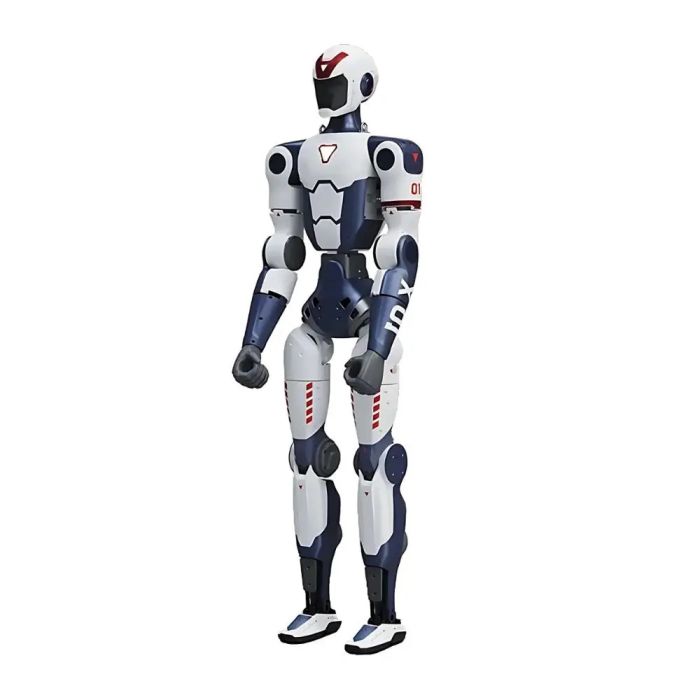
Unitree R1 Basic Humanoid Robot (R1 Basic)
In stock
- BRAND:
- UNITREE ROBOTICS
- MODEL:
- R1 BASIC
- ORIGIN:
- China
- Warranty:
- 8 MONTHS
- AVAILABILITY:
- SUBJECT TO AVAILABILITY
- SKU:
- Unitree-Robotics-R1-Basic
Design and Physical Features
121 to 123 cm Compact Form Factor
The R1 Basic stands 121 to 123 centimeters tall — approximately the height of an average seven-year-old child. At this compact scale, the robot is less imposing than full-size humanoids, fits comfortably in standard home furniture clearances, can be carried by a single adult without assistance, and loads into standard passenger vehicles without requiring special equipment. Unitree describes this scale as intentionally less intimidating for home settings and easier to transport, consistent with the R1's positioning as a "civilian robot" targeting individual consumers and educational buyers
Dimensions are confirmed at 1230 × 357 × 190 mm. Body weight is approximately 25 to 29 kilograms depending on the specific battery and configuration included in the Basic package.
26 Degrees of Freedom: The Full Articulated Body
The R1 Basic's 26 DOF total includes six degrees of freedom more than the R1 Air, specifically adding:
Waist degrees of freedom: The R1 Basic includes waist articulation — confirmed as waist yaw (±150°) and roll (±30°) — enabling torso rotation and lateral lean that the R1 Air's fixed torso cannot provide. This waist articulation is what enables the R1 Basic to perform coordinated whole-body athletic maneuvers: cartwheels, which require torso rotation and lean, and handstands, which require whole-body coordination including torso stiffness at extended positions.
Head degrees of freedom: The R1 Basic adds two head DOF (pan and tilt) that the R1 Air lacks, enabling active visual tracking — the robot can independently aim its cameras at objects and people of interest without repositioning its whole body. Combined with the binocular stereo cameras at the head, the two-DOF head enables visual tracking of moving targets, maintaining camera fixation on a person's face during conversation, and adjusting the camera's field of view to inspect objects at different heights.
The confirmed DOF distribution from Ronomics and 3digital.tech: 6 DOF per leg (bilateral, 12 total), 5 DOF per arm (bilateral, 10 total), 2 DOF waist, 2 DOF head = 26 total. The 5-DOF arm configuration — consistent with the base R1 body without the 7-DOF arm upgrade of EDU Pro variants — covers the arm articulation needed for natural arm swing during locomotion and basic gesture production without wrist yaw articulation.
Binocular Stereo Cameras: The Key Upgrade from R1 Air
The binocular stereo camera system is the hardware feature most likely to influence a buyer's choice between the R1 Air and R1 Basic. Binocular stereo vision works by comparing the two slightly offset images from left and right cameras to compute disparity — the difference in where each camera sees a given point in the scene. Disparity is geometrically proportional to depth: points that appear very differently positioned in the two cameras are close; points that appear nearly identically positioned are far. This disparity computation produces a dense depth map covering the camera's field of view.
The practical advantages of genuine stereo depth over monocular depth estimation:
Real-time reliable depth at close range: Stereo depth computation is reliable at the 0.5 to 3 meter range most relevant to home navigation and obstacle avoidance, where monocular depth estimation degrades significantly with moving cameras or visually ambiguous surfaces.
Depth-based object localization: The robot can determine the precise distance to objects in front of it, enabling more reliable object approach trajectories, safer navigation around obstacles of known distance, and richer spatial awareness in cluttered environments.
Improved human presence sensing: Stereo depth reliably detects and localizes people at short ranges, supporting the social interaction and proximity-aware behavior that the R1's "civilian robot" positioning requires.
Technology and Specifications
Full R1 Basic Specifications
| Specification | R1 Air | R1 Basic |
|---|---|---|
| Price | $4,900 | $5,900 |
| Height | 121–123 cm | 121–123 cm |
| Weight | ~25 kg | ~25–29 kg |
| Total DOF | 20 | 26 |
| Waist DOF | No | Yes (±150° yaw, ±30° roll) |
| Head DOF | No | Yes (2 DOF) |
| Camera | Monocular | Binocular stereo |
| Depth Perception | Estimated only | True stereo depth |
| Warranty | 6 months | 8 months |
| Max Speed | 9 km/h | 9 km/h |
| Athletic Capabilities | Cartwheels, handstands, kicks, fall recovery | Same |
| SDK / Secondary Dev | No (closed system) | No (closed system) |
| Main Compute | 8-core CPU/GPU | 8-core CPU/GPU |
| AI Framework | UnifoLM multimodal | UnifoLM multimodal |
| Battery | Quick-swappable, ~1 hour | Quick-swappable, ~1 hour |
| OTA Updates | Yes | Yes |
| AliExpress Global | Yes | Yes |
Athletic Capabilities: What the R1 Basic Can Do
Both the R1 Air and R1 Basic share the same locomotion capability profile — the distinction between them is not locomotion performance but rather sensing and body articulation:
Running at up to 9 km/h: The confirmed maximum speed for the R1 platform, achievable on flat surfaces and downhill terrain. This represents genuine bipedal running — a flight phase where both feet are momentarily off the ground simultaneously.
Cartwheels: Coordinated whole-body lateral rotation requiring the waist and arm DOF that the R1 Basic adds over the R1 Air. The waist articulation of the 26-DOF Basic enables the torso rotation component of cartweel execution.
Handstands: Vertical body inversion with balance maintained on the hand contact points. The R1 demonstrates handstand capability as part of its "Born for Sport" locomotion mandate.
Spin-kicks: Rotational leg kick maneuvers requiring whole-body balance coordination.
Autonomous fall recovery: The robot can detect falls and execute recovery policies that return it to standing position without operator intervention or pre-programmed specific fall configurations — a general skill learned through reinforcement learning.
UnifoLM Multimodal AI: Onboard Voice and Vision
The R1 Basic includes Unitree's UnifoLM large multimodal model running entirely onboard the 8-core CPU/GPU — providing voice command recognition, image-based task instruction, and gesture recognition without cloud connectivity. This onboard AI enables users to give the robot natural language voice commands and show it objects or scenes with the binocular camera, receiving responses or behavior adjustments accordingly.
The binocular camera system of the R1 Basic feeds into UnifoLM's visual processing pipeline — the stereo depth information provides richer scene understanding than the monocular camera's image data, potentially improving UnifoLM's responses to spatially situated questions ("what is on the table?" where the depth information helps locate objects relative to the table surface).
OTA updates push improved UnifoLM versions and locomotion policy improvements to the R1 Basic after delivery, providing ongoing capability enhancement without hardware replacement.
Applications and Use Cases
Home Consumer Exploration and Companion Use
The R1 Basic's binocular camera, 26-DOF body, and UnifoLM voice-and-vision AI enable home companion interactions that the R1 Air's monocular setup handles less reliably. Voice-commanded navigation around a home environment, object identification and location description ("where is my phone?"), presence detection and social response, and the expressive head motion enabled by the 2-DOF head — all benefit from the R1 Basic's depth perception and head articulation.
Educational Demonstration Programs
For secondary schools and community colleges introducing students to humanoid robotics, the R1 Basic at $5,900 provides a visually complete, depth-sensing humanoid that can demonstrate bipedal locomotion, dynamic athletic behaviors, and AI-driven voice-and-vision interaction without requiring institutional research computing infrastructure. Students can observe the robot performing cartwheels and handstands, issue voice commands, and study how the robot responds to visual scenes.
Entertainment and Content Creation
The R1 Basic's athletic capabilities — cartwheels, handstands, running at 9 km/h, spin-kicks — combined with its head tracking and voice interaction make it a compelling subject for content creation. The active head tracking provided by the 2-DOF head and binocular camera enables the robot to follow its operator or a designated target with its camera gaze, producing more engaging interaction footage than a robot with a fixed camera orientation.
Retail and Exhibition Demonstrations
For brand demonstrations, retail activations, and exhibition events where a humanoid robot must engage visitors, respond to voice commands, and track moving people with its camera, the R1 Basic's binocular depth sensing and active head tracking provide a more reliable visitor engagement experience than the monocular R1 Air's fixed camera setup.
Advantages and Benefits
True Stereo Depth Perception for Reliable Spatial Awareness: The binocular camera system provides genuine depth measurement rather than estimated depth — substantially more reliable for obstacle avoidance, object localization, and spatial navigation in real environments.
26 DOF Including Waist and Head Articulation: The 6 additional DOF over the R1 Air enable whole-body athletic maneuvers requiring torso coordination (cartwheels, handstands) and active visual tracking through the 2-DOF head.
8-Month Warranty vs. R1 Air's 6-Month Coverage: The additional 2 months of warranty coverage represents added institutional support value for buyers in the consumer and entry education market.
Active Head Tracking for Natural Social Interaction: The 2-DOF head enables the robot to maintain camera gaze on people and objects of interest independently of body orientation — producing more natural-feeling social interaction for HRI and entertainment contexts.
AliExpress Global with Free Shipping (Brand+ Markets): The R1 Basic is available on AliExpress through Unitree's Brand+ channel with free shipping and free returns in North America, Europe, Japan, and Singapore — the same consumer e-commerce channel as the R1 Air.
Onboard UnifoLM AI Without Cloud Dependency: Voice and vision AI run entirely on the robot's compute without requiring persistent internet connectivity — enabling operation in WiFi-limited environments.
Comparison: R1 Air vs. R1 Basic vs. R1 EDU Standard
| Feature | R1 Air ($4,900) | R1 Basic ($5,900) | R1 EDU Standard ($10–12K) |
|---|---|---|---|
| DOF | 20 | 26 | 24 |
| Camera | Monocular | Binocular stereo | Binocular stereo |
| Depth Perception | Estimated | True stereo | True stereo |
| Waist | No | Yes | Yes |
| Head DOF | No | Yes (2) | Yes |
| Warranty | 6 months | 8 months | Extended |
| SDK | No | No | Yes (Full) |
| ROS 2 | No | No | Yes |
| AI Compute | 8-core CPU | 8-core CPU | Jetson Orin 40 TOPS |
| Best For | Budget, open space | Consumer, depth sensing | Research, programming |
Frequently Asked Questions (FAQ)
What is the Unitree R1 Basic? The Unitree R1 Basic is the mid-tier consumer configuration of Unitree's R1 humanoid robot, priced at $5,900. It stands 121 to 123 centimeters tall and weighs approximately 25 to 29 kilograms. Key specifications include 26 total degrees of freedom, binocular stereo cameras for true depth perception, an 8-month warranty, and the same athletic locomotion capabilities as the R1 Air: running at up to 9 km/h, cartwheels, handstands, spin-kicks, and autonomous fall recovery. It runs UnifoLM multimodal AI onboard for voice and vision interaction. Like the R1 Air, it is a closed system with no SDK or secondary development support.
What is the difference between the R1 Air and R1 Basic? The R1 Air ($4,900) has 20 DOF, a monocular camera, a 6-month warranty, and a fixed torso and head. The R1 Basic ($5,900) adds 6 degrees of freedom (26 total) — including waist articulation (±150° yaw, ±30° roll) and a 2-DOF head — replaces the monocular camera with binocular stereo cameras for true depth perception, and extends the warranty to 8 months. The athletic locomotion capabilities, operating speed (9 km/h), closed-system designation, and AliExpress availability are identical for both.
Does the Unitree R1 Basic support programming or ROS 2? No. The R1 Basic is a closed system with no secondary development support — it cannot be programmed with custom code, has no SDK access, and does not support ROS 2. For programmable humanoid capability, buyers must select the R1 EDU series starting at $10,000 (EDU Standard, Jetson Orin 40 TOPS, full SDK, ROS 2). BotInfo.ai states explicitly: "R1 Basic ($5,900) is remote-controlled only — NO ROS 2, NO Python, NO SDK."
What can the Unitree R1 Basic do athletically? The R1 Basic can run at speeds approaching 9 kilometers per hour, perform cartwheels using whole-body torso rotation (enabled by its waist DOF), execute handstands, perform spin-kicks, and recover from falls autonomously without operator intervention. It can also respond to voice commands through the onboard UnifoLM AI, identify objects through its binocular cameras, and actively track people and objects of interest with its 2-DOF head. All athletic capabilities are pre-programmed and cannot be modified in the Basic configuration.
Summary
The Unitree R1 Basic Humanoid Robot provides the most capable consumer bipedal humanoid available below $6,000 — adding genuine binocular stereo depth perception, six additional degrees of freedom covering waist and head articulation, and eight months of warranty coverage to the R1 Air's athletic locomotion foundation at a $1,000 premium. Its cartwheels, handstands, 9 km/h running speed, and autonomous fall recovery make it the most physically dynamic consumer robot available for purchase globally; its binocular camera and active 2-DOF head tracking make it more appropriate for home navigation, visitor engagement, and social interaction than the monocular R1 Air.