
Senad Six-Side Barcode Scan DWS System
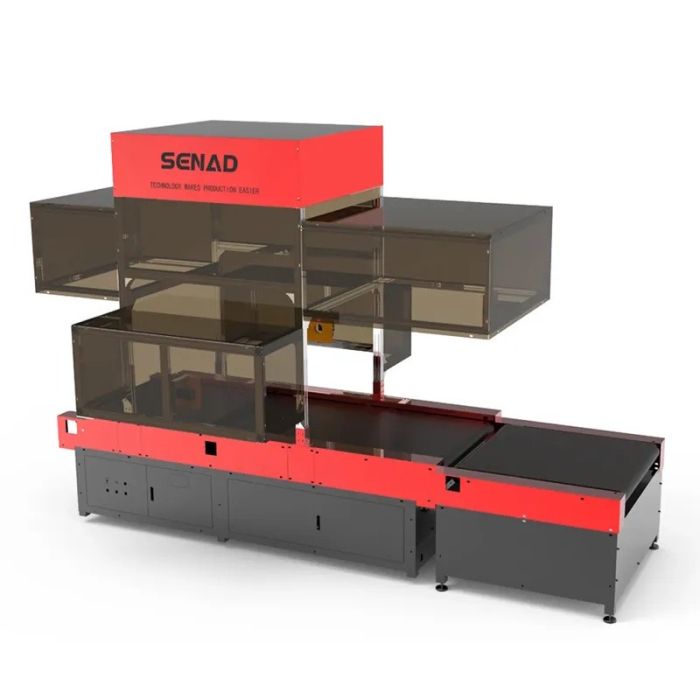
In stock
- BRAND:
- SENAD
- PART #:
- Six-side Barcode Scan DWS System
- ORIGIN:
- China
- AVAILABILITY:
- SUBJECT TO AVAILABILITY
- SKU:
- Senad-Six-side-Barcode-Scan-DWS-System
Senad Six-Side Barcode Scan DWS System
In the DWS category, “dimensioning” refers to automated measurement of an item’s length, width, and height; “weighing” captures mass; and “scanning” identifies the item—most commonly via 1D/2D barcodes—so that operational systems can rate shipments, validate sort plans, reconcile inventory, and produce carrier-compliant labels.
A defining feature of a six-side barcode scan DWS is its use of multi-angle optical capture so that barcodes can be read regardless of which face of a parcel is visible, reducing the need for manual re-orientation or rescans. In practice, six-side scanning is typically implemented using an array of industrial cameras and illumination mounted around a conveyor tunnel (or “scan portal”), synchronized with sensors that detect parcel presence and trigger data capture at the correct moment.
DWS systems are widely deployed in parcel hubs, courier depots, 3PL warehouses, and automated sortation facilities because they replace manual measurement and hand-scanning with consistent, auditable capture of shipping attributes—especially for rate shopping, dimensional-weight billing, and exception reduction. More broadly, DWS solutions from major industrial measurement vendors are described as systems that automatically measure package weight and volume and identify parcels by reading 1D/2D codes, supporting operational traceability in high-volume environments.
Design and Features
Six-side barcode reading architecture
A six-side barcode scan DWS system is engineered to increase first-pass read rates by capturing barcode imagery from multiple perspectives. Common design elements include:
-
Multi-camera vision tunnel (top and side views, often complemented by angled cameras)
-
High-intensity, controlled lighting to stabilize exposure on glossy shrink-wrap, polybags, and printed labels
-
Real-time decoding of common symbologies (e.g., Code 128, Code 39, EAN/UPC, QR, Data Matrix), depending on configuration
-
Photographic evidence capture (optional) to support claims handling and compliance workflows
Senad’s six-side DWS product positioning emphasizes integrated barcode scanning with dimensional and weight capture in a compact workstation layout intended for operational deployment on conveyor lines.
Dimensioning and weighing integration
A DWS workstation typically combines:
-
A dimensioning subsystem (camera-based 3D measurement or structured light, depending on design) to compute parcel volume
-
An in-motion or static scale (application-dependent) to capture mass
-
A control cabinet / industrial PC to synchronize sensors, cameras, scale I/O, and conveyor timing
DWS “scan–weigh–dimension” solutions are often described as computer-vision-driven measurement workflows that capture dimensions, weight, and barcodes as parcels move through the station.
Software and data interfaces
Operational value depends on the system’s ability to export standardized data to upstream and downstream software. Typical integrations include:
-
WMS (Warehouse Management System) for inventory and packing validation
-
TMS (Transportation Management System) for rating, manifesting, and carrier selection
-
Sorter control / PLC layer for routing decisions
-
Databases/APIs for audit trails and analytics dashboards
In modern implementations, the DWS event record can include barcode(s), timestamp, measured dimensions, weight, calculated dimensional weight (DIM), image references, and exception flags (e.g., “no-read,” “multi-read,” “out-of-range”).
Technology and Specifications
Core technologies
While exact performance varies by configured hardware, installation, and parcel mix, six-side DWS systems generally rely on:
-
Machine vision: multi-camera image capture and barcode decoding
-
3D measurement: camera-based dimensioning to estimate L×W×H
-
Industrial automation: photoelectric sensors, encoders, and PLC timing for precise parcel tracking
-
Edge computing: on-station processing to minimize latency and maintain throughput
-
Networking: Ethernet-based communication to WMS/TMS and plant systems
DWS systems are commonly characterized (in the broader industry) as automated measurement-and-identification platforms that capture weight, volume, and barcode identity without manual handling.
Throughput and accuracy considerations
In practice, the usable throughput of a six-side barcode scan DWS depends on:
-
Conveyor speed and parcel spacing
-
Label quality and placement (wrinkles, curvature, glare)
-
Packaging type (carton vs polybag vs irregular)
-
Required accuracy class for dimensions and scale
-
Whether the system must also capture images for evidence or OCR
Senad’s six-side DWS system is marketed as a production-ready workstation for logistics operations, with specification options and configuration details typically determined at quotation/engineering time.
Applications and Use Cases
Parcel and e-commerce fulfillment
A common use case is outbound parcel verification in e-commerce warehouses:
-
Confirm packed carton identity (barcode match)
-
Capture certified weight for carrier labels
-
Measure volume for DIM billing and packaging optimization
-
Reduce “manifest vs actual” disputes
Courier, express, and parcel (CEP) hubs
In sortation hubs, a six-side barcode scan DWS can act as an upstream “data gate” that:
-
Provides accurate attributes before automated sorting
-
Identifies exceptions early (no-read labels, overweight/oversize)
-
Feeds routing logic for cross-belt or sliding-shoe sorters
3PL billing, audit, and compliance
For third-party logistics providers, DWS data supports:
-
Customer billing based on measured attributes
-
SLA reporting and operational analytics
-
Evidence packages for damage claims and chargebacks (when imaging is enabled)
Advantages / Benefits
Higher first-pass identification rates
Six-side scanning reduces reliance on a single label-facing orientation. The result is typically fewer manual touches, fewer rescans, and improved flow stability—especially when label placement is inconsistent.
Automated dimensional weight capture
Because carriers often bill by dimensional weight for lightweight-but-bulky shipments, automated dimensioning reduces revenue leakage and improves rate accuracy. Industry descriptions of DWS emphasize automated capture of volume and weight as a core function.
Better data quality for operations
A DWS station produces standardized, timestamped measurement records that can improve:
-
Pack-out compliance and cartonization tuning
-
Carrier invoice reconciliation
-
Facility performance analytics (throughput, exceptions, rework rates)
Reduced labor and safer handling
Removing manual weighing and measuring lowers repetitive handling tasks and helps standardize processes across shifts and sites.
FAQ Section
What is a Senad Six-Side Barcode Scan DWS System?
A Senad Six-Side Barcode Scan DWS System is an automated workstation that captures dimensions, weight, and barcode identity for parcels using multi-angle (six-side) scanning and integrated measurement components.
How does a six-side barcode scan DWS system work?
Parcels pass through a scan portal where cameras and sensors capture label images from multiple sides while the system simultaneously records weight and computes dimensions. The workstation then outputs a single data record to operational software (e.g., WMS/TMS).
Why is a DWS system important in logistics and e-commerce?
DWS stations reduce manual handling and improve billing and process accuracy by automatically capturing volume, weight, and barcode ID, which are critical for dimensional-weight rating, sortation decisions, and audit trails.
What are the benefits of six-side barcode scanning compared to single-side scanning?
Six-side scanning generally improves first-pass barcode reads when label placement varies, reducing rework and manual rescans—especially in high-throughput parcel operations.
Summary
The Senad Six-Side Barcode Scan DWS System represents a modern, automation-oriented approach to parcel measurement and identification, combining multi-angle barcode scanning with integrated dimensioning and weighing to produce reliable shipping attributes at operational speed. By improving first-pass reads, standardizing measurement records, and enabling tighter integration with warehouse and transportation software, six-side DWS workstations support the accuracy, traceability, and throughput requirements of contemporary e-commerce and logistics networks.