
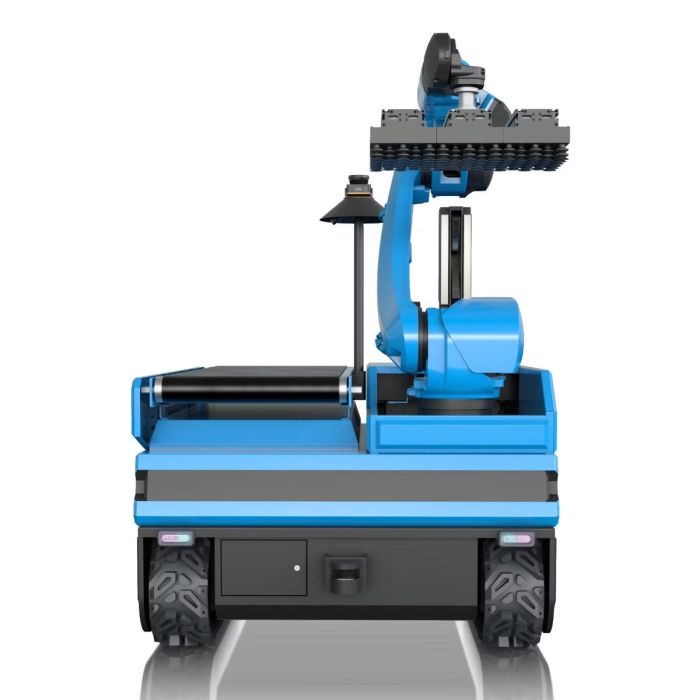
Senad iLoabot-M Autonomous Loading and Unloading Robot
In stock
- BRAND:
- SENAD
- PART #:
- iLoabot-M
- ORIGIN:
- China
- AVAILABILITY:
- SUBJECT TO AVAILABILITY
- SKU:
- Senad-iLoabot-M
iLoabot-M sits at the intersection of autonomous mobile robotics, machine-vision-guided picking, and truck/container automation. Public Senad product materials say it is suitable for loading and unloading containers, box trucks, and trolleys, and that it can handle both boxed and bagged goods. The same materials also state that it supports heavy-duty trucks without requiring modifications to the platform, which is an important point for logistics operators that want automation without redesigning trailers or docks.
Senad’s product lineup places iLoabot-M within its broader warehouse robotics portfolio. On the company’s product index, the robot appears alongside parcel-sorting systems, telescopic conveyors, and depalletizing solutions, which suggests that Senad positions iLoabot-M as part of a larger logistics automation ecosystem rather than as a standalone novelty machine.
Design and Features
Core Design Principles
Industrial robots are built for repeatability, durability, speed, payload handling, and integration into production systems. Unlike service robots that work in public-facing spaces, industrial robots are typically designed for controlled factory environments, where they may operate inside guarded cells, on assembly lines, or alongside specialized tooling and fixtures. The ISO/IFR definition emphasizes reprogrammability and multi-axis movement because these qualities allow one robot platform to support different industrial tasks over time.
Main Types of Industrial Robots
The most common type is the articulated robot, usually a multi-axis robot arm with joints that mimic an arm-like structure. ABB says articulated robots are widely used for welding, assembly, painting, and material handling, and describes them as flexible systems available from small-payload to heavy-duty ranges.
Other important industrial robot types include SCARA robots, cartesian robots, delta robots, and collaborative robots. While the product mix varies by manufacturer, the reason these categories exist is that industrial tasks differ greatly: some require speed over a small workspace, some require long reach and high payload, and some require precise vertical insertion or packaging motion. That task specialization is a defining trait of industrial robotics as a whole.
End-of-Arm Tooling and Peripheral Systems
An industrial robot is rarely useful on its own. In practice, it depends on end-of-arm tooling such as grippers, welding torches, paint applicators, suction cups, screwdrivers, or vision-guided tools. It also often works with conveyors, positioners, machine tools, safety systems, and software such as offline programming or digital simulation. ABB’s application pages and FANUC’s application-specific product lines make clear that robot usefulness comes from the full cell or system, not just the robot arm itself.
Technology and Specifications
Axes, Reach, and Payload
Industrial robots are commonly described by number of axes, reach, payload, and repeatability. ISO’s definition requires three or more programmable axes, but most articulated factory robots use six axes, giving them flexibility for orientation and positioning in space. FANUC’s official arc-welding product pages show many six-axis models with different payload classes and reach values, illustrating how manufacturers tailor robots for specific process needs.
Payload determines how much the robot can carry at the wrist, including tooling and workpieces. Reach determines how far it can extend into a workspace. Repeatability measures how consistently it can return to the same position. For manufacturers, these three figures are often more important than raw speed alone because they directly affect cell design and process capability. FANUC’s published model tables, for example, list payloads ranging from smaller welding-class values to larger handling-class values, with repeatability measured in fractions of a millimeter.
Motion Control and Software
Industrial robots depend on servo motors, encoders, motion controllers, and software to move precisely. Although these technical subsystems are not always fully detailed on vendor marketing pages, they are implicit in the robot definition itself: industrial robots are automatically controlled and reprogrammable, which requires closed-loop motion control and programmable task logic. IFR’s methodology also notes that robotics technology includes perception, reasoning, and planning algorithms, even though classic industrial robots have historically focused more on programmed motion than on open-ended autonomy.
Modern industrial robotics increasingly adds simulation, offline programming, digital twins, AI-enhanced vision, and cell-level orchestration. Recent ABB and NVIDIA news illustrates this shift toward AI-supported industrial robotics and virtual training environments, although that is better understood as an emerging layer on top of the established industrial robot category rather than a replacement for it.
Safety and Integration
Industrial robots are also defined by how they integrate into factory safety systems. Traditional robots often operate inside fenced workcells with interlocks and safety scanners, while collaborative robots may use force limiting or other safety-rated functions to work closer to people. Even when collaboration is possible, industrial deployment usually depends on formal risk assessment and compliance with industrial safety standards. IFR’s standardization pages reinforce that industrial robots are part of a structured standards ecosystem, not merely a product category.
Applications and Use Cases
Welding
Welding is one of the classic industrial robot applications. ABB lists spot welding and arc welding among its core robot uses, and FANUC has dedicated arc welding robots and cobots marketed around repeatability and welding quality. Welding is well suited to robot automation because it is repetitive, sensitive to path precision, and often hazardous for human workers.
Material Handling and Machine Tending
Another major category is material handling, including pick-and-place, transfer, loading, unloading, and machine tending. ABB and FANUC both market robots for machine tending, and FANUC explicitly frames robotic machine tending as a way to increase flexibility, speed, and reliability in manufacturing. These applications are common because many factory tasks consist of moving parts between machines, conveyors, pallets, or inspection stations.
Assembly, Packaging, and Palletizing
Industrial robots are also widely used for assembly, packaging, and palletizing. ABB’s official application pages include all three, showing how robots support the end stages of production as well as core fabrication processes. Palletizing is especially important in food, beverage, consumer goods, and warehouse-linked manufacturing because it automates the repetitive stacking of finished products.
Painting, Cutting, and Specialized Processes
In addition to general handling and welding, industrial robots are used for painting, cutting, dispensing, polishing, and inspection-related operations. These tasks benefit from consistent programmed motion and can improve worker safety by reducing exposure to fumes, heat, or repetitive strain. ABB’s published application pages explicitly include painting and cutting among standard industrial robot tasks.
Advantages / Benefits
One major benefit of industrial robots is productivity. IFR’s 2025 data showing more than half a million annual installations suggests that manufacturers continue to see strong value in robot deployment at scale. Robots can run repetitive cycles with high consistency and are often used to support extended production hours.
A second benefit is quality and repeatability. Welding, assembly, machine tending, and palletizing all benefit when motion can be repeated accurately thousands of times. FANUC’s welding materials emphasize repeatability as a major reason for robotic use, which is representative of the wider market.
A third benefit is worker safety. Industrial robots can take over hot, heavy, dirty, or hazardous tasks such as welding, painting, and repetitive material handling. This does not eliminate the need for people, but it often moves workers into roles involving supervision, programming, maintenance, quality control, and line optimization. ABB’s and FANUC’s application framing strongly supports this interpretation.
A fourth benefit is manufacturing flexibility. Because industrial robots are reprogrammable, one platform can often be adapted for new products or process changes more easily than dedicated hard automation. That flexibility is one reason industrial robots remain central to advanced manufacturing strategy.
FAQ Section
What are industrial robots?
Industrial robots are automatically controlled, reprogrammable, multipurpose manipulators programmable in three or more axes for use in industrial automation environments. That is the ISO-based definition referenced by the IFR.
How do industrial robots work?
Industrial robots work by combining multi-axis mechanical structures, servo-driven motion control, programmable controllers, sensors, and end-of-arm tools to move parts or tools precisely in manufacturing processes such as welding, assembly, handling, and palletizing.
Why are industrial robots important?
They are important because they improve productivity, repeatability, manufacturing flexibility, and safety in factory operations. IFR’s latest data shows global annual installations reached 542,000 units in 2024, confirming their central role in modern manufacturing.
What are the benefits of industrial robots?
The main benefits are higher throughput, better repeatability, safer handling of hazardous tasks, and the ability to automate repetitive production steps such as welding, machine tending, packaging, and palletizing.
Are industrial robots the same as service robots?
No. Industrial robots are used in industrial automation environments, while service robots are used outside that context for tasks that help humans or equipment. IFR treats them as separate categories.
Summary
Industrial robots are a foundational technology of modern manufacturing. Defined by ISO and tracked globally by the IFR, they are reprogrammable multi-axis manipulators used for tasks such as welding, assembly, material handling, machine tending, packaging, palletizing, painting, and cutting. Current IFR data shows that global demand remains strong, with 542,000 industrial robots installed in 2024 and Asia leading deployments. As factories continue to pursue productivity, quality, and flexibility, industrial robots remain one of the most important automation technologies in the global industrial economy.