
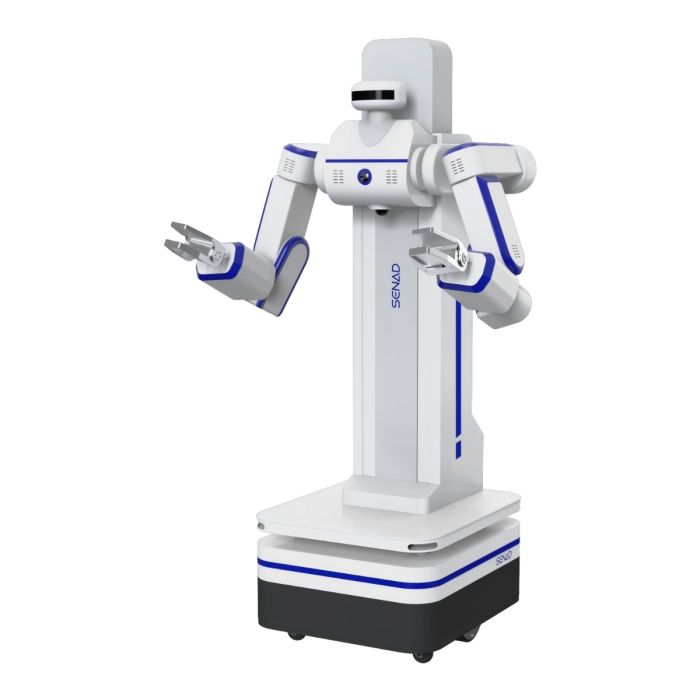
Senad iLoabot-X Heavy-Duty Wheeled Humanoid Logistics Robot
In stock
- BRAND:
- SENAD
- PART #:
- iLoabot-X
- ORIGIN:
- China
- AVAILABILITY:
- SUBJECT TO AVAILABILITY
- SKU:
- Senad-iLoabot-X
The iLoabot series is presented by Senad as a class of “embodied” robots—machines that combine physical mobility with perception and decision-making to execute end-to-end tasks in real-world facilities. On Senad’s corporate site, the company also describes a supporting software stack that includes an industry-focused multimodal VLA (Vision-Language-Action) vertical model and associated control and reinforcement-learning components intended to serve as a “robot brain” and “cerebellum” for industrial logistics applications.
Design and Features
Humanoid logistics form factor
In logistics environments, a humanoid or human-like upper body can be useful for interacting with shelves, bins, conveyors, carts, workbenches, and packaging stations that were designed around human ergonomics. iLoabot-X is described as a humanoid robot specialized for logistics, emphasizing capability in complex scenarios such as package supply/feeding and picking.
Heavy-duty handling orientation
Senad positions iLoabot-X as “heavy-load” within its embodied logistics lineup, indicating a focus on moving and manipulating substantial parcels, totes, or workpieces in operational settings. Public-facing product summaries emphasize scenario fit (logistics, manufacturing assembly, lab operations) rather than publishing a complete standardized spec table.
Autonomy and learning-by-doing
A distinguishing claim in Senad’s iLoabot-X description is autonomous learning, where performance improves as the robot repeats tasks—suggesting iterative skill acquisition and adaptation to facility-specific variations (packaging types, placement variability, station layouts, or operational rules).
Technology and Specifications
Perception, decision-making, and end-to-end task execution
Senad’s description highlights an “end-to-end domain model” approach, implying an integrated pipeline that maps sensor inputs to actions for logistics tasks (e.g., perceive → plan → grasp → place), rather than relying only on rigid, pre-programmed sequences.
Multimodal “robot brain” stack (VLA)
On its corporate site, Senad describes development of a multimodal VLA vertical model intended for logistics as part of a broader embodied intelligence framework, along with:
-
A dedicated robot controller (“small brain”) and
-
Reinforcement-learning control algorithms for motion and manipulation.
What is (and is not) publicly standardized
As of the accessible public pages used here, iLoabot-X information is primarily presented as capability and application descriptions (what it is designed to do) rather than a fully enumerated list of numeric specifications (exact payload, reach, speed, battery runtime, etc.).
For procurement, integrators typically request a formal datasheet or product manual, factory acceptance criteria, and site commissioning requirements.
Applications and Use Cases
Logistics sorting and parcel handling
iLoabot-X is explicitly described for logistics sorting and complex parcel workflows such as package feeding and picking, which commonly occur in e-commerce fulfillment centers, parcel hubs, and distribution facilities.
Intelligent manufacturing and assembly support
Senad’s product description also lists intelligent manufacturing assembly among target applications. In practice, this can include kitting, line-side material replenishment, component transfer, and workstation support where flexible manipulation reduces reliance on dedicated fixtures.
Laboratory and controlled-environment operations
The iLoabot-X description includes laboratory operations, a category that often values traceability, repeatability, and safe handling of materials (including time-sensitive or contamination-sensitive items) under defined SOPs.
Electronics processing and medical logistics
Additional listed domains include electronics product processing and medical logistics, both of which can demand careful handling, consistent placement, and integration with facility IT systems (task dispatch, barcode workflows, WMS/MES events).
Advantages / Benefits
Flexible automation in human-designed spaces
A humanoid-form logistics robot can operate across mixed infrastructure—racks, tables, conveyors—without requiring a full facility redesign. This can be attractive where automation needs to be layered onto existing workflows.
Potential to reduce bottlenecks in repetitive handling
Parcel induction, tote transfer, replenishment, and station feeding are common throughput limiters. A robot designed for these tasks can improve consistency and shift coverage in high-volume operations.
Learning-oriented approach for operational variability
Senad emphasizes autonomous learning over repeated work cycles, which—if realized in deployment—can reduce manual tuning as packaging formats, SKU profiles, or station layouts evolve.
Alignment with broader “embodied” warehouse robotics trends
Warehouses and logistics providers have been actively piloting humanoid robots to explore multi-task flexibility beyond single-purpose automation, reflecting an industry-wide interest in embodied robots for material handling
FAQ Section
What is the Senad iLoabot-X?
The Senad iLoabot-X is a heavy-duty humanoid logistics robot designed for complex warehouse and industrial logistics tasks such as package feeding and picking, with an emphasis on learning and adaptation over repeated work cycles.
How does the iLoabot-X work?
Senad describes iLoabot-X as using an end-to-end domain model for logistics tasks and supporting autonomous learning, allowing performance to improve as it repeats jobs. Senad also describes a broader stack that includes a multimodal VLA model and reinforcement-learning control components for embodied logistics robots.
Why is a heavy-duty humanoid logistics robot important?
Heavy-duty humanoid logistics robots target tasks that are difficult to fully automate with conveyors or simple AMRs—especially where facilities are designed around human reach and manipulation. Logistics providers have been piloting humanoids to explore more flexible warehouse automation.
Where can iLoabot-X be used?
Senad lists applications including logistics sorting, intelligent manufacturing assembly, laboratory operations, electronics processing, and medical logistics.
What are the benefits of iLoabot-X?
Key described benefits include suitability for complex logistics scenarios, an autonomous learning approach intended to improve skills with repeated work, and alignment with an embodied intelligence stack designed for industrial logistics environments.
Summary
Senad iLoabot-X is positioned as a heavy-duty humanoid logistics robot for demanding warehouse and industrial scenarios, with emphasis on complex parcel workflows and autonomous learning designed to improve performance over time. While publicly available pages focus on applications and system concepts rather than full numeric specifications, the stated direction—end-to-end task modeling plus an embodied “robot brain” stack—reflects a broader industry push toward flexible humanoid automation in logistics.