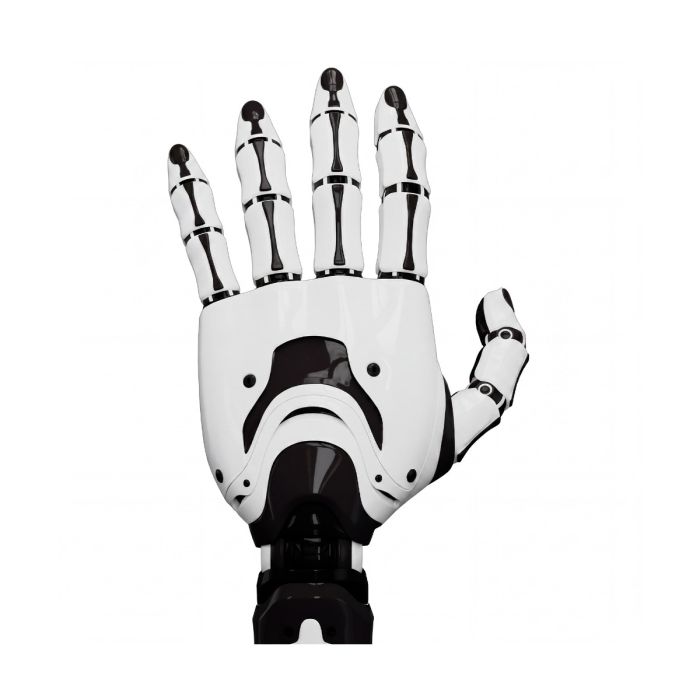
Linkerbot Linker Hand L30 Cable Driven Version
In stock
- BRAND:
- LINKERBOT
- PART #:
- Linker Hand L30
- ORIGIN:
- China
- AVAILABILITY:
- SUBJECT TO AVAILABILITY
- SKU:
- Linkerbot-Linker-Hand-L30
Linkerbot Linker Hand L30 Cable Driven Version
Linker Hand L30 Cable Driven Version (Linker Hand L30)
The “cable-driven” descriptor refers to a tendon/cable transmission architecture, in which actuators drive finger joints via routed cables (tendons) rather than direct gear trains at each joint. This design approach is widely used in high-dexterity hands because it can enable compact finger geometry, lower distal mass, and compliance during contact-rich manipulation.
Publicly available specifications for “L30” vary by source and may reflect different counting conventions (e.g., whether the wrist is included, whether passive joints are counted, and whether “DoF” refers only to actively actuated joints). For example, the manufacturer’s Chinese product page describes the L30 as a tendon-driven dexterous hand with 25 degrees of freedom including 2 at the wrist, while a reseller-style specification table describes 21 joints (17 active + 4 passive) and lists CAN FD as the control interface.
In practice, the Linker Hand L30 is positioned for applications where a conventional two-finger gripper is insufficient—such as handling irregular objects, stabilizing parts during assembly, operating human-designed tools and controls, or performing bimanual tasks on humanoid or mobile manipulation platforms.
Design and Features
Cable-driven (tendon) transmission
The defining mechanical feature of the L30 cable-driven version is its tendon-driven transmission mode, which routes cables through the hand structure to produce joint motion. In tendon-driven hands, cables can be tensioned to distribute forces across joints and to create controllable compliance—useful when the hand must maintain stable contact without damaging objects.
Multi-joint finger kinematics
Across published references, the L30 is presented as a high-dexterity, high-DoF hand designed to emulate aspects of human grasping. The manufacturer highlights bionic (“biomimetic”) intent and high freedom of motion, while other published spec tables emphasize the distinction between active joints (directly actuated) and passive joints (moving through mechanical coupling or compliance).
Industrial integration orientation
Public listings consistently categorize the L30 as an industrial hand/end effector intended for integration into larger robotic systems rather than as a standalone consumer device. Typical integration considerations include mounting geometry, power requirements, communications, and SDK/software tooling.
Technology and Specifications
Because specifications differ by source, the most defensible way to describe the L30 is as a configuration family with published parameters that may change by variant (hand-only vs. hand+wrist; different sensor packages; firmware revisions).
Degrees of freedom and joints (published counts)
-
Manufacturer product page (Chinese): tendon-driven; 25 DoF (including 2 wrist DoF).
-
Published spec table (reseller-style): 21 joints (17 active + 4 passive); “Degrees of Freedom” listed as 17 (commonly interpreted as actively actuated DoF).
Interpretation: it is common for dexterous hands to report (a) total kinematic DoF (including passive joints and/or wrist) and (b) active DoF (actuated joints only). These are both “correct” within their own conventions, but they are not interchangeable.
Control interface and communications
A published specification table lists CAN FD as the control interface with a listed communication rate of 500 kbps.
In addition, an official SDK repository for LinkerHand describes connecting the hand via a USB-to-CAN device on Ubuntu, indicating a typical PC-to-hand development path for configuration and control.
Power and electrical (published figures)
A published L30 spec table lists DC 24V operation and provides indicative currents (quiescent, average movement, and peak).
(As with many robotic subsystems, real current draw can vary with motion profile, load, friction, and control tuning.)
Weight and payload (published figures)
A published specification table lists:
-
Weight: approximately 1400 g
-
Maximum load: 5 kg
-
Grip force: 12 N (as presented on that page)
Note on payload reporting: payload can be defined in multiple ways (static hold vs. dynamic manipulation; at fingertips vs. near the palm; single-finger vs. power grasp). For procurement or engineering validation, these values typically require vendor confirmation of the test method.
Applications and Use Cases
Humanoid robots and mobile manipulation
Dexterous hands are frequently paired with humanoids and mobile manipulators to enable tasks that combine navigation with interaction—opening doors, operating switches, handling tools, or performing two-handed stabilization. The L30’s cable-driven architecture is aligned with this “contact-rich manipulation” paradigm.
Industrial automation and flexible handling
In manufacturing and logistics, a dexterous hand can be useful for:
-
handling irregular or mixed items that do not fit a single gripper geometry,
-
orienting parts for insertion or alignment,
-
holding a workpiece while performing secondary actions (pressing, turning, sliding),
-
interacting with human-designed knobs, latches, and fixtures.
Research and embodied AI development
Dexterous hands are widely used in robotics research for grasp planning, tactile/force control, and learning-based manipulation (imitation learning, reinforcement learning, and hybrid approaches). LinkerHand’s availability of an SDK and Linux/ROS-oriented workflows supports this kind of development environment.
Advantages / Benefits
Cable-driven compliance and contact robustness
Tendon-driven designs can offer helpful mechanical compliance, potentially improving safety and grasp stability when interacting with uncertain objects and environments.
High dexterity for varied object geometries
Compared with simple grippers, high-DoF hands can support a broader grasp repertoire—pinch, tripod, power grasp, and multi-contact stabilization—especially useful in mixed-item handling.
Integration-friendly control path
Published materials indicate CAN FD control and a practical developer pathway using a USB-to-CAN interface plus an SDK.
FAQ Section
What is the Linkerbot Linker Hand L30 cable-driven version?
It is a dexterous robotic hand end effector designed for robots that need multi-finger grasping and manipulation. It uses a tendon (cable) drive and is marketed as an industrial-grade hand for automation and robotics integration.
How does the Linker Hand L30 work?
The L30 uses tendon-driven transmission, where actuators pull routed cables to move finger joints. Control is typically provided over a communications interface such as CAN FD, and software tooling may use a USB-to-CAN adapter for development and testing on a PC.
Why is the Linker Hand L30 important?
Dexterous hands are important because they enable robots to do more than simple pick-and-place—supporting irregular object handling, contact-rich manipulation, and interaction with human-designed tools and controls. The L30 is positioned as a higher-dexterity, cable-driven option with published active/passive joint structure and industrial control interfaces.
What are the benefits of the Linker Hand L30?
Commonly cited benefits include the cable-driven design, a high joint/DoF structure (reported differently depending on counting conventions), and an integration path that includes CAN FD control and SDK-based connectivity for robotics development.
Summary
The Linkerbot Linker Hand L30 cable-driven version is a tendon-driven dexterous robotic hand aimed at industrial and research integration where multi-finger manipulation is required. Public sources describe it as a high-DoF hand with published counts that vary by convention (e.g., wrist inclusion and active vs. passive joints), and they indicate an integration stack that includes CAN FD control and SDK-based development pathways.