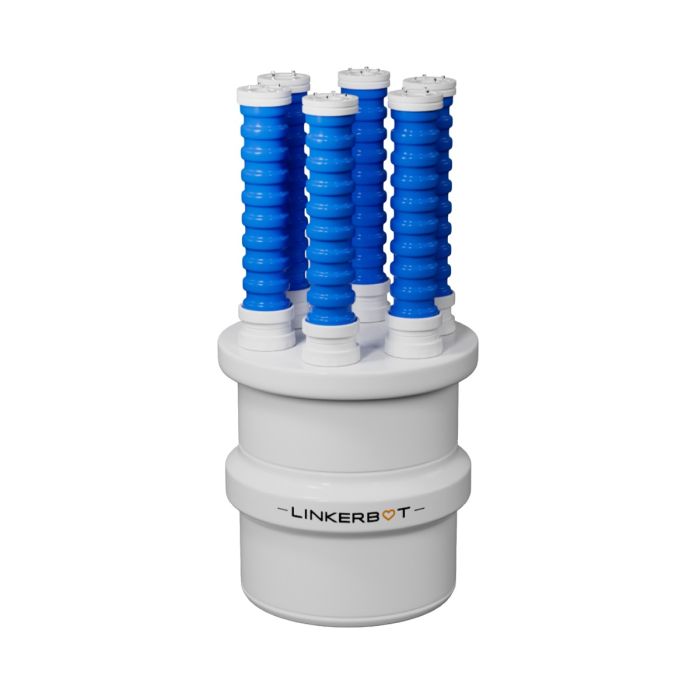
Linkerbot Linker Hand J42 Industrial Grade 6 Finger Claw
In stock
- BRAND:
- LINKERBOT
- PART #:
- Linker Hand J42
- ORIGIN:
- China
- AVAILABILITY:
- SUBJECT TO AVAILABILITY
- SKU:
- Linkerbot-Linker-Hand-J42
Linkerbot Linker Hand J42 Industrial Grade 6 Finger Claw
Linker Hand J42 Industrial Grade 6 Finger Claw (Linker Hand J42)
Within the broader Linker Hand product family, the J42 is positioned as the highest-degree-of-freedom configuration, described in third-party references as offering up to 42 degrees of freedom (DoF) and using a tendon (cable) drive approach. This places it in the category of high-dexterity “robot hands” that aim to approximate aspects of human hand function (multi-contact grasping, in-hand repositioning, and complex posture control), rather than simpler parallel-jaw grippers optimized for uniform parts.
Because commercialization of dexterous hands spans multiple configurations (sensor options, left/right variants, integration kits, and control electronics), published specifications often emphasize architecture and capabilities rather than a single universal bill of materials. As a result, integrators typically confirm details such as sensing modules, control stack, and interfaces at quotation or system-design time.
Design and Features
Six-finger industrial form factor
The J42 is commonly presented as a six-finger hand intended for robust grasping in industrial settings. A six-finger layout can increase contact redundancy compared with five-finger anthropomorphic hands, enabling stable enveloping grasps on irregular objects and providing additional constraints during manipulation (for example, when an object must be held while another finger performs a pushing or sliding action).
High-DoF dexterous architecture
A defining characteristic of the J42 is its high DoF count. One industry report summarizes the Linker Hand lineup and states that the J42 reaches “up to 42 active DoF” (i.e., a large number of independently actuated joints) among the series variants. High DoF hands are commonly used in research and advanced automation where the objective is not only “pick-and-place,” but also fine manipulation such as reorientation, tool use, button/lever interaction, or handling deformable items.
Tendon-driven (“cable-driven”) transmission
The same report describes the J42 as tendon-driven. In tendon-driven robotic hands, actuators (motors) pull cables routed through the hand to create joint motion. This architecture is often selected to:
-
keep distal fingers lighter (improving speed and reducing inertia),
-
support compliance and shock tolerance through cable elasticity and control,
-
enable dense joint packing when many joints are needed.
However, tendon-driven designs also introduce engineering tradeoffs (cable wear, tension calibration, routing friction, and maintenance), so industrial deployments typically prioritize serviceability and repeatable calibration procedures.
Technology and Specifications
Reported core identifiers
-
Product name: Linkerbot Linker Hand J42 Industrial Grade 6-Finger Claw
-
Part number: Linker Hand J42
-
Robot type: Hand (end effector)
-
Intended use: Industrial
Degrees of freedom and drive method (public references)
-
DoF: described as up to 42 for J42 within the Linker Hand family
-
Drive method: described as tendon (cable) driven for J42
-
Finger count: described as 6-finger (industrial claw)
Interfaces and robotics software integration
A third-party product overview of the Linker Hand series states that the family supports industrial communication interfaces including CAN, RS485, and USB, and mentions compatibility with ROS (Robot Operating System) workflows. While that source discusses the series broadly (not only J42), these interfaces are consistent with common integration patterns for robotic end effectors in humanoids, mobile manipulators, and fixed automation cells.
Sensor and control ecosystem (series-level positioning)
Public coverage around the Linker Hand ecosystem highlights an emphasis on multi-sensor perception for manipulation, including configurations referencing camera-based perception and “electronic skin” style tactile sensing for contact-rich interaction. Not all deployments include the same sensor stack; in practice, integrators typically validate sensor availability, sampling rates, data interfaces, and calibration tools as part of integration.
Applications and Use Cases
Industrial manipulation and flexible automation
High-DoF hands are often evaluated for flexible manufacturing and “mixed-SKU” environments where object geometry varies widely. A six-finger, high-DoF hand can be useful for tasks such as:
-
picking and reorienting irregular items,
-
stabilizing an object while adjusting its pose,
-
handling soft packaging without crushing (when tactile/force feedback is available),
-
manipulating controls, latches, or fixtures designed for human fingers.
Humanoid robots and mobile manipulation
In humanoid or mobile manipulation systems, a dexterous hand can extend capability beyond grippers—supporting two-handed coordination (bimanual tasks), human-tool interaction, and more natural task execution in human spaces. Series-level references explicitly position J42 as an industrial-oriented model within a lineup that spans education, research, and industrial use.
Research and embodied AI training
Dexterous hands are widely used to develop and benchmark manipulation learning methods (imitation learning, reinforcement learning, and hybrid control approaches), especially when tasks require contact reasoning. The Linker Hand series is discussed publicly in the context of advanced dexterous manipulation capabilities and sensor-rich configurations.
Advantages / Benefits
High dexterity for complex grasps
With up to 42 DoF described for the J42 configuration, the hand is positioned for fine-grained posture control and multi-point contact grasps that can improve stability and expand the range of object shapes that can be handled.
Tendon-driven architecture suited to dense jointing
The tendon-driven approach described for J42 can be advantageous when many joints must fit into a human-scale hand envelope, often enabling lighter distal structures and potentially smoother compliance during contact.
Series-level integration options
Series-level references highlight CAN/RS485/USB connectivity and ROS-oriented integration paths, which can reduce engineering friction when deploying into existing robotics stacks.
FAQ Section
What is the Linkerbot Linker Hand J42?
The Linkerbot Linker Hand J42 is an industrial-grade dexterous robotic hand sold as a 6-finger claw end effector (part number Linker Hand J42) designed for advanced grasping and manipulation applications.
How does the Linker Hand J42 work?
Public references describe the J42 as tendon (cable) driven and capable of up to 42 degrees of freedom, meaning many joints can be actuated for complex finger postures. In tendon-driven hands, motors pull routed cables to create coordinated finger motion for grasping and manipulation.
Why is the Linker Hand J42 important?
High-dexterity end effectors are important because they expand what robots can do beyond simple gripping—supporting irregular object handling, multi-contact stability, and manipulation tasks that resemble human hand use. The J42 is positioned within its series as the highest-DoF, industrial-oriented configuration.
What are the benefits of the Linker Hand J42?
Key publicly referenced benefits include a 6-finger layout, very high DoF (up to 42) for dexterous postures, and a tendon-driven architecture commonly used for dense joint designs. Series-level references also point to industrial connectivity options such as CAN/RS485/USB and ROS-oriented integration.
Summary
The Linkerbot Linker Hand J42 is an industrial-grade 6-finger dexterous robotic hand positioned for advanced grasping and manipulation. Public references describe it as a tendon-driven design with up to 42 degrees of freedom, aligning it with high-end manipulation applications in flexible automation, humanoid robotics, and research into contact-rich control. Series-level references also emphasize integration-friendly communications (e.g., CAN/RS485/USB) and ROS-oriented workflows, reflecting the practical requirements of deploying dexterous hands in real robotic systems.