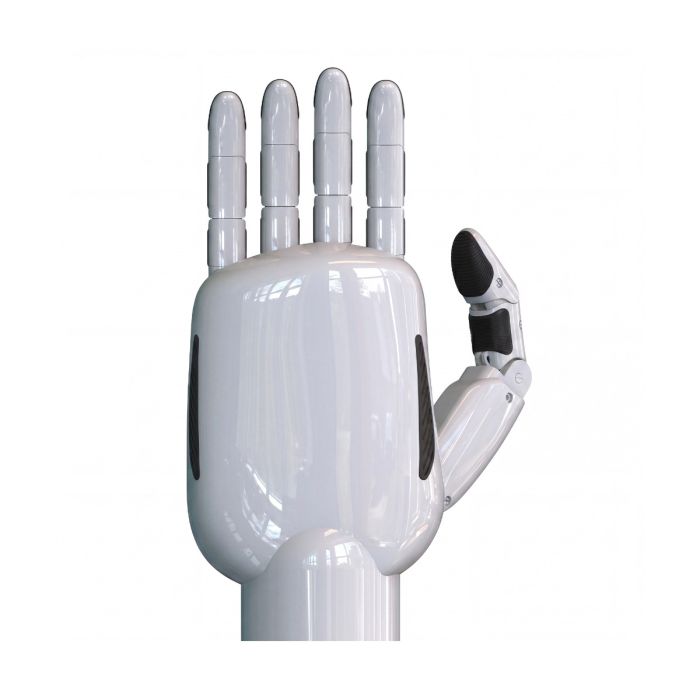
Linkerbot Linker Hand L20 Pro Version
In stock
- BRAND:
- LINKERBOT
- PART #:
- Linker Hand L20
- ORIGIN:
- China
- AVAILABILITY:
- SUBJECT TO AVAILABILITY
- SKU:
- Linkerbot-Linker-Hand-L20
Linkerbot Linker Hand L20 Pro Version
Linker Hand L20 Pro Version (Linker Hand L20)
The L20 family is positioned as a general-purpose end-effector for humanoid robots, collaborative robot arms (cobots), and lab automation rigs, emphasizing high degrees of freedom, linkage-based finger actuation, and software integration with ROS for rapid prototyping and embodied-AI experimentation.
In public materials, the L20 is described both by its total degrees of freedom (DoF) and by the number of actively actuated joints. For example, the World Robot Conference product entry highlights a linkage structure and 16 active DoF, while the official product manual explains that the L20’s motion model includes 16 active DoF plus passive DoF (for coupled or manually adjustable joints), aligning with the broader “high-DoF” positioning for dexterous manipulation.
Design and Features
Hand architecture and linkage drive
The L20 is a five-finger anthropomorphic hand that uses a linkage transmission method (as opposed to purely tendon/cable-driven routing) to couple certain joint motions and improve mechanical robustness. The product manual describes coupled linkages in the four-finger structure and thumb joints, enabling coordinated flexion patterns similar to common human grasp synergies.
Degrees of freedom
Across published sources, the L20 family is typically characterized as:
-
20 DoF (product manual / product overview framing)
-
16 active DoF + passive DoF (detailed motion model)
-
21 DoF (industry reporting for L20 variants, including general-purpose and industrial versions)
In practice, these descriptions are not mutually exclusive: “total DoF” may include passive or mechanically coupled joints, while “active DoF” counts only independently motor-driven axes. The L20 is therefore best understood as a high-dexterity hand with a mix of actively actuated joints and mechanically coupled/passive motion elements.
Sensor system (tactile, force, and optional vision)
A core differentiator of modern dexterous hands is multimodal sensing. The L20 manual and retail documentation describe configurations that can include:
-
Tactile sensing (including fingertip tactile sensors; some listings specify a tactile array)
-
Force sensing (including multi-axis force/torque sensing referenced in retail documentation)
-
Optional vision and visual-tactile perception, using fingertip/palm/wrist camera concepts in certain configurations
These sensing options are aimed at tasks such as delicate grasp stabilization, slip detection, contact-rich manipulation, and data collection for imitation learning and reinforcement learning workflows.
Technology and Specifications
Mechanical and physical parameters
Published specifications vary by configuration and by how payload is measured (e.g., payload at a given reach). Examples include:
-
Mass around ~1.0 kg for an aluminum-alloy housing configuration
-
Max payload values cited as 5 kg (at a specified reach) in one retail listing
-
Higher “maximum load” claims (e.g., 10 kg) appear in some reseller specifications, likely reflecting different test conditions or a different variant of the L20 line
Because dexterous-hand payload depends strongly on lever arm, grasp geometry, friction, and safety limits, payload figures are best interpreted alongside the vendor’s stated test setup (reach distance, grasp type, and duty cycle).
Communications and control interfaces
The L20 supports industrial-style communications for real-time control. The product manual states that versions support CAN bus debugging and EtherCAT, with integration approaches designed for ROS-based control stacks.
For developers, Linkerbot has also published a ROS-oriented SDK (archived on GitHub) that describes bringing up a CAN interface at 1,000,000 bps and launching a ROS package to control L10/L20 hands, reflecting a typical robotics workflow: bring up the bus, start a driver node, and publish joint targets / subscribe to state feedback.
Software ecosystem (ROS, demos, and development workflow)
The L20 product manual explicitly references compatibility with ROS and Qt applications, providing ROS plugins and support for secondary development (custom applications on top of the core driver).
The published ROS SDK repository further indicates support for:
-
Launching L10/L20 drivers via ROS launch files
-
State feedback (angles/radians) and command topics
-
Example tooling such as GUI control sliders and simulation hooks (e.g., PyBullet examples referenced in the SDK docs)
Applications and Use Cases
Research and embodied intelligence
The L20 is positioned for education and scientific research, where hands serve as data generators for grasping datasets, imitation learning demonstrations, and contact-rich manipulation benchmarking. The product manual explicitly lists education and research as target scenarios.
Industrial automation and flexible handling
Dexterous hands can complement traditional grippers when tasks require:
-
Picking irregular objects
-
Handling tools
-
Re-orienting parts in-hand
-
Performing light assembly steps (depending on force control and end-effector compliance)
Industry reporting also frames L20 variants (general-purpose and industrial versions) as capable of operating human tools, supporting broader industrial applicability.
Service robotics and assistive scenarios
The manual describes potential use in household assistance and health care / nursing, reflecting a common direction in humanoid and mobile-manipulator development: dexterous hands enabling object retrieval, handling daily objects, and safe interaction around people.
Advantages / Benefits
High dexterity with a linkage-based approach
Compared with simpler parallel-jaw grippers, the L20’s multi-finger design supports a wider set of grasp types (pinch, tripod, power grasps) and can enable limited in-hand manipulation. Linkage coupling can also reduce complexity in certain motion patterns while maintaining practical dexterity.
Sensor-rich manipulation for modern robotics
Tactile/force (and optional vision) sensing supports closed-loop behaviors such as grip adjustment, slip correction, and contact-aware placement—capabilities increasingly important in embodied AI and real-world robotics deployments.
Integration with robotics middleware
Support for ROS-based control and published SDK materials can reduce integration time for labs and system integrators, especially when pairing hands with common robot arms and humanoid platforms.
FAQ Section
What is the Linkerbot Linker Hand L20 Pro Version?
It is a dexterous robotic hand (L20 family) designed for humanoids and robot arms, featuring multi-finger grasping, linkage-based actuation, and sensor options for contact-rich manipulation.
How does the Linker Hand L20 work?
The L20 uses a linkage transmission mechanism and motor-driven joints to coordinate finger motion, while tactile/force (and optional vision) sensing supports closed-loop grasping and manipulation behaviors.
Why is the Linker Hand L20 important?
Dexterous hands like the L20 help robots move beyond simple gripping into tool use, delicate handling, and data-driven learning, which are key capabilities in embodied AI and advanced automation.
What are the benefits of the Linker Hand L20 Pro Version?
Common benefits include high dexterity, sensor-rich manipulation, and ROS-friendly integration, which can reduce development time for research and applied robotics projects that require human-like grasping.
Summary
The Linkerbot Linker Hand L20 Pro Version (L20 Pro) is a high-dexterity robotic hand emphasizing linkage-driven anthropomorphic grasping, sensor-enabled manipulation, and ROS-oriented integration. Its combination of active and passive/coupled degrees of freedom, multi-sensor options, and industrial communications (CAN/EtherCAT in documented configurations) positions it as a practical dexterous end-effector for research labs and advanced automation efforts.