
Unitree Go2 Self-Charging Board (GO2-SCHARGB)
In stock
- BRAND:
- UNITREE ROBOTICS
- PART #:
- GO2-SCHARGB
- ORIGIN:
- China
- AVAILABILITY:
- SUBJECT TO AVAILABILITY
- SKU:
- Unitree-GO2-SCHARGB
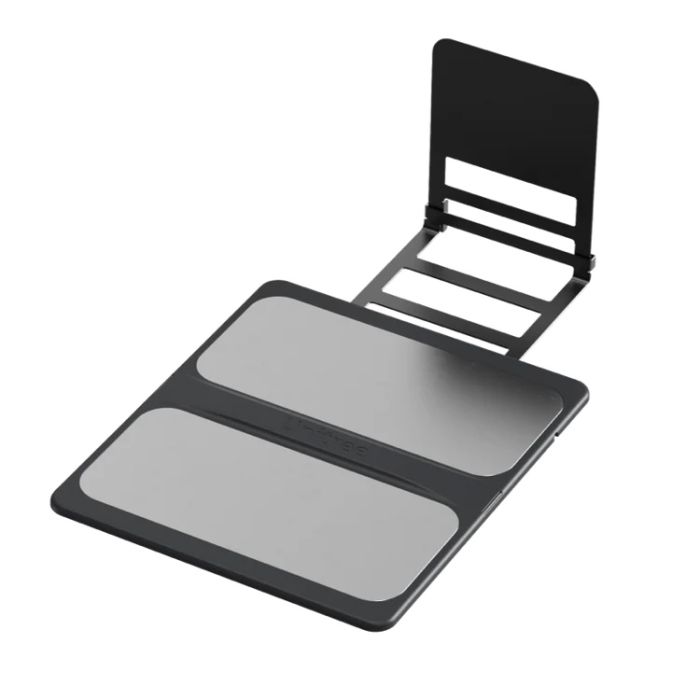
Go2 Self-Charging Board Go2 Series Products (Go2-Schargb) (GO2-SCHARGB)
Within the Go2 accessory ecosystem, the GO2-SCHARGB is typically positioned as a higher-level autonomy and uptime accessory, intended to support longer deployments and reduced manual battery handling. Multiple suppliers describe the self-charging board as an upgrade accessory—particularly tied to Go2 EDU Plus configurations—so that the robot can complete longer development, patrol, or research sessions with fewer interruptions.
Unlike handheld chargers that connect directly to a removable battery pack, the GO2-SCHARGB is best understood as a charging “station” or “board” that acts as a physical docking target—supporting workflows where the robot returns to a known location to recharge.
Design and Features
Lay-down contact charging concept
A defining characteristic of the GO2-SCHARGB is its contact charging method. Instead of plugging a cable into the robot or removing the battery for bench charging, the Go2 can dock by laying down on the board, where charging begins via contact interfaces. This method is explicitly described in retailer technical listings as a “lay-down dock” charging type.
This form factor is frequently used in robotics deployments because it:
-
reduces repetitive battery removal/installation
-
supports more continuous operation cycles
-
enables predictable charging behavior in a fixed location
-
can be integrated into patrol routes or lab workflows
High-power charging performance
Product listings consistently describe the GO2-SCHARGB charging output as:
-
Charging voltage: 33.6V
-
Charging current: up to 9A
These figures are notable because 33.6V is commonly associated with the charge limit for Go2 battery packs, and 9A indicates a relatively high charging current for rapid replenishment (similar in current level to the Go2 fast charger category used for battery charging).
Intended for Go2 EDU / EDU Plus charging workflows
Several suppliers explicitly state the self-charging board is meant to be used together with specific Go2 variants, including:
-
Go2 EDU Plus (Mid-360 LiDAR)
-
Go2 EDU Plus (XT16 LiDAR)
This positioning is important for buyers because Unitree’s Go2 family includes multiple models and configurations (AIR/PRO/X/EDU variants). Compatibility and accessory support can vary depending on the version and sensor/compute package.
Environmental suitability guidance
Retail technical pages frequently publish environment and storage constraints for the GO2-SCHARGB, including:
-
Operating temperature: 5°C to 40°C
-
Storage temperature: 22°C to 28°C
-
Relative humidity: ≤95%
While these ranges are not unusual for electronics intended for indoor or controlled outdoor use, they are particularly relevant for field deployment planning—especially in humid environments or locations where temperatures fluctuate beyond standard operating ranges.
Technology and Specifications
Electrical charging specifications
Across multiple independent reseller technical listings, the GO2-SCHARGB is described with the following electrical properties:
-
Charging voltage: 33.6V
-
Charging current: up to 9A
These values align closely with the Go2 ecosystem’s fast-charge current class (9A), which is also referenced in Go2 charging documentation for rapid charging equipment.
Docking / charging method
Technical listings describe the station as a contact-based “lay-down dock,” meaning the robot charges when it physically contacts the board in the correct position.
Environmental specifications
Commonly published values include:
-
Working environment temperature: 5°C–40°C
-
Storage temperature: 22°C–28°C
-
Relative humidity: ≤95%
Compatibility notes
Multiple listings state that the self-charging board is intended to be used specifically with Go2 EDU models, and in some cases it is explicitly tied to Go2 EDU Plus LiDAR configurations.
Applications and Use Cases
Continuous robotics lab operation and battery automation
In research labs and education programs, the GO2-SCHARGB supports a more automated workflow: rather than stopping an experiment to remove the battery, operators can incorporate a “return-to-base” routine in their process. This can be particularly helpful for:
-
autonomous navigation assignments
-
repeated mapping and perception experiments
-
long-duration data collection sessions
-
multi-classroom scheduling where the robot needs predictable charge windows
Patrol demonstrations and semi-autonomous recharging
The self-charging board is commonly associated with patrol-style scenarios where the robot performs a route and returns to a known location to recharge. Even in low-autonomy settings, it can reduce operational friction by making charging a repeatable placement rather than a manual plug-and-charge cycle.
Reducing manual battery handling in training environments
Frequent battery swaps can introduce wear, connector stress, or simple workflow delays—especially in environments where many users take turns with the same robot. The GO2-SCHARGB can reduce the frequency of manual interventions and simplify operation for:
-
training centers
-
public demos
-
multi-operator labs
Support for long-duration “charging infrastructure” deployments
For organizations exploring persistent robotics deployments—such as recurring inspection routines or periodic monitoring tasks—the self-charging board functions as a foundational piece of charging infrastructure, similar in concept to robotic vacuum docking stations but adapted for a quadruped platform.
Advantages / Benefits
Improved uptime and reduced operational interruptions
The largest operational advantage is less downtime. When charging becomes a docking routine, the robot can spend less time offline during busy schedules, and staff spend less time managing cables and battery packs.
Higher charging power capability
With commonly listed 33.6V / up to 9A charging performance, the GO2-SCHARGB is positioned for rapid charging behavior, supporting more frequent return-to-service cycles.
Consistent, repeatable charging alignment
Docking boards support structured workflows where charging happens in one predictable physical location. This can simplify:
-
robot staging and storage
-
daily lab setup
-
charging compliance and monitoring
-
demonstrations with “always-ready” positioning
Integration suitability for Go2 EDU development stacks
Compatibility listings tied to Go2 EDU/EDU Plus variants suggest the board is intended for development-oriented configurations.
This is relevant for teams who want a “full ecosystem” approach (robot + sensors + dev tools + charging base) rather than only handheld charging accessories.
FAQ Section
What is the Unitree Go2 Self-Charging Board (GO2-SCHARGB)?
The Unitree Go2 Self-Charging Board (GO2-SCHARGB) is a contact charging base that allows a Unitree Go2 robot to recharge by laying down on a docking board, enabling more automated charging workflows.
How does the Go2 Self-Charging Board work?
The robot positions itself onto the board and charging begins via contact docking (often described as a “lay-down dock”). The board is commonly specified at 33.6V charging voltage with up to 9A charging current.
Why is the Go2 Self-Charging Board important?
It helps reduce downtime and manual battery handling by turning charging into a docking routine, supporting longer demos, continuous lab schedules, and patrol-style workflows.
What are the benefits of the Go2 Self-Charging Board?
Key benefits include repeatable dock-and-charge operation, higher-current charging capability (up to 9A), reduced manual battery swapping, and suitability for scheduled deployments and robotics research environments.
Summary
The Unitree Go2 Self-Charging Board (GO2-SCHARGB) is a Go2 charging accessory designed for contact-based lay-down docking, enabling more automated recharging routines for the Unitree Go2 platform. With commonly listed charging performance of 33.6V and up to 9A, plus published operating constraints (e.g., 5°C–40°C operating temperature and ≤95% relative humidity), it is positioned as an uptime-focused accessory—especially associated with Go2 EDU/EDU Plus deployment scenarios. For labs, education programs, and pilot deployments that prioritize reduced downtime and consistent charging infrastructure, the GO2-SCHARGB provides a practical foundation for repeatable robot operations.
Specifications
| PART # | GO2-SCHARGB |
|---|---|
| BRAND | UNITREE ROBOTICS |
What's included
Related Products
Out of stock