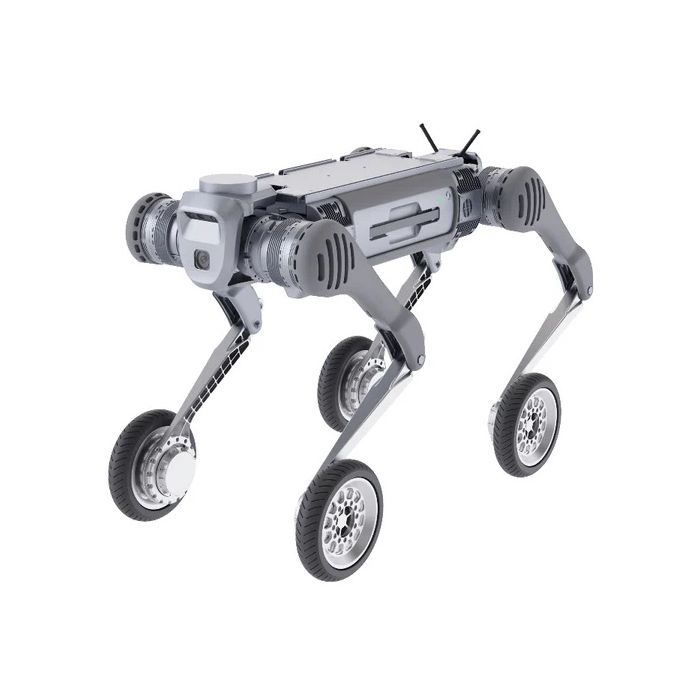
Unitree B2-W (B2W-ROBOT)
In stock
- BRAND:
- UNITREE ROBOTICS
- PART #:
- B2W-ROBOT
- ORIGIN:
- China
- AVAILABILITY:
- SUBJECT TO AVAILABILITY
- SKU:
- Unitree-B2W-ROBOT
B2-W B2 Series Products (B2W-Robot) (B2W-ROBOT)
This hybrid “wheels + legs” approach is intended to improve long-range mobility, operational efficiency, and deployment flexibility in industrial and field robotics applications.
On Unitree’s official product page, B2-W is described as a high-efficiency model designed to “go further,” and is positioned as part of Unitree’s industry robot lineup alongside platforms such as the B2 and B1.
B2-W is typically discussed in the context of inspection, security, logistics support, and industrial automation, where robots must travel across mixed terrain (warehouse floors, gravel paths, slopes, outdoor routes) while maintaining the ability to climb or step over obstacles that would stop a purely wheeled platform.
Design and Features
Hybrid “wheels + legs” mobility
The defining feature of the B2-W is its wheeled-quadruped architecture—a four-legged robot equipped with integrated wheels on the feet. In many use cases, the wheels enable efficient travel on relatively smooth surfaces, while the legs preserve the ability to handle uneven terrain, steps, and obstacles.
Unitree’s official B2-W page highlights the platform’s focus on higher efficiency and longer travel capability, reinforcing the product’s positioning as a long-range industrial mobility solution rather than a purely agility-focused quadruped.
Industrial load capability
Unitree’s published specifications indicate that B2-W supports:
-
Maximum load (standing): 120 kg
-
Walking load: >40 kg
This places the robot in a category suited to real-world industrial payloads such as mounted sensor kits, inspection equipment, communications modules, and task-specific tooling.
Large-format battery and endurance design
The B2-W includes a high-capacity power system intended for extended travel. Unitree lists:
-
Battery capacity: >2 kWh
-
Voltage: 58 V
The platform is marketed around “go further” endurance behavior, and its published range capability supports that emphasis (see Endurance below).
Dimensions, weight, and transport profile
Unitree provides approximate physical dimensions in two configurations:
-
Size (standing): ~1098 × 550 × 758 mm
-
Size (lying prone): ~950 × 550 × 450 mm
The official published weight is:
-
~85 kg total weight (battery included)
These figures help frame B2-W as a full-size industrial quadruped—substantially larger than compact consumer-class robot dogs—optimized for durability and payload support.
Technology and Specifications
Mobility and speed
B2-W is designed for high-speed travel relative to many industrial legged robots. Unitree lists:
-
Top speed: 15 km/h
Its wheel configuration is supported by a published wheel size reference:
-
Wheel diameter: 225 mm
This emphasizes the platform’s ability to move efficiently across large facilities, corridors, roads, and mixed outdoor surfaces.
Endurance and range
Unitree’s endurance specification highlights two major conditions:
-
Maximum endurance of 25 km with a 40 kg load
-
Maximum endurance without load: ~30 km
These figures position B2-W as a long-range mobile robotics system for continuous inspection routes or extended patrol coverage, where a typical leg-only gait might consume more energy over distance.
Payload limits
Unitree lists two different payload metrics:
-
Maximum load (standing): 120 kg
-
Load (walking): >40 kg
In industrial robotics terms, this means the robot can support heavier static loads at rest, while maintaining a large “sustained” payload capacity for movement-based tasks.
Relationship to Unitree B2 industrial platform
B2-W is often understood as a wheeled extension of Unitree’s B2 industrial quadruped family. The B2 product documentation (in Unitree’s China-language overview) emphasizes B2’s industrial-grade performance, including >6 m/s maximum running speed, ~360 N·m joint torque, high payload and strong terrain capability, and IP67 protection rating in its published spec summary.
While B2 and B2-W are not identical, the published materials suggest B2-W inherits the “industrial deployment” focus and payload class, with the primary distinction being the wheeled-foot mobility strategy for extended travel efficiency.
Applications and Use Cases
Industrial inspection and asset monitoring
B2-W’s long-range capability supports facility inspection rounds, particularly in environments where operators need a robot to travel far distances while carrying sensor payloads. Typical inspection roles include:
-
perimeter checks around large industrial sites,
-
pipeline or infrastructure observation routes,
-
equipment monitoring and data capture across a campus-scale area.
Unitree’s broader B2 messaging highlights industrial inspection use cases such as power inspection and industrial detection scenarios, aligning with the general application category B2-W targets.
Security patrol and autonomous site coverage
Wheeled-quadruped mobility can be useful for patrol-style tasks where the robot must cover large regions quickly, stop to observe specific points of interest, then continue along its route. The hybrid design is especially relevant for mixed terrain environments such as outdoor pathways, gravel surfaces, and transitions between indoor and outdoor spaces.
Logistics support and payload transport
With a >40 kg walking payload capability, B2-W can be configured for payload delivery or tool transport, including carrying:
-
inspection toolkits,
-
radios and relay nodes,
-
survey equipment,
-
specialized sensors.
The standing payload rating (120 kg) also supports heavy topside integration in stationary or staged positions.
Robotics research, testing, and industrial R&D
B2-W is also relevant to research teams working on:
-
hybrid locomotion control (rolling + stepping),
-
long-range autonomy planning,
-
industrial navigation and mapping,
-
field robotics perception and teleoperation experiments.
Because Unitree positions the B2 family for industrial use, these platforms are often evaluated by robotics teams who want a deployable base that can carry meaningful payloads and operate over long routes.
Advantages / Benefits
Higher travel efficiency over distance
The primary advantage of B2-W’s wheeled design is efficiency. For long routes, rolling can reduce energy consumption compared to pure legged walking, which aligns with the official published endurance numbers up to 30 km without load.
Strong payload capability for real industrial tasks
With 120 kg standing and >40 kg walking payload ratings, B2-W supports heavier sensor payloads and tool modules than many smaller quadruped robots, making it more suitable for industrial deployments.
Fast industrial mobility
The official 15 km/h top speed specification places B2-W among high-mobility industrial robots, where speed can directly translate into higher inspection throughput and faster incident response capability.
Multi-terrain deployment flexibility
By keeping legged articulation while adding wheels, B2-W can potentially handle routes that mix smooth corridors and uneven surfaces—an important advantage for industrial campuses and outdoor facilities where ground conditions vary throughout a single mission.
FAQ Section
What is Unitree B2-W (B2W-ROBOT)?
Unitree B2-W is an industrial wheeled-quadruped robot that combines legged locomotion with wheeled travel for longer range and higher efficiency.
How does Unitree B2-W work?
B2-W uses a hybrid mobility concept: it can drive using its wheel-equipped feet for efficient movement on suitable surfaces while maintaining quadruped leg articulation for stability and obstacle-handling.
Why is Unitree B2-W important?
It addresses a common limitation of legged robots—energy cost over long distances—by adding wheels, while preserving the terrain flexibility of a quadruped. Unitree’s published endurance figures reach ~30 km without load.
What are the benefits of Unitree B2-W?
Key benefits include 15 km/h top speed, long-range endurance (up to 30 km without load), and high payload support (120 kg standing, >40 kg walking) for industrial tasks.
Summary
Unitree B2-W (B2W-ROBOT) is a high-end industrial robot that combines quadruped locomotion with wheel-enabled travel to increase efficiency and range in real deployments. With published specifications including 15 km/h top speed, >2 kWh (58 V) battery capacity, endurance up to 25 km with a 40 kg load (and ~30 km without load), and payload ratings of 120 kg standing and >40 kg walking, the B2-W is positioned for long-distance inspection, patrol, and industrial automation tasks where conventional leg-only mobility may be less efficient.
Specifications
| PART # | B2W-ROBOT |
|---|---|
| BRAND | UNITREE ROBOTICS |
What's included
Related Products