
Realman Robotics Single Arm Compound Robot (RMC-SA)
In stock
- BRAND:
- REALMAN
- PART #:
- RMC-SA
- AVAILABILITY:
- SUBJECT TO AVAILABILITY
- SKU:
- Realman Robotics-RMC-SA
Realman Robotics Single Arm Compound Robot (RMC-SA)
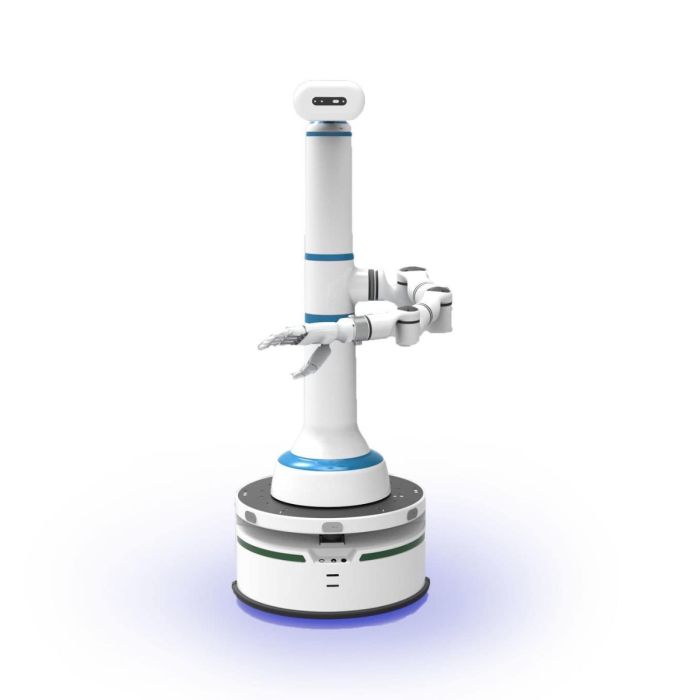
Single Arm Compound Robot (RMC-SA)
Within RealMan’s product taxonomy, “compound robot” refers to integrated systems that go beyond a standalone arm—typically combining mobility, sensing, and interaction modules so the robot can move through an environment and physically act on it. RealMan positions these compound platforms for high-complexity, high-precision environments, emphasizing mobility, autonomy, and cooperation (coordinated operation with sensors, tools, and workflow logic).
Design and Features
Integrated mobile base + single-arm architecture
RMC-SA is designed as an “all-in-one” platform that integrates the mobile chassis, robotic arm, and supporting compute/interfaces. This integrated design is described as space-saving and convenient for deployment and maintenance, reflecting a common goal of mobile manipulators: reducing the integration burden compared with separately purchasing an AMR and then engineering a custom arm mount, power distribution, and safety stack.
Navigation and autonomy stack
RealMan’s RMC-SA materials describe capabilities typically associated with indoor autonomy—mapping, navigation, and path planning—paired with perception (vision recognition) so that the robot can localize itself and plan movements while also supporting manipulation-related perception pipelines.
In practice, these functions enable workflows such as moving to a station, detecting objects or fiducials, and then executing a manipulation routine with the arm.
Safety-oriented sensing and stop functions
A key theme in published specifications for RMC-SA is a layered protection stack. The platform is described as supporting laser scanning obstacle avoidance, visual obstacle avoidance, force sensors, and an emergency stop function.
These features are common prerequisites for operating in mixed indoor spaces where people, carts, and other equipment may be present, although real-world safety still depends on system configuration, speed limits, and a formal risk assessment.
Open software framework and development orientation
RealMan’s product overview emphasizes that RMC-SA provides rich control cases and an open software framework, positioning it for users who want to implement or experiment with algorithms, rather than only deploying a fixed-function appliance.
This orientation aligns with typical R&D and education use cases where teams need access to navigation, motion planning, and perception pipelines for customization.
Technology and Specifications
Platform specifications (published)
Publicly available datasheets and catalogs provide a consistent set of platform-level specifications for RMC-SA:
-
Platform size: Height 1360 mm, maximum arm span (reach envelope) 1040 mm.
-
Weight: approximately 72 kg.
-
Operating voltage: DC 24 V.
-
Charging power supply: single-phase three-wire ~220 V ±10% 50 Hz.
-
Positioning accuracy (navigation): < ±5 cm.
-
Maximum speed: 1 m/s.
-
External interfaces: Ethernet (network), USB, HDMI.
-
Working environment: references include −10°C to +40°C, humidity ≤85% (25°C), altitude <4000 m.
-
System software reference: catalogs note Ubuntu 18.04.
-
Audio/interaction reference: a 4-microphone linear array is listed in one RealMan catalog document.
Functional specification framing
Rather than focusing only on mechanical numbers, RealMan’s RMC-SA overview describes the platform as capable of supporting the major software blocks required for mobile manipulation: navigation and mapping, arm motion planning, and perception/recognition.
This framing matters because compound robots often succeed or fail based on the maturity of their software stack as much as their chassis or arm hardware.
Applications and Use Cases
Mobile manipulation in structured indoor environments
RMC-SA is well-suited to “structured” indoor environments—labs, warehouses, stores, and manufacturing spaces—where the robot can map corridors, approach stations, and perform tasks within a defined workspace. RealMan’s materials explicitly emphasize autonomy functions (mapping, navigation, planning) alongside arm kinematics and vision recognition, suggesting the platform’s intended role as a general-purpose mobile manipulator.
Research, education, and algorithm development
Because RealMan highlights an open framework and “rich control cases,” RMC-SA is frequently positioned as a platform for teams who want to implement or evaluate algorithms such as SLAM (mapping), local planning, trajectory generation, and vision-driven grasping.
This emphasis also aligns with listings that treat the system as a “platform” rather than a single-purpose product.
Handling, inspection support, and service-style automation
Directories describe the robot in handling-oriented categories (i.e., moving and positioning objects) and present it as a mobile unit that can be configured to suit different application scenarios.
In practice, many RMC-SA-style robots are deployed for tasks such as sample or part delivery, basic picking/placement, and station-to-station assistance, where mobility provides the flexibility to serve multiple locations.
Advantages / Benefits
One system for “navigate + manipulate”
The central advantage of RMC-SA is integration: autonomy functions plus a single manipulator in one platform. For teams building a mobile manipulation proof-of-concept, an integrated compound robot can reduce engineering overhead compared with assembling an AMR, an arm, and a custom controller stack from scratch. RealMan’s own description of an integrated design supports this intended benefit.
Layered safety features for shared environments
Published specifications list obstacle avoidance via laser scanning and vision, plus force sensing and emergency stop capability. These features are commonly necessary for operating in spaces where humans and machines coexist, particularly during pilot deployments and demonstrations.
Developer-friendly positioning
RealMan repeatedly emphasizes open software and example control cases, aligning RMC-SA with innovation teams that need to adapt behaviors to different sites or integrate the robot into custom workflows.
FAQ Section
What is the Realman Robotics Single Arm Compound Robot (RMC-SA)?
The RMC-SA is a single-arm mobile manipulation robot that integrates a mobile base with a robotic arm, designed to support mapping/navigation, path planning, motion/trajectory planning, and vision recognition within one platform.
How does the RMC-SA work?
RMC-SA navigates using mapping and planning functions, avoids obstacles using a sensor-based protection stack (laser scanning and vision obstacle avoidance), and performs tasks by executing arm trajectories informed by kinematics/dynamics planning and vision recognition pipelines.
Why is the RMC-SA important?
Single-arm compound robots are important because they enable “go-to-the-work” automation—combining mobility and manipulation so one robot can serve multiple stations. RealMan’s RMC-SA materials emphasize an open framework intended to accelerate development across different scenarios.
What are the benefits of the RMC-SA?
Published benefits include an integrated design, support for autonomy and perception algorithms, and safety/protection features such as laser and visual obstacle avoidance, force sensors, and emergency stop—along with standard interfaces (Ethernet/USB/HDMI) for integration.
Summary
The Realman Robotics Single Arm Compound Robot (RMC-SA) is a mobile manipulator designed to unify autonomous navigation and single-arm manipulation in one integrated platform. With published specifications such as 1360 mm platform height, 1040 mm arm span, ~72 kg weight, DC 24 V operation, <±5 cm positioning accuracy, 1 m/s speed, and a safety stack that includes laser/visual obstacle avoidance, force sensing, and emergency stop, it is positioned for research, education, and practical indoor automation prototypes where mobility and adaptable manipulation are essential