
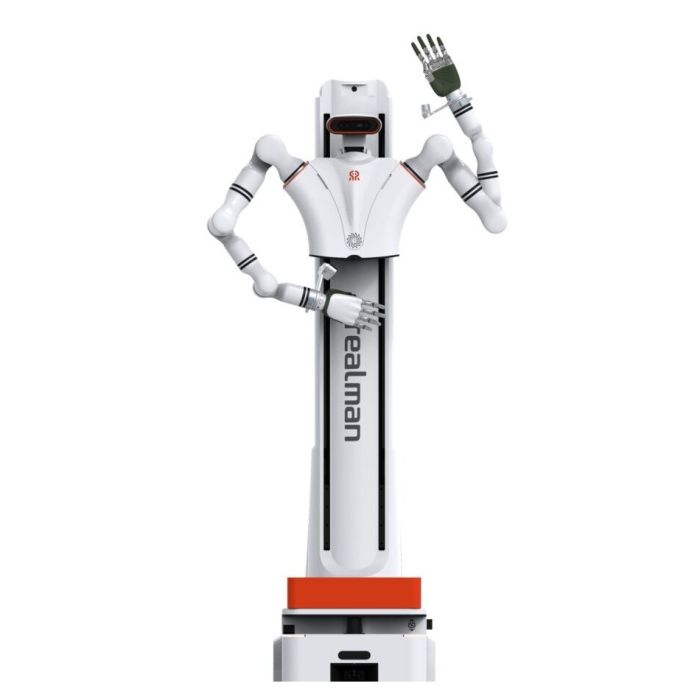
Realman Robotics Dual Arm Embodied AI Development Platform (DAP-D-65)
In stock
- BRAND:
- REALMAN
- PART #:
- DAP-D-65
- AVAILABILITY:
- SUBJECT TO AVAILABILITY
- SKU:
- Realman Robotics-DAP-D-65
Realman Robotics Dual Arm Embodied AI Development Platform (DAP-D-65)
Dual Arm Embodied AI Development Platform (DAP-D-65)
RealMan describes its dual-arm embodied intelligence development platform as a data-collection device for large embodied models, reporting that with imitation learning plus static-data training, “50 task demonstrations” can raise task success to up to 90% (as presented in RealMan’s product/news materials).
Design and Features
Dual-arm teleoperation and demonstration capture
A central design goal of DAP-D-65-class platforms is capturing high-quality demonstrations. RealMan’s user documentation describes a master–slave approach in which an operator can guide “master” arms while the “slave” arms follow, enabling synchronized bimanual manipulation and structured dataset capture for learning-based control.
RealMan’s event communication describes a “standard configuration” that includes dual main arms for operation, a passive secondary arm, and global + local cameras for object recognition and localized viewpoints.
Integrated sensing for embodied AI workflows
RealMan’s platform documentation and product parameters consistently emphasize multi-camera sensing. In the dual-arm development platform materials, RealMan specifies Intel RealSense D435 depth cameras used for both global monitoring and close-range task perception.
In the user manual, RealMan notes the D435 can provide both depth and color images, with an effective range listed as 0.11 m to 10 m, supporting everyday manipulation scenes and visual learning experiments.
Modular, education-friendly system structure
RealMan’s user manual frames the platform as a combined teaching + research system: it supports virtual simulation and real-scene experiments for robotics curricula (e.g., robot operating systems and kinematics), and it is positioned for lab development and application prototyping.
Technology and Specifications
Standard configuration (published)
On RealMan’s official product page for the dual-arm embodied development platform, the standard configuration includes: servo master arms ×2, RM65-B-V ×2, D435 cameras ×3, grippers ×2, and a fixed bracket ×1.
Master arm parameters (teleoperation side)
RealMan’s product parameters for the master arm include: 599 mm operating radius, 0.088° angle resolution, 6 DOF per arm (12 DOF for the pair), ~1.5 kg weight (with fixture), “zero-force drag”, and 110 RPM max operating speed. The same page lists adjustable gravity compensation and a photoelectric auto-sensing handheld start/stop interaction.
Slave arm parameters (RM65-B-V class)
On the official parameters page, the slave arm is listed with 626 mm operating radius, 5 kg rated payload, ~7.2 kg arm net weight, ±0.05 mm repeatability, DC 24 V supply, 0–45°C operating temperature, and communications via Ethernet/Wi-Fi/RS485 plus 4-channel reusable digital I/O.
RealMan’s user manual for the dual-arm platform describes the RM65-B-V as an integrated controller arm concept (controller integrated into the base), and in that manual the RM65-B-V weight is described as 7.6 kg with 5 kg payload, 626 mm arm span, and ±0.05 mm repeatability—indicating that published specs can vary slightly by version or documentation revision.
System interfaces and development stack
RealMan’s platform documentation lists external connectivity including network ports, USB, Wi-Fi, and RS485, with secondary-development interfaces spanning C/C++, C#, Python, MATLAB, ROS, and JSON-based integration paths.
Applications and Use Cases
Embodied AI dataset creation for dual-arm manipulation
DAP-D-65 is fundamentally aimed at collecting demonstration data for training and evaluating large embodied models and imitation-learning pipelines. RealMan’s descriptions explicitly reference imitation learning with a relatively small number of task demonstrations (e.g., 50) combined with static data training to improve success rates, reflecting the platform’s “data-first” design intent.
Robotics research and experimentation
RealMan’s user manual positions the platform as suitable for laboratories and research institutes working on bimanual coordination, visual servoing, end-to-end policy learning, and human-in-the-loop robotics. The documentation highlights both standalone arm operation and teleoperation modes, supporting experimentation across different control paradigms.
The platform is also framed as an instructional system for university-level training in robot kinematics, trajectory planning, vision recognition, and robot operating systems. RealMan’s manual describes the platform as supporting practical training, course design, and capstone projects, aligning with “embodied intelligence” curricula and research-based teaching.
Prototype development for service and industrial scenarios
RealMan’s documentation and product pages describe potential application domains spanning industrial, service, office, and healthcare contexts, largely as target environments for dual-arm manipulation and data-driven autonomy development.
Advantages / Benefits
Purpose-built for imitation learning and “large model” workflows
Unlike general-purpose cobots that focus on deterministic industrial routines, DAP-D-65-class systems are presented as data-collection platforms—with teleoperation, multi-view perception, and development interfaces designed to accelerate embodied AI iteration.
Bimanual capability for richer task coverage
Dual-arm systems can represent human-like two-handed behaviors (holding + manipulating, handovers, coordinated alignment), expanding the scope of datasets beyond typical single-arm pick-and-place. RealMan’s materials explicitly emphasize the wider application potential of dual-arm robots versus single-arm systems in both industrial and service settings.
Developer-oriented openness
RealMan emphasizes multiple secondary-development options and common robotics software stacks (including ROS), enabling teams to integrate custom perception pipelines, policy learners, and evaluation harnesses without being constrained to a single proprietary toolchain.
FAQ Section
What is the Realman Robotics Dual Arm Embodied AI Development Platform (DAP-D-65)?
DAP-D-65 is a RealMan dual-arm embodied AI development platform designed for teleoperation, data collection, and imitation-learning research, typically built around RM65-class arms and multi-camera perception.
How does the DAP-D-65 work?
The platform supports master–slave bimanual control for demonstrations, records robot and vision data, and enables developers to use that dataset for training embodied AI policies (including imitation learning). RealMan describes workflows using a small number of demonstrations plus static data training to improve task success.
Why is the DAP-D-65 important?
Embodied AI systems depend on high-quality, task-relevant data. RealMan positions its dual-arm platform as a purpose-built device for collecting such data for “large embodied models,” supporting more realistic two-handed behaviors than many single-arm setups.
What are the benefits of the DAP-D-65?
Published benefits include dual-arm operation, multi-view depth sensing (e.g., D435 modules), and developer interfaces (C/C++/Python/ROS and related options), making it suitable for embodied AI experiments, education, and rapid prototyping.
Summary
The Realman Robotics Dual Arm Embodied AI Development Platform (DAP-D-65) is a dual-arm, dataset-oriented robotics system positioned for embodied AI—combining bimanual manipulation, multi-camera depth perception, and developer-friendly interfaces to support teleoperation-driven demonstration capture and imitation-learning research. With published configurations including RM65-B-V-class arms, D435 depth cameras, 5 kg payload per slave arm, and ±0.05 mm repeatability, it targets labs and innovators building robust two-handed skills for real-world manipulation scenarios.