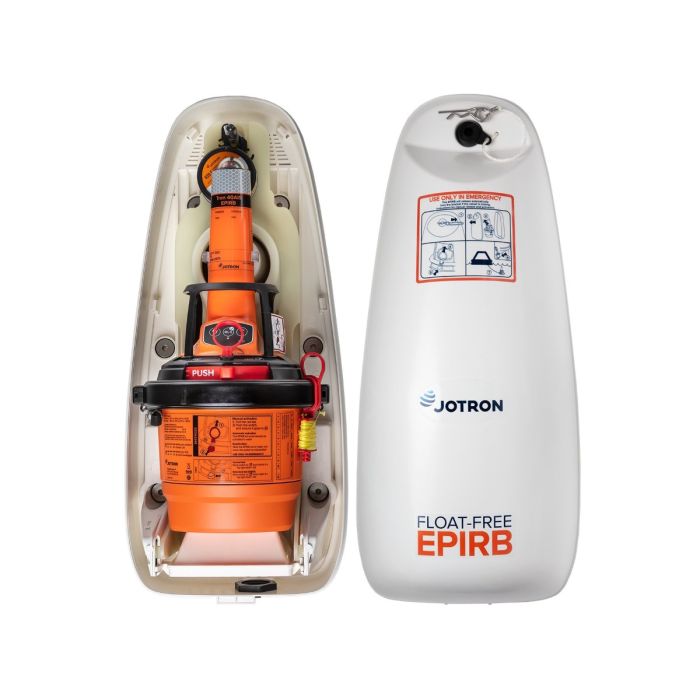
Jotron Tron 40AIS (103220)
In stock
- PART #:
- 103220
- AVAILABILITY:
- SUBJECT TO AVAILABILITY
- SKU:
- Jotron-103220
Jotron Tron 40AIS (103220)
In Jotron’s Tron EPIRB portfolio, Tron 40AIS is positioned as a “technologically advanced” EPIRB aligned with the latest EPIRB performance standard (IEC 61097-2 Ed.4) and the IMO regulatory updates that became mandatory in the 2022 timeframe.
Design and Features
Float-free bracket architecture (Part Number 103220)
The Tron 40AIS is offered in multiple mounting configurations, and 103220 specifically refers to the unit with a float-free bracket. Jotron also lists a float-free heating bracket variant (103210), intended for installations where additional anti-icing/temperature support is required.
A float-free EPIRB installation is designed so that the beacon can release from its bracket and begin emergency transmissions without manual handling, improving survivability in rapid-onset emergencies.
AIS homing for faster local localization
A defining feature of the Tron 40AIS is AIS homing technology, which broadcasts the beacon’s location to nearby AIS-equipped vessels and SAR units, allowing responders in the vicinity to home in faster than satellite-only workflows in many practical scenarios. Jotron promotes AIS homing as a key factor in “faster localization.”
RLS readiness via Galileo
Tron 40AIS is described as prepared for Return Link Service (RLS) through Galileo GNSS, a capability that can provide an acknowledgment back to the beacon (via the satellite system) that the distress alert has been received by the SAR system.
IR LED for night-vision assisted SAR
The product includes an IR LED intended to support detection with night-vision devices and to assist SAR operations in low-light conditions.
Simple manual and water activation logic
In addition to float-free release, the user manual describes manual operation and activation procedures and notes how transmissions can be stopped (e.g., removing from water and switching to the middle position), reinforcing its design for emergency-only activation with clear user controls.
Technology and Specifications
Distress alerting and homing layers
Tron 40AIS is built around the standard multi-layer EPIRB concept:
-
406 MHz Cospas-Sarsat distress alerting for global satellite detection (core EPIRB function).
-
AIS transmission for local homing and rapid nearby localization.
-
Additional homing/location support referenced in Jotron’s brochure feature list, alongside AIS and satellite alerting, consistent with modern EPIRB designs.
GNSS positioning (multi-constellation)
Jotron’s brochure describes an advanced GNSS capability (“72 channels GNSS”) and references Galileo as part of the RLS pathway. In operational terms, GNSS provides accurate beacon coordinates embedded in the distress message, improving SAR routing and reducing search area.
Compliance with IEC 61097-2 Ed.4 (April 2021)
Jotron states the Tron 40AIS has been tested against IEC 61097-2 Ed.4, the EPIRB performance standard that underpins the “latest EPIRB standard” claim. This matters for regulated carriage and type-approval pathways (e.g., MED/MER and other regional approvals).
Safety documentation for transport and materials
Jotron publishes Product Safety Information documents for Tron 40AIS (including 103210 and 103220), supporting safe handling, shipping, and regulatory compliance in logistics chains.
Documentation and conformity declarations
Jotron provides formal declarations and documentation packs for Tron 40AIS, including recent Declarations of Conformity that explicitly enumerate 103220 as “Tron 40AIS with float free bracket.”
Applications and Use Cases
SOLAS/GMDSS carriage on commercial vessels
Tron 40AIS is designed for regulated maritime safety environments where EPIRBs are required or strongly recommended, such as SOLAS-class commercial vessels, offshore support fleets, and passenger craft operating under stringent safety regimes. Its emphasis on IEC 61097-2 Ed.4 and IMO-aligned updates reflects this target market.
Faster “last-mile” recovery in SAR operations
AIS homing is particularly relevant when SAR assets or nearby vessels are already within VHF/AIS reception distance, enabling rapid on-scene convergence after the initial satellite alert has been raised. This can be valuable in busy sea lanes, coastal waters, and areas with dense commercial traffic.
Night operations and reduced-visibility conditions
The IR LED feature is aimed at real-world recovery conditions where visual spotting is difficult (night, haze, adverse weather). When SAR units use night-vision aids, IR visibility can provide an additional detection channel beyond strobe-only approaches.
Cold-weather and high-latitude installations
Jotron’s availability of a float-free heating bracket variant in the same product family suggests use in colder climates where ice, snow, or low temperatures can affect bracket release reliability or operational readiness.
Advantages / Benefits
Multi-layer localization stack improves practical rescue outcomes
Tron 40AIS integrates several complementary location methods—satellite distress alerting, GNSS position, AIS homing, and IR support—so responders can (a) detect the distress globally and (b) localize more quickly as they approach the search area.
Standards-driven design for compliance-heavy fleets
Compliance with IEC 61097-2 Ed.4 and alignment with “latest EPIRB standard” expectations make the product a fit for operators prioritizing regulatory clarity and documented conformity pathways.
Float-free bracket simplifies emergency activation
The 103220 configuration’s float-free bracket is designed to automate release and activation in scenarios where crew cannot manually deploy the EPIRB—particularly relevant in sudden flooding, capsize, or rapid abandonment situations.
FAQ Section
What is Jotron Tron 40AIS (103220)?
Jotron Tron 40AIS (103220) is a float-free EPIRB supplied with a float-free bracket, designed for GMDSS/SOLAS maritime safety and enhanced with AIS homing, GNSS positioning, and RLS readiness.
How does Jotron Tron 40AIS work?
It transmits a 406 MHz Cospas-Sarsat distress alert (with GNSS position data when available) and also broadcasts AIS homing messages to help nearby vessels and SAR teams locate it more quickly. It is also prepared for Galileo Return Link Service (RLS).
Why is Jotron Tron 40AIS important?
It combines global satellite distress alerting with “last-mile” localization aids like AIS homing and IR support, and it is tested to the latest EPIRB standard (IEC 61097-2 Ed.4)—a combination aimed at improving rescue efficiency and regulatory alignment.
What are the benefits of Jotron Tron 40AIS?
Key benefits include AIS homing for faster localization, RLS readiness, IR LED support for night SAR, and compliance with the latest EPIRB performance standard.
What is the difference between 103220 and 103210?
103220 is Tron 40AIS with a float-free bracket, while 103210 is Tron 40AIS with a float-free heating bracket option intended for colder/icing-prone conditions.
Summary
The Jotron Tron 40AIS (103220) is a float-free, standards-aligned EPIRB designed for modern maritime safety operations. By combining 406 MHz Cospas-Sarsat distress alerting, GNSS positioning, AIS homing, Galileo RLS readiness, and an IR LED for night-vision assisted SAR—within a float-free bracket installation—Tron 40AIS is positioned to improve both the detection and localization stages of rescue while supporting compliance with the latest EPIRB performance expectations.
Specifications
| PART # | 103220 |
|---|