
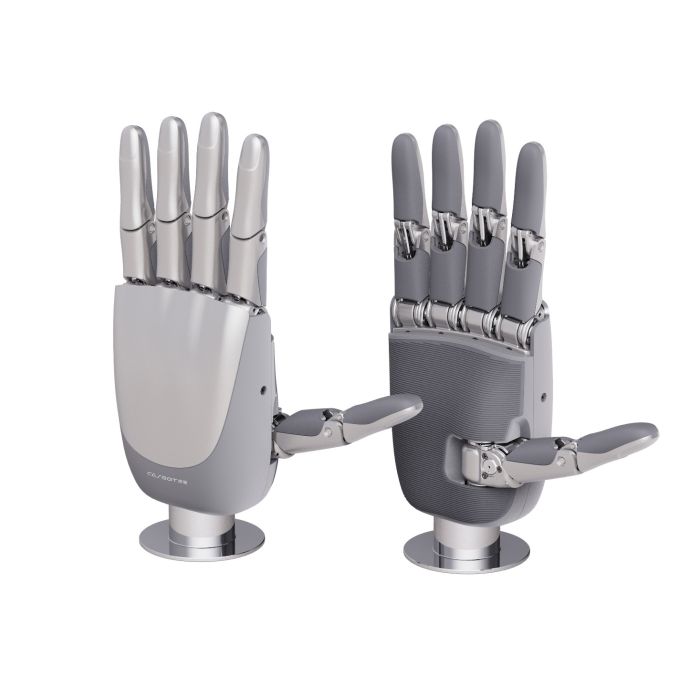
Casbot Handle L1 Dexterous Robotic Hand (Handle L1)
In stock
- BRAND:
- CASBOT
- PART #:
- Handle L1
- ORIGIN:
- China
- AVAILABILITY:
- SUBJECT TO AVAILABILITY
- SKU:
- Casbot-Handle-L1
Casbot Handle L1 Dexterous Robotic Hand (Handle L1)
The Handle-L1 has been showcased in major robotics exhibition contexts, including China’s World Robot Conference (WRC), where it has been described as a five-finger lightweight dexterous hand that complements humanoid robot bodies by enabling flexible, human-style interaction with objects and environments.
Design and Features
Five-finger anthropomorphic layout
Dexterous hands aim to approximate the functional versatility of the human hand by using multiple fingers to achieve stable grasps (force closure), precision pinches, and controlled repositioning. In this class of end-effector, design goals often include a compact palm, compliant contact surfaces, and coordinated finger motion to handle objects of varied shapes.
Handle-L1 is described as a five-finger dexterous hand intended for humanoid platforms and embodied operation, emphasizing “adaptive grasping and execution capabilities” along with multi-dimensional sensing.
Lightweight, integrated end-effector
A recurring theme in Handle-L1 coverage is compactness and integration—the hand is presented as a tightly packaged system that integrates actuation, transmission, sensing, and control. One published report describing Casbot’s five-finger dexterous hand architecture highlights a highly compact configuration and an “integrated” design approach combining drive, transmission, sensing, and control.
Multi-modal perception for manipulation
In-hand and contact-rich manipulation typically benefits from sensing beyond joint position alone—especially when objects vary in texture, weight distribution, or slipperiness. Handle-L1 is promoted as supporting multi-dimensional perception, and reporting on Casbot’s dexterous-hand approach highlights a multi-source perception scheme that includes tactile, force, and vision cues to improve grasp stability and task adaptability.
Technology and Specifications
Core capabilities (as publicly described)
Publicly available descriptions frame Handle-L1 as:
-
A five-finger dexterous hand for humanoids and embodied operation platforms
-
Designed for adaptive grasping and “execution” (task performance)
-
Highly integrated, lightweight, and intended to be easy to deploy
Published weight and rated load (reported)
A widely circulated report describing Casbot’s five-finger dexterous hand states:
-
Single-hand weight: ~800 g
-
Rated payload: ~5 kg
Embodied AI and learning-centric manipulation context
Dexterous hands are frequently used in research on learning-based manipulation (e.g., reinforcement learning, imitation learning, and hybrid planning) because they expose rich control and contact dynamics. This broader research context includes well-known demonstrations of learned in-hand manipulation on multi-finger robot hands.
Applications and Use Cases
Humanoid robots and embodied operation platforms
Handle-L1 is explicitly positioned for humanoid robots and embodied operation—systems designed to perceive, decide, and act in the physical world through interaction. Typical tasks include:
-
Picking and placing objects of varied geometry
-
Handling everyday tools and props used in demos or service scenarios
-
Contact-rich manipulation where tactile/force cues improve reliability
Research, education, and prototyping
Dexterous hands are commonly deployed in laboratories and universities because they enable experiments in:
-
Grasp planning and grasp stability evaluation
-
Slip detection, force control, and tactile exploration
-
Learning policies that generalize across objects
Demonstrations, media, and public engagement
Coverage of WRC exhibitions highlights robots performing interactive demos and task showcases, where dexterous hands serve as the visible “skill endpoint” for grasping and manipulation. Handle-L1 has been referenced in WRC-related reporting as part of this product showcase ecosystem.
Advantages / Benefits
Human-scale manipulation potential
A five-finger hand can, in principle, use many human-designed objects and tools more naturally than simpler grippers especially when combined with tactile and force cues. This is one reason dexterous hands remain central to long-term humanoid roadmaps.
Lightweight payload-to-mass positioning (reported)
If the reported ~800 g / ~5 kg figures reflect the deployed configuration, the implied positioning is a lightweight end-effector with a meaningful rated load, which can be beneficial for humanoid arms where total distal mass affects balance, energy use, and motion smoothness.
Integration and deployment emphasis
Product listings and descriptions repeatedly emphasize integration, reliability, and ease of deployment, suggesting a target audience that includes integrators and teams that want a ready-to-integrate dexterous hand rather than a purely experimental prototype.
FAQ
What is the Casbot Handle L1 Dexterous Robotic Hand?
The Casbot Handle L1 is a five-finger dexterous robotic hand designed for humanoid robots and embodied operation platforms, promoted for adaptive grasping and multi-dimensional perception.
How does the Handle L1 work?
Handle-L1 functions as an end-effector that coordinates finger actuation with sensing and control to grasp and manipulate objects. Public descriptions emphasize multi-modal perception (including tactile/force/vision in Casbot’s dexterous-hand approach) to support stable grasping and adaptable execution.
Why is a dexterous robotic hand important for humanoid robots?
Hands enable humanoids to interact with the world using the same “interfaces” humans rely on—tools, handles, buttons, and household objects. Dexterity (especially with tactile feedback) is widely considered one of the key barriers to general-purpose robotics and practical humanoid deployment.
What are the benefits of the Handle L1?
Commonly cited benefits include five-finger dexterity, multi-dimensional perception, and an emphasis on integration, reliability, lightweight design, and ease of deployment for embodied operation systems. A published report also describes a configuration with ~800 g single-hand weight and ~5 kg rated payload.
Summary
Casbot Handle L1 (Handle-L1) is presented as a lightweight, integrated five-finger dexterous robotic hand for humanoid and embodied AI platforms, emphasizing adaptive grasping and multi-modal perception. With public reporting indicating a ~800 g hand weight and ~5 kg rated payload in a Casbot five-finger dexterous-hand configuration, it represents an emerging class of end-effectors aimed at making real-world manipulation more practical for next-generation robots.
Specifications
| PART # | Handle L1 |
|---|---|
| ROBOT TYPE | HAND |
| BRAND | CASBOT |