
Casbot W1 Wheeled Humanoid Robot (W1)
In stock
- BRAND:
- CASBOT
- PART #:
- W1
- ORIGIN:
- China
- AVAILABILITY:
- SUBJECT TO AVAILABILITY
- SKU:
- Casbot-W1
Casbot W1 Wheeled Humanoid Robot (W1)
Casbot W1 Wheeled Humanoid Robot (W1)
Within the broader CASBOT product ecosystem, W1 is positioned as a platform for embodied AI: systems that connect perception (vision + sensors), planning (AI models), and physical action (manipulation + mobility). Coverage of CASBOT’s event demonstrations and competitions also links W1 to scenarios such as material handling, sorting, scanning, and labeling, reflecting an emphasis on logistics and light industrial automation.
Design and Features
Physical design
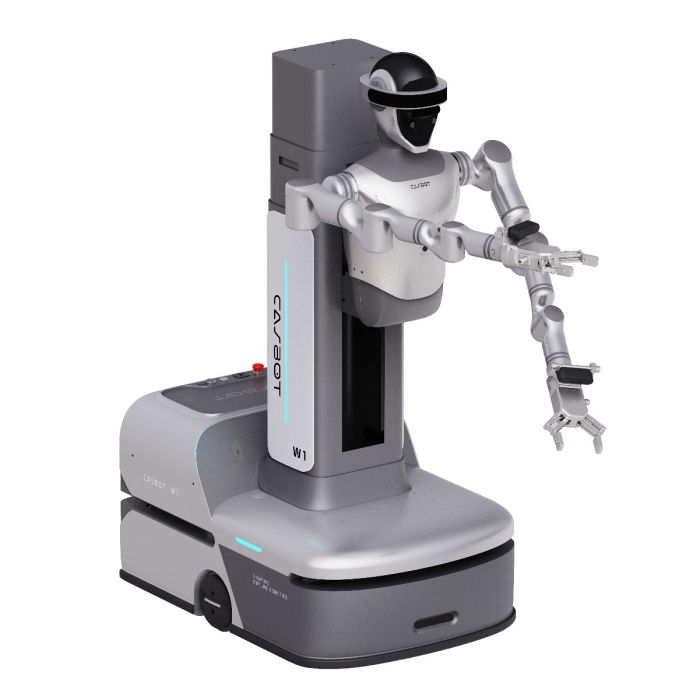
A defining element of the W1 concept is its wheeled mobile base paired with a height-adjustable (multi-level) lifting mechanism, allowing the robot to align its arms and end effectors with different work surfaces, bins, or shelves. This architecture is commonly used to reduce energy consumption and simplify stability compared with full bipedal locomotion, while still enabling “humanoid-style” interactions above the waist.
Manipulation system
Multiple reports describe W1 as using two arms with 7 degrees of freedom (DoF) each, enabling a wide workspace and more human-like reach and orientation control for grasping and placement.
Chinese coverage further highlights sub-millimeter-level operational precision as a key performance goal for industrial manipulation tasks.
Human–robot interaction
W1 is presented as a robot intended to accept high-level task instructions and convert them into actionable steps (e.g., “pick, take, place, organize”), aligning with current trends toward natural-language tasking and agent-style interfaces in robotics.
Technology and Specifications
Perception and sensor suite
A frequently cited capability of W1 is multi-sensor perception for robust operation in cluttered, dynamic environments. A competition recap describing W1 lists components such as RGB-D cameras, 3D tactile sensors, 6-axis force sensors, LiDAR, and an IMU, intended to support both environmental understanding and contact-rich manipulation.
Onboard computing and “embodied brain”
Public materials and reporting commonly describe W1 as equipped with high-performance NVIDIA computing hardware for running perception and embodied AI algorithms.
In addition, Chinese coverage references a CASBOT “embodied brain” system (often described as CASBOT Embodied Brain 2.0) and a proprietary model described as a VLA model (vision-language-action style approach), positioning W1 as a platform where AI models translate multimodal inputs and instructions into robot actions.
Motion and navigation
While detailed navigation specs are not always published in brief press coverage, the combination of LiDAR + IMU commonly supports mapping/localization and stable motion on a wheeled base. In practice, wheeled humanoid robots are typically deployed on structured indoor floors (warehouses, retail backrooms, production corridors), where reliable localization and obstacle avoidance are achievable without the complexity of legged locomotion.
Applications and Use Cases
Warehouse and intralogistics
W1 is frequently framed around tasks such as sorting, handling, and transferring items—work that sits between traditional AMRs (which move bins) and fixed automation (which manipulates in one place). In a competition setting, W1 was described as completing sequences that included moving items, sorting, scanning, and labeling, which resemble common warehouse and kitting workflows.
Industrial and light manufacturing support
In industrial contexts, W1’s dual-arm design is typically suited to materials staging, line-side replenishment, bin picking in constrained stations, and basic assembly-adjacent handling (moving parts to/from fixtures). The emphasis on higher precision operation is often connected to these task families.
Commercial operations and shelf organization
Press coverage has also linked W1 to commercial tasks such as shelf organization and backroom operations, where a robot must navigate narrow aisles and handle a wide variety of packaged goods.
Advantages / Benefits
Practical mobility with lower complexity than bipedal robots
A wheeled platform can be simpler to deploy and maintain than bipedal locomotion in many indoor settings. By keeping stable ground contact and shifting complexity to manipulation and perception, a wheeled humanoid design can prioritize throughput and reliability for repetitive operational tasks.
Dual-arm versatility
Two arms can support bimanual handling (steadying + grasping), handoffs between grippers, and more flexible item placement—especially when paired with force/tactile sensing and higher precision targets.
Embodied AI workflow potential
The positioning of W1 around VLA-style modeling and an “embodied brain” reflects a broader industry push: reducing the integration burden by moving from low-level programming to higher-level task descriptions and generalized skills.
FAQ
What is CASBOT W1?
CASBOT W1 is a wheeled humanoid-style robot with a mobile base, a height-adjustable structure, and dual multi-DoF arms, designed for embodied AI tasks such as handling, sorting, and operational assistance in industrial and commercial settings.
How does CASBOT W1 work?
W1 combines multi-sensor perception (commonly described as RGB-D vision, LiDAR, IMU, and force/tactile sensing) with onboard compute to interpret the environment and execute manipulation behaviors through its arms and end effectors. Its lifting mechanism helps align the arms to different working heights.
Why are wheeled humanoid robots important?
They address a key gap in automation: many facilities can already move goods with AMRs, but still rely on people to pick, place, sort, and organize items. Wheeled humanoid robots aim to bring manipulation into mobile workflows, potentially improving efficiency where full bipedal robots are unnecessary.
What are the benefits of CASBOT W1?
Commonly cited benefits include dual-arm versatility, precision handling targets (including claims of sub-millimeter operational precision), and a wheeled architecture that can simplify deployment in structured indoor environments while supporting embodied AI workflows.
Summary
CASBOT W1 is a wheeled, dual-arm humanoid robot platform aimed at practical embodied intelligence tasks in warehouses, light industry, and commercial operations. Its combination of a mobile base, multi-level lift, multi-sensor perception, and AI-oriented control stack positions it as a bridge between transport-only AMRs and more complex bipedal humanoids—optimized for real facilities where reliable navigation and high-precision handling matter most.