
BWSENSING Cost-Effective Digital Dual-Axis Inclinometer (BWM466)
In stock
- BRAND:
- BWSENSING
- PART #:
- BWM466
- ORIGIN:
- China
- AVAILABILITY:
- SUBJECT TO AVAILABILITY
- SKU:
- BWSENSING-BWM466
BWSENSING Cost-Effective Digital Dual-Axis Inclinometer (BWM466)
The BWM466 series is described as a MEMS-based inclinometer with optional RS485 or TTL digital outputs, aimed at balancing measurement performance with affordability for volume deployments.
BWSENSING (Wuxi Bewis Sensing Technology LLC) presents itself as a China-based sensing manufacturer and notes company background including establishment in 2010 and later branding milestones, which helps contextualize the product family within a broader portfolio of industrial orientation and motion sensors.
Design and Features
Compact “module-style” form factor
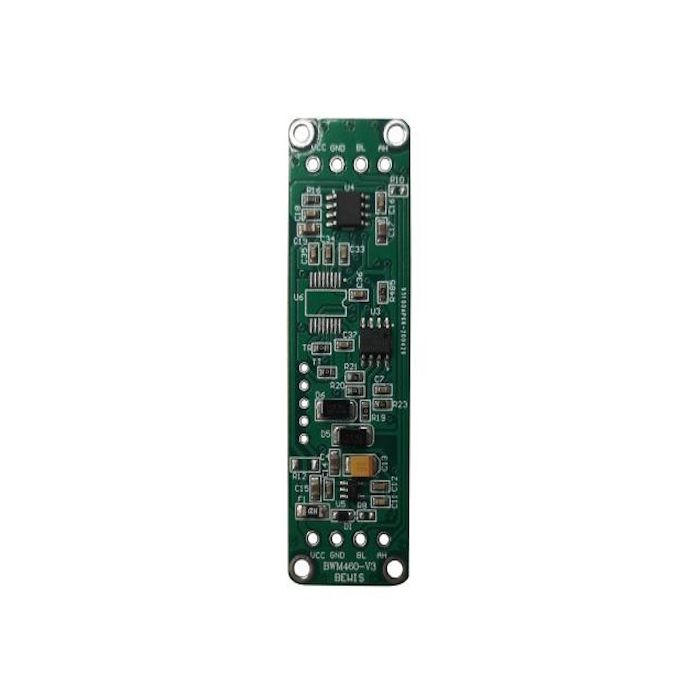
A defining characteristic of the BWM466 is its small physical footprint. The product documentation lists a 73 × 20 × 8 mm size, which supports installation in tight spaces such as control cabinets, machine frames, monitoring nodes, or embedded instrumentation.
Dual-axis measurement
Dual-axis inclinometers measure tilt in two directions (commonly labeled X and Y) to capture both pitch and roll. This is useful in real-world installations where a structure or platform can shift on more than one axis—such as construction equipment booms, small platforms, solar tracking systems, or geotechnical monitoring points.
Digital output options (RS485 / TTL)
The BWM466 is offered with RS485 and TTL output options, which can be selected depending on system needs (long cable runs and noise immunity vs. direct microcontroller interfacing). This flexibility is highlighted directly in the product’s documentation.
Technology and Specifications
Sensing principle (MEMS inclinometer)
The BWM466 is described as MEMS-based, using micro-electromechanical sensing elements that infer inclination by measuring the gravity vector. In practical terms, the sensor converts orientation changes into digital angle outputs, allowing a controller or monitoring platform to log trends, trigger alarms, or drive corrective actions.
Measurement ranges (series variants)
Product documentation describes multiple range variants within the BWM466 series, including ±5°, ±30°, and ±60° configurations (commonly denoted by suffixes such as BWM466-5, BWM466-30, and BWM466-60).
Performance (accuracy, resolution, data rate)
The published specification table for the BWM466 family includes quantitative performance parameters such as resolution and a listed response frequency (data update rate), along with accuracy figures that vary by range class and conditions. These values are documented as part of the model’s specification set and are typically used by system designers to choose a range/accuracy trade-off suitable for the application.
Electrical characteristics and environmental ratings
The BWM466 documentation specifies a 9–35 V supply range and lists additional environmental and robustness parameters including operating temperature ranges and vibration/shock tolerances (as presented in the product’s specification table).
Mechanical integration notes
The mechanical characteristics page lists the compact dimensions and indicates a “bare board” protection level in the documentation, implying the module may be intended for integration into an enclosure or host device rather than used as a fully sealed standalone sensor.
Communications and protocol behavior
For digital integration, the documentation describes a serial communications approach (including default serial parameters and frame conventions) used to transmit angle data over the supported interfaces. In the protocol description, parameters such as baud rate and message framing are presented for host-side implementation.
Applications and Use Cases
BWM466-class dual-axis digital inclinometers are commonly deployed anywhere tilt is a safety-critical or performance-critical measurement. Typical use cases include:
-
Construction and heavy equipment: monitoring chassis tilt, boom angle, or platform leveling to improve safety interlocks and operator feedback.
-
Civil engineering and infrastructure monitoring: detecting gradual shifts in retaining walls, slopes, bridges, or temporary supports; often used as part of broader condition monitoring.
-
Industrial automation and machine alignment: verifying fixture alignment, gantry leveling, or machine frame tilt during installation and maintenance.
-
Energy and outdoor systems: platform leveling for field equipment, small trackers, or remote monitoring stations (especially when paired with telemetry).
Advantages / Benefits
Cost-effective dual-axis digital tilt measurement
A core value proposition is delivering dual-axis inclination measurements in a compact digital module, with multiple range variants that can be selected for either fine-tilt monitoring (e.g., ±5°) or wider-angle measurement (e.g., ±60°).
Flexible integration via RS485 or TTL
Support for both RS485 and TTL enables the BWM466 to fit different architectures—from longer-distance industrial networks (RS485) to embedded controller designs (TTL).
Space-efficient mechanical footprint
The small size supports embedded or retrofitted installations where larger enclosures or bulky industrial tiltmeters are impractical.
FAQ Section
What is the BWSENSING BWM466?
The BWM466 is a digital, dual-axis MEMS inclinometer designed to measure tilt angles on two axes, offered with RS485 or TTL output options for industrial and embedded integrations.
How does the BWM466 work?
Like many MEMS inclinometers, the BWM466 estimates inclination by measuring the direction of gravity relative to its sensing axes, then outputs computed angles digitally over its selected interface.
Why is a dual-axis inclinometer important?
Dual-axis measurement matters when an object can tilt in more than one direction. It supports more complete monitoring (e.g., pitch and roll), improves safety logic for equipment, and provides better diagnostics for structural or platform movement than a single-axis sensor.
What are the benefits of the BWM466?
Key benefits include compact size, dual-axis digital tilt output, and interface flexibility (RS485/TTL), making it suitable for embedded monitoring and industrial measurement systems.
Summary
The BWSENSING BWM466 is a compact, cost-oriented dual-axis digital inclinometer built around MEMS sensing, offered in multiple tilt ranges (±5°/±30°/±60°) and with RS485 or TTL digital output options. Its small module format and documented serial protocol make it well suited for OEM embedding, industrial automation, and monitoring deployments where reliable tilt measurement and straightforward digital integration are priorities.
Specifications
| PART # | BWM466 |
|---|---|
| BRAND | BWSENSING |