
BWSENSING Low Cost Dual-Axis Digital Output With Modbus Inclinometer (BWL327S)
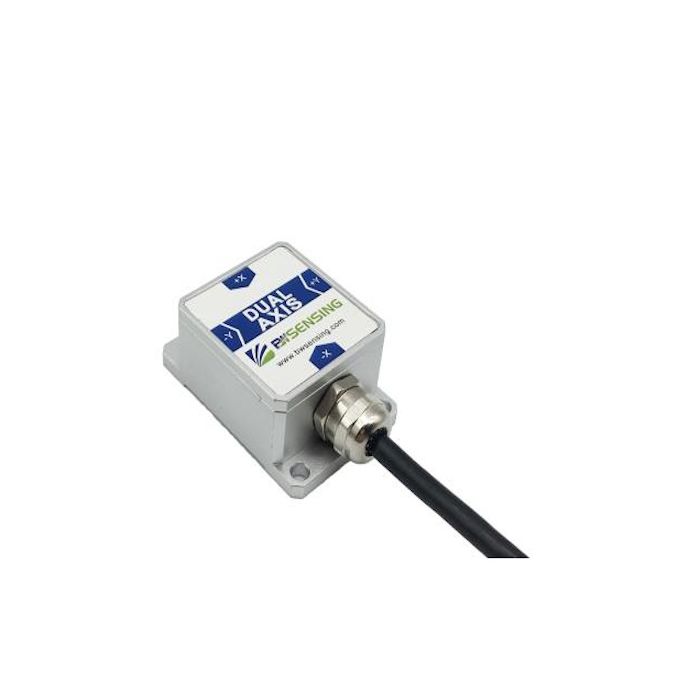
In stock
- BRAND:
- BWSENSING
- PART #:
- BWL327S
- ORIGIN:
- China
- AVAILABILITY:
- SUBJECT TO AVAILABILITY
- SKU:
- BWSENSING-BWL327S
BWSENSING Low Cost Dual-Axis Digital Output With Modbus Inclinometer (BWL327S)
Positioned as a Modbus-output inclinometer, the device converts changes in the static gravity vector into X- and Y-axis inclination angles and reports those measurements over a serial interface commonly deployed in automation and monitoring systems.
In practical deployments, the BWL327S is used as an industrial tilt sensor for applications such as photovoltaic (solar) tracking, tower and mast inclination monitoring, industrial leveling, and equipment orientation feedback—particularly in systems that favor RS-485 / Modbus RTU style networking for multi-drop communication and long cable runs.
Design and Features
Industrial MEMS sensing core
The BWL327S is built around an industrial-grade MEMS accelerometer. In static conditions, gravity provides a constant reference vector; the sensor estimates tilt by measuring how gravity projects onto the device’s measurement axes and converting that into angular values for each axis.
Rugged enclosure and installation approach
BWSENSING describes the packaged unit as small and lightweight for constrained installations. The product is available as a sealed, field-ready assembly with an IP67 protection level, intended to withstand dust ingress and temporary water immersion in real-world environments.
Mechanically, the device supports mounting via M4 screws, and correct installation is emphasized to reduce error from uneven surfaces, misalignment, or vibration-related effects.
Key functional features
Commonly highlighted features include:
-
Dual-axis tilt measurement for X/Y orientation monitoring
-
Resolution down to 0.01° under stable conditions
-
Wide operating temperature range suitable for outdoor/industrial settings (−40°C to +85°C)
-
Anti-interference characteristics associated with industrial digital interfaces
Technology and Specifications
Measurement performance
The BWL327S supports a ±90° measuring range and reports tilt on mutually perpendicular X-Y axes.
Accuracy depends on the measurement range window. The technical manual lists:
-
±10°, ±30°, ±60°: accuracy up to 0.1° (room temperature)
-
±90°: accuracy up to 0.2° (room temperature)
Other performance characteristics include:
-
Resolution: 0.01° (when completely still)
-
Cross-axis error: up to 0.1°–0.2° across −40°C to +85°C (depending on range)
-
Start-up time: < 50 ms
-
Output frequency: 5–100 Hz adjustable (up to 100 Hz)
-
MTBF: ≥ 90,000 hours
-
Impact resistance: 2000 g, 0.5 ms, 3 times/axis
Electrical and interface specifications
The BWL327S is specified for:
-
Supply voltage: 9–36 V DC
-
Operating current: typical 20–40 mA (no load)
-
Communication / output options: RS485 / RS232 / TTL variants are listed, with Modbus positioning in the manual (commonly implemented as Modbus RTU over RS-485 in industrial setups).
Mechanical specifications
The technical manual provides:
-
Product size: 55 × 37 × 24 mm (packaged)
-
Weight: approximately 210 g (without outer packaging)
-
Protection level: IP67
Applications and Use Cases
Solar tracking and renewable energy
One of the most common applications for a dual-axis inclinometer with digital bus output is photovoltaic automatic tracking, where the tilt sensor provides feedback for actuator control or for verifying alignment over time.
Tower, mast, and structure monitoring
The BWL327S is presented as suitable for tower tilt monitoring and similar structure applications. In these contexts, the inclinometer can be installed on a mast/column to measure gradual lean, sudden shifts, or drift—often logged through a Modbus-capable monitoring unit.
Industrial leveling and automation
The device is also used for industrial automatic leveling (e.g., machine platforms, lifting equipment, and angle-controlled mechanisms). Digital output supports integration with automation controllers and allows centralized reading of multiple sensors on a shared serial bus.
Heavy equipment, drilling, and field machinery
The manual lists applications including oil drilling equipment, lifting equipment inclination control, and other industrial instruments—use cases where vibration, shock, and outdoor exposure can be significant.
Advantages / Benefits
Modbus-oriented integration
A Modbus/serial inclinometer can simplify system integration in environments already standardized on PLCs and industrial gateways. Typical benefits include:
-
Multi-drop wiring (especially with RS-485)
-
Centralized polling and timestamped logging
-
Reduced analog noise sensitivity compared with voltage/current outputs (implementation-dependent)
Balance of performance and cost
BWSENSING frames the BWL327S as low cost while still offering 0.01° resolution and up to 0.1° accuracy in smaller measurement windows. This makes it a practical choice for volume installations (e.g., repeated deployments across equipment fleets) where ultra-high precision is not mandatory.
Environmental robustness
With IP67 sealing, wide operating temperature, and strong impact resistance, the BWL327S is designed for demanding industrial settings such as outdoor renewable energy sites, utilities, and heavy machinery.
FAQ Section
What is the BWSENSING BWL327S?
The BWL327S is a dual-axis inclinometer (tilt sensor) designed for industrial measurement of X and Y inclination angles, with a focus on Modbus-oriented digital output and rugged field deployment.
How does a dual-axis Modbus inclinometer work?
A dual-axis inclinometer uses a MEMS accelerometer to measure gravity’s direction relative to the sensor body. From that, it calculates tilt angles along two perpendicular axes and transmits the measurements digitally (commonly via RS-485/serial protocols such as Modbus RTU).
Why is a Modbus inclinometer important in industrial systems?
Modbus and serial buses are widely used in industrial automation because they support long-distance wiring, multi-device networks, and centralized data acquisition. A Modbus inclinometer can integrate directly into PLC and gateway ecosystems without analog scaling and noise considerations.
What are the benefits of the BWL327S?
Key benefits include dual-axis measurement, 0.01° resolution, up to 0.1° accuracy in smaller ranges, IP67 sealing, −40°C to +85°C operation, adjustable 5–100 Hz output frequency, and industrial durability features such as high shock resistance and MTBF specification.
What is the measuring range and typical accuracy?
The BWL327S supports a ±90° range. The manual indicates 0.1° accuracy (room temperature) for ±10°/±30°/±60° windows and 0.2° for ±90°.
Summary
The BWSENSING BWL327S is a cost-effective dual-axis Modbus inclinometer engineered for practical industrial tilt measurement. Combining a MEMS-based sensing approach with digital serial interface options, IP67 protection, and field-friendly mechanical/electrical specifications, it is commonly positioned for solar tracking, structural monitoring, and automation leveling where reliable angle data and straightforward integration matter.
Specifications
| PART # | BWL327S |
|---|---|
| BRAND | BWSENSING |