
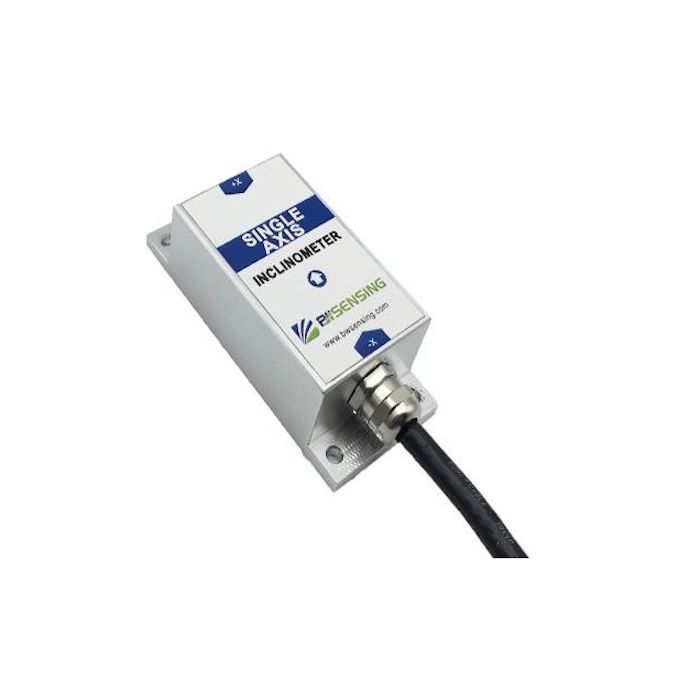
BWSENSING Inclinometer (BWK218)
In stock
- BRAND:
- BWSENSING
- PART #:
- BWK218
- ORIGIN:
- China
- AVAILABILITY:
- SUBJECT TO AVAILABILITY
- SKU:
- BWSENSING-BWK218
BWSENSING Inclinometer (BWK218)
BWSENSING Inclinometer (BWK218)
Unlike inertial measurement units (IMUs) that fuse multiple sensors to estimate dynamic motion, inclinometer products like the BWK218 typically focus on tilt/attitude derived from the gravity vector, making them especially useful in applications where absolute tilt angle is more important than rapid motion tracking.
Design and Features
The BWK218 is described as a compact, lightweight inclinometer built around an industrial-grade MEMS accelerometer. In typical implementations, the sensor is mounted to a structure whose tilt angle must be monitored; the device converts the sensed gravity component on its measurement axis into an inclination angle, then outputs that value via a current loop suitable for industrial environments.
Key design characteristics commonly associated with the BWK218 include:
-
Single-axis measurement (one tilt axis) with a wide range up to ±180°
-
Current-loop output options, including 4–20 mA, with additional ranges noted by the manufacturer listing
-
Emphasis on low cost, simple integration, and industrial robustness (shock resistance and insulation resistance values are listed)
Technology and Specifications
Measurement principle
The BWK218 measures tilt by sensing acceleration due to gravity on a single axis (static gravity field). When the device rotates relative to level, the projection of the gravity vector changes, allowing the inclinometer to compute a tilt angle. This approach is widely used in industrial tilt sensing because it provides an absolute reference (gravity) without requiring external beacons.
Typical specifications (as published in product listings)
Specifications may vary slightly by listing and configuration, but the following values are commonly stated for BWK218:
| Parameter | Typical value (BWK218) |
|---|---|
| Measurement range | ±180° |
| Accuracy | up to 0.2° (often stated as “max” or at room temperature) |
| Resolution | 0.02° |
| Output | 4–20 mA (with 0–20 mA / 0–24 mA also listed as options) |
| Output frequency / response | adjustable (listed as 5–100 Hz, up to 100 Hz) |
| Startup time | < 3 seconds |
| Operating temperature | commonly listed as −40°C to +85°C (some marketplaces also show wider temperature limits) |
| Shock / impact resistance | 2000 g, 0.5 ms, 3 times per axis |
| Insulation resistance | ≥ 100 MΩ |
| Weight | ~230 g (excluding packaging) |
| MTBF | listed as ≥ 90,000 hours in one product listing (other listings may differ) |
Note on specification differences: online product pages sometimes present different MTBF or temperature ranges for the same model name. When accuracy or environmental limits are critical, buyers typically confirm the exact revision/configuration via the seller’s datasheet or manual tied to the purchased unit.
Applications and Use Cases
The BWK218 is marketed for practical industrial tilt measurement where a single tilt axis is sufficient and where current-loop output is preferred for reliability.
Photovoltaic (PV) solar tracking
In PV tracker systems, inclinometer feedback can help measure and correct panel tilt, improving alignment with the sun. The BWK218 is explicitly presented as suitable for photovoltaic automatic tracking and related attitude measurement tasks.
PTZ and positioning systems
For camera towers and PTZ platforms, tilt sensing supports repeatable positioning, stabilization logic, or safety interlocks. Product listings cite PTZ control and monitoring as typical uses.
Tower, turbine, and structural monitoring
Single-axis tilt monitoring is a common technique for detecting slow changes in towers, turbines, masts, and similar structures. The BWK218 is referenced in the context of tower turbines monitoring.
Industrial machinery and mobile equipment
Listings also associate the BWK218 with use cases such as lifting equipment inclination control, industrial conversion/automation scenarios, and other machinery where tilt is a safety-relevant or performance-relevant parameter.
Advantages / Benefits
Industrial-friendly integration (4–20 mA)
A major advantage of the BWK218 class of sensors is compatibility with standard industrial control systems. 4–20 mA current loops are widely used because they are robust over long cable runs and relatively resistant to electrical noise compared with simple voltage outputs.
Wide angular coverage in a single axis
With a stated ±180° measurement range, the BWK218 can cover many full-rotation tilt scenarios on its axis, which is helpful in tracker mechanisms and rotating mounts.
Practical performance for monitoring and control
Listings commonly cite 0.2° accuracy and 0.02° resolution, positioning the product for monitoring/control tasks where sub-degree tilt measurement is adequate and cost matters.
Ruggedness indicators
Published shock/impact resistance and insulation resistance values indicate an intention for industrial environments where vibration, handling shocks, and electrical robustness may be relevant.
FAQ Section
What is the BWSENSING BWK218 inclinometer?
The BWK218 is a single-axis MEMS inclinometer that measures tilt relative to gravity over a wide range (commonly listed up to ±180°) and outputs the angle through an industrial current loop (commonly 4–20 mA, with other ranges also listed).
How does the BWK218 inclinometer work?
The BWK218 uses a MEMS accelerometer to sense the gravity vector on its measurement axis. As the sensor tilts, the gravity component changes; the device converts that change into an inclination angle and outputs the value as a current signal for industrial monitoring and control.
Why is a 4–20 mA inclinometer important in industrial systems?
A 4–20 mA interface is widely used in industrial automation because it is generally resilient to electrical noise and cable losses across longer distances, making it practical for outdoor structures (e.g., trackers or towers) and electrically noisy machinery environments. The BWK218 is explicitly marketed with current output options including 4–20 mA.
What are the benefits of the BWK218 inclinometer?
Commonly listed benefits include low cost, simple current-loop integration, wide single-axis range, and published performance figures such as 0.2° accuracy and 0.02° resolution for tilt monitoring and control use cases like PV tracking and PTZ positioning.
Summary
The BWSENSING BWK218 is a cost-oriented, single-axis inclinometer that converts gravity-referenced tilt into a 4–20 mA (and related) current output, aimed at practical industrial use cases such as PV solar tracking, PTZ control, and tower/turbine monitoring. With commonly published specifications including ±180° range, ~0.2° accuracy, and ~0.02° resolution, it is positioned as a straightforward tilt-measurement component for automation and monitoring systems where analog current loops and ruggedness indicators are valued.