
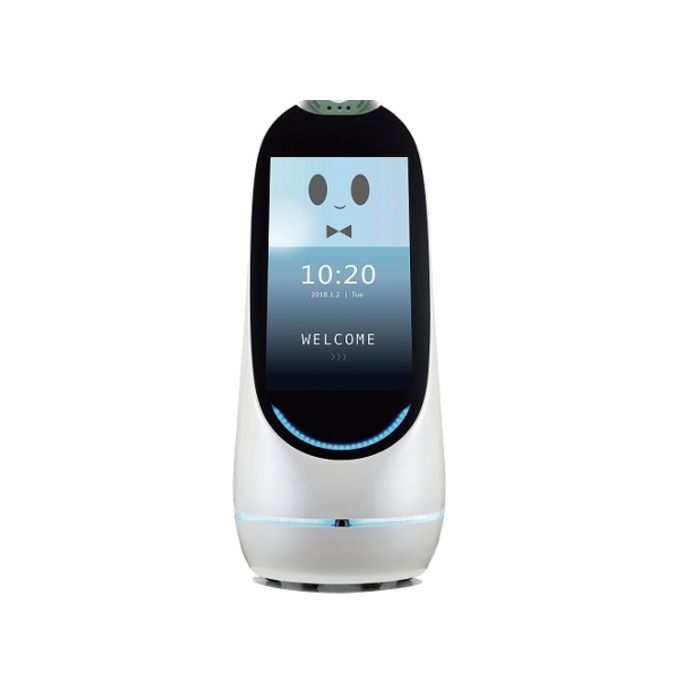
Yunji YUNJI SAIL Guidance Robot (SAIL)
In stock
- BRAND:
- YUNJI
- PART #:
- SAIL
- ORIGIN:
- China
- AVAILABILITY:
- SUBJECT TO AVAILABILITY
- SKU:
- Yunji-SAIL
In practice, guidance robots like SAIL combine autonomous navigation with an on-robot user interface (often a touchscreen) to interact with guests, present instructions, and escort people to destinations. Industry deployments frequently emphasize safe indoor mobility, reliable navigation in dynamic spaces, and integration with building workflows (for example, coordinating routes, service schedules, and access-controlled areas). In one documented deployment context, SAIL is referenced as a guiding robot used alongside autonomous delivery robots for service automation in large facilities.
Design and Features
Mobile platform and visitor-facing interface
SAIL is described in deployment literature as an autonomous guide robot equipped with a front-facing control panel based on Android, suggesting an interaction design centered on a familiar touchscreen UI for staff or guest use. This approach is common in guidance robots because it supports multilingual prompts, map-style navigation cues, and simple task selection (e.g., “Take me to reception,” “Show meeting room,” “How do I get to the elevator?”).
Human–robot interaction in public spaces
Guidance robots must communicate clearly while moving through mixed pedestrian traffic. Typical interaction patterns include:
-
On-screen prompts for destination selection and instructions
-
Signaling behaviors (stopping, yielding, rerouting) to move safely around people
-
Escort mode, where the robot leads at walking speed and adapts to congestion
While specific behavioral details vary by software configuration and site policy, SAIL is positioned as part of service-robot deployments focused on improving guest experience and streamlining operations.
Technology and Specifications
Publicly available documentation for SAIL focuses more on system architecture and deployment roles than on a complete consumer-style spec sheet (e.g., dimensions, weight, top speed). However, several technical characteristics are described in third-party deployment material.
Navigation, sensing, and autonomy
A case study describing SAIL as an autonomous guide robot notes that autonomous running is controlled by software on a separate Linux PC, and that the robot uses laser sensors and cameras. These elements are consistent with modern indoor autonomy stacks, where laser-based ranging (often LiDAR-class sensing) supports mapping and obstacle detection, while cameras can contribute to perception and situational awareness.
System architecture and software stack
The same deployment material highlights a split architecture:
-
Android control panel (front-facing UI)
-
Autonomy software running on a Linux system
This division can help separate user interaction from navigation and robotics control, enabling more robust updates, remote maintenance, and integrations with enterprise IT workflows.
Integration with facility operations
Large-scale service deployments increasingly require robots to operate as part of a “building system,” not as isolated devices. A publicly described smart-building deployment by Shimizu Corporation references the use of Yunji service robots (including guide and delivery robots) in a high-rise environment, illustrating how service robots may be integrated into broader operational workflows such as coordinated movement through multi-floor facilities.
Applications and Use Cases
Hotels and hospitality
In hotels, guidance robots are commonly used to:
-
Escort guests to amenities (elevators, restaurants, conference rooms, spas)
-
Provide directions in large or multilingual properties
-
Support front-desk staff during peak check-in/check-out hours
SAIL is explicitly discussed in hospitality-adjacent contexts as part of a broader service-robot ecosystem.
Restaurants and retail
In restaurants and retail environments, guidance robots may:
-
Direct customers to seating, counters, or pickup points
-
Provide promotional or informational content
-
Help manage customer flow in busy periods
The same case study material places SAIL within service settings that include hotels and restaurants.
Hospitals and public facilities
In healthcare and public buildings, guidance robots can be used for visitor routing—helping people find departments, waiting areas, or administrative offices—particularly where signage alone is insufficient or staff are frequently interrupted for directions.
Advantages / Benefits
Operational efficiency and staffing support
A central motivation for deploying guidance robots is to reduce repetitive, high-frequency tasks (such as giving directions) so staff can focus on higher-value service. This can be particularly helpful in facilities with complex layouts or high visitor turnover.
Consistent guest experience
Robots can provide uniform, predictable guidance instructions and support multilingual information display, which may improve accessibility for international visitors.
Scalability and remote management
The deployment ecosystem described in the TeamViewer case study emphasizes remote access and device management themes—capabilities often valued in service robot fleets operating across many sites. While the case study centers on operational tooling rather than consumer feature claims, it illustrates the enterprise orientation of service-robot deployments.
FAQ Section
What is Yunji SAIL Guidance Robot (SAIL)?
The Yunji SAIL Guidance Robot (SAIL) is an autonomous indoor service robot designed to guide visitors in places such as hotels, restaurants, and other public facilities. It is described in deployment materials as an autonomous guide robot with an Android-based control panel and autonomy components supported by laser sensors and cameras.
How does Yunji SAIL (SAIL) work?
SAIL operates by combining a visitor-facing touchscreen interface with autonomous indoor navigation. Deployment documentation describes a system where the front control panel runs on Android while autonomous running is controlled by software on a separate Linux PC, using laser sensors and cameras for mobility and perception.
Why is Yunji SAIL important?
In high-traffic venues, visitor guidance consumes staff time and can create bottlenecks at reception areas. A guidance robot can provide consistent wayfinding, reduce repetitive interruptions, and support a more scalable service model—especially in large properties with complex layouts.
What are the benefits of Yunji SAIL (SAIL)?
Common benefits include reducing staff workload for routine directions, improving the consistency of guest guidance, supporting multilingual information delivery, and enabling fleet-style operations when deployed across multiple properties.
Summary
The Yunji SAIL Guidance Robot (SAIL) is positioned as an autonomous indoor guide robot for hospitality and public-facing environments, combining a touchscreen-driven interaction model with sensor-based navigation. Public deployment materials describe an Android-based control panel, autonomy software running on a Linux system, and sensing that includes laser sensors and cameras, reflecting a modern service-robot architecture aimed at scalable, enterprise operations.
Specifications
| PART # | SAIL |
|---|---|
| BRAND | YUNJI |