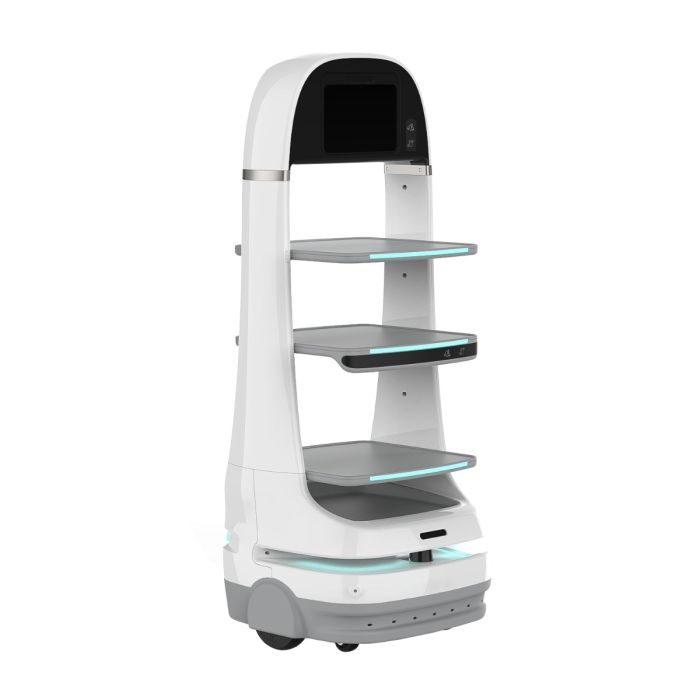
UBTECH AUCARI Open Shelf Delivery Robot
In stock
- BRAND:
- UBTECH
- PART #:
- AUCARI
- ORIGIN:
- China
- AVAILABILITY:
- SUBJECT TO AVAILABILITY
- SKU:
- UBTECH-AUCARI
UBTECH AUCARI Open Shelf Delivery Robot
UBTECH AUCARI Open Shelf Delivery Robot
“Open shelf” delivery robots are a common category of autonomous indoor mobile robots designed to carry items on accessible trays or shelves rather than within a lockable cabinet. This configuration is often used for workflows where quick handoff matters—such as delivering supplies, documents, meals, or small parcels—while maintaining predictable routes and safer navigation than manual cart pushing in busy corridors.
Design and Features
Open-shelf cargo architecture
An open-shelf delivery robot typically uses one or more shelves/trays that allow staff to place and retrieve items without unlocking compartments. In practical deployments, this design can support:
-
Rapid loading/unloading at stations, nursing desks, reception areas, or service points
-
Multi-stop routes (drop-off to multiple departments or tables)
-
Flexible cargo types, from boxed supplies to meal trays or small equipment cases
Because open shelves are not inherently access-controlled, many deployments pair the robot with operational procedures (e.g., staff-only zones, supervised handoffs) or optional software features (e.g., task authentication at pickup/drop-off) depending on the environment.
Human–robot interaction (HRI)
Service delivery robots generally emphasize clear signaling for safe operation around people. Common HRI features in this class include:
-
On-robot displays for task status and instructions
-
Audio prompts (arrival notifications, yielding warnings)
-
Visible lighting to indicate motion, stopping, or docking states
The specific HRI feature set for AUCARI can vary by configuration and deployment requirements; detailed public specification sheets are not consistently published in widely accessible sources.
Docking and charging
Indoor delivery robots typically use autonomous docking to a charging station to maximize uptime. Operationally, this supports:
-
Scheduled recharge cycles (e.g., between peak delivery periods)
-
Opportunity charging during idle windows
-
Reduced manual handling versus swapping batteries for every shift
Technology and Specifications
Navigation stack and autonomy
Open-shelf delivery robots generally rely on autonomous navigation methods that combine mapping, localization, and obstacle avoidance. In many commercial systems, this includes:
-
SLAM-based indoor mapping (creating and updating an internal map of corridors and rooms)
-
Localization (knowing the robot’s position within the mapped space)
-
Dynamic obstacle avoidance to navigate around pedestrians, carts, and temporary obstructions
While company-profile sources identify AUCARI’s role (open shelf delivery) rather than publishing detailed sensor or performance figures, UBTECH’s broader commercial service robot positioning emphasizes practical indoor mobility and operational integration for service workflows.
Sensors and safety
For this category, sensor packages commonly include combinations of:
-
LiDAR (for distance sensing and navigation)
-
Depth/vision cameras (for perception and obstacle detection)
-
Bump sensors and emergency stop systems (for last-resort safety controls)
In people-dense environments like hospitals and hotels, safety is often implemented as a multi-layer approach: speed limiting, stop distances, cautious turning behavior, and explicit yielding around pedestrians.
Fleet management and integration
Commercial deployments frequently manage multiple robots via a centralized console or cloud platform, enabling:
-
Task dispatching and prioritization
-
Robot health monitoring (battery, faults, uptime)
-
Traffic management (route coordination and congestion reduction)
-
Analytics for delivery volume, utilization, and time-to-complete metrics
Applications and Use Cases
Healthcare and wellness facilities
Hospitals, clinics, and senior-care environments are common targets for indoor delivery robots because they feature repetitive transport tasks and long corridors. Typical use cases include:
-
Delivering linens, basic consumables, or boxed supplies
-
Transporting non-critical items between storage and nursing stations
-
Reducing staff time spent on routine walking deliveries
UBTECH’s company profile explicitly references solutions for wellness institutions and related service products (including WASSI and WELLI), consistent with this broader care-environment emphasis.
Hospitality and commercial venues
Hotels, convention centers, and large restaurants often use open-shelf delivery robots for:
-
Room-service staging support (in controlled back-of-house areas)
-
Banquet and event logistics (moving items between prep zones and service points)
-
Front-of-house assistance where fast, repeated trips are required
Offices, campuses, and light logistics
In corporate campuses, educational facilities, and large office buildings, open-shelf delivery robots may support:
-
Mailroom-to-department distribution
-
Document and small parcel transport
-
Inter-floor or inter-building deliveries when elevators and access policies are compatible
Advantages / Benefits
Operational efficiency
Open-shelf delivery robots are primarily deployed to reduce “walking time” in repetitive internal logistics. Benefits often emphasized by adopters include:
-
More staff time on high-value tasks (care, service, or technical work)
-
More predictable delivery cadence on scheduled routes
-
Reduced physical strain from pushing carts over long distances
Flexibility and fast handoffs
Compared with cabinet robots, open shelves can improve speed of use in supervised settings:
-
No unlock step for quick pickup/drop-off
-
Easy visual confirmation of cargo presence
-
Simpler loading for diverse item shapes
Scalability through fleets
When paired with fleet management, organizations can add robots and expand route coverage incrementally, often starting with one building or one department and scaling after workflow validation.
FAQ Section
What is the UBTECH AUCARI Open Shelf Delivery Robot?
The UBTECH AUCARI is described in company-profile materials as an open shelf delivery robot, intended for indoor transport of items placed on accessible shelves rather than inside a cabinet.
How does an open shelf delivery robot work?
Open shelf delivery robots typically operate by mapping indoor spaces, navigating autonomously along planned routes, avoiding obstacles (like people and carts), and stopping at designated pickup/drop-off points for staff to load or retrieve items.
Why are open shelf delivery robots important?
They can reduce time spent on repetitive internal deliveries, improve consistency of routine transport tasks, and support staff by automating frequent point-to-point movement—especially in large buildings with long corridors.
What are the benefits of the UBTECH AUCARI Open Shelf Delivery Robot?
Key benefits associated with the open-shelf delivery robot category include fast handoffs (no cabinet unlock), flexible cargo handling for supervised workflows, and the potential to scale operations via multi-robot fleet management in large facilities.
Summary
The UBTECH AUCARI Open Shelf Delivery Robot is positioned as an indoor service logistics platform, described publicly as an “open shelf delivery robot” within UBTECH’s broader commercial robotics portfolio. While detailed, standardized specifications are not consistently available in broadly accessible sources, the product’s categorization aligns with a well-established class of autonomous indoor delivery robots used to streamline routine transport tasks across healthcare, hospitality, and large-building logistics—where rapid handoff and predictable, repeatable routing are core requirements.