
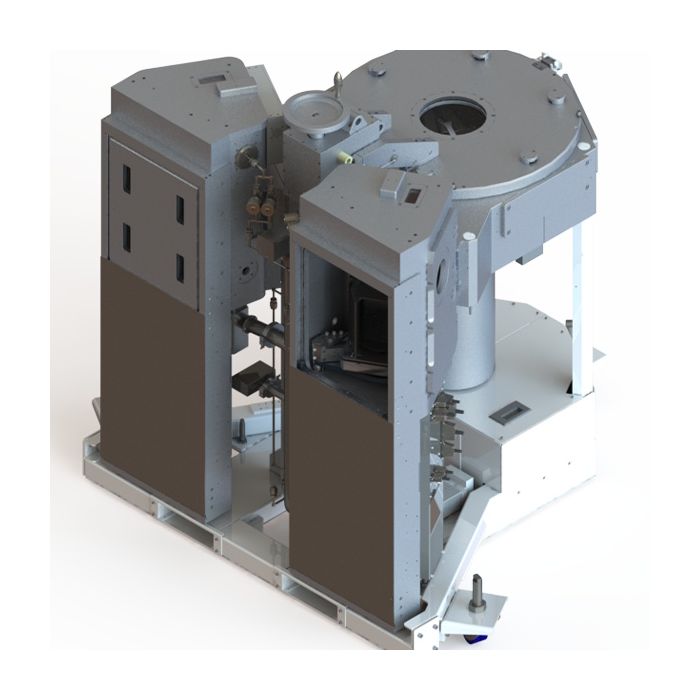
SIASUN Vacuum Transfer Platform Diagram 600 (Diagram 600)
In stock
- BRAND:
- SIASUN
- PART #:
- Diagram 600
- ORIGIN:
- China
- AVAILABILITY:
- SUBJECT TO AVAILABILITY
- SKU:
- SIASUN-Diagram-600
SIASUN Vacuum Transfer Platform Diagram 600 (Diagram 600)
In this context, a “vacuum transfer platform” typically refers to an integrated subsystem that enables wafer movement between load/unload interfaces and vacuum-based process modules, maintaining controlled pressure conditions to reduce contamination risk and support repeatable production flows.
Public product descriptions for Diagram 600 characterize it as a platform used primarily for wafer transfer inside semiconductor chip production facilities, and describe an architecture comprising loading/unloading chambers (load locks), a transfer chamber, a pre-aligner, and a vacuum robot, with vacuum extraction and backfilling functions to support high cleanliness operation.
In broader semiconductor tooling, vacuum transfer platforms sit downstream of front-end automation (often an EFEM or FOUP interface) and upstream of process chambers. Their main purpose is to move wafers under vacuum (or through controlled vacuum transitions) so that process chambers do not need to be vented to atmosphere between cycles—an approach that supports productivity and process stability.
Design and Features
System-level architecture
A typical vacuum transfer platform is organized around multiple chambers and interfaces:
-
Loading/Unloading chambers (Load Locks): Intermediate chambers that cycle between atmospheric pressure and vacuum, allowing wafers to enter/exit vacuum tools without venting the main vacuum environment.
-
Transfer chamber: A central vacuum chamber that provides the controlled environment where a wafer-handling robot moves substrates between interfaces.
-
Vacuum robot: The internal handling mechanism that performs pick/place operations under vacuum.
-
Pre-aligner (wafer orienter): A module used to orient or center wafers prior to transfer into process modules or downstream handling positions.
SIASUN’s Diagram 600 listing explicitly names these core modules—loading/unloading chambers, transfer chamber, pre-aligner, and vacuum robot—as principal included functional elements.
Vacuum extraction and backfilling
The Diagram 600 description also references “vacuum extraction and backfilling” aimed at high cleanliness operation. In semiconductor vacuum systems, load locks and transfer modules commonly use controlled pump-down and vent (backfill) procedures to transition wafers between atmospheric handling and vacuum processing while reducing particle introduction and limiting pressure shocks.
Cleanliness and contamination control intent
Semiconductor wafer transfer under vacuum is strongly linked to contamination control. Industry references describe how wafers enter and exit vacuum tools through load lock chambers to maintain correct vacuum levels and support particle-sensitive processes. Diagram 600 is presented with “high cleanliness” as a central operational goal, consistent with the motivations for vacuum transfer platforms in wafer fabs.
Technology and Specifications
Core functional modules
Public-facing information for Diagram 600 tends to be high level. The product listing identifies the platform’s main elements but does not publish a full datasheet (e.g., wafer size support, pumping speed, robot repeatability, cycle time). What is stated publicly is that Diagram 600 “primarily facilitates wafer transfer” and includes the following modules:
-
Loading/Unloading chambers (load locks)
-
Transfer chamber
-
Pre-aligner
-
Vacuum robot
-
Vacuum extraction and backfilling capability
How vacuum transfer modules typically operate
In semiconductor vacuum tools, load lock chambers function as pressure-transition buffers. Wafers enter/exit via a load lock to reach the target vacuum level before being handed into a vacuum transfer chamber. Inside the transfer chamber, a robot arm transports wafers between interfaces and connected process modules. Patents and technical descriptions commonly depict this arrangement: process chambers connected to a transfer chamber, with a robot moving wafers between process chambers and load locks.
Role of pre-alignment
A pre-aligner (also called an orienter/aligner) is used to ensure wafers are properly oriented before being loaded into subsequent stages. Patent literature describing vacuum systems often references wafer aligners located in or near the front end or transfer path to ensure correct orientation when loading process or load lock chambers.
Notes on “Diagram 600” as a product designation
“Diagram 600” appears as a part/model designation for the SIASUN vacuum transfer platform in distributor-style listings. Without a public SIASUN engineering datasheet in the available sources, model-specific numeric specifications should be treated as quote- and configuration-dependent.
Applications and Use Cases
Semiconductor wafer fabrication
The primary application described for Diagram 600 is wafer transfer in semiconductor chip production facilities. Typical use cases include:
-
Transferring wafers between load lock modules and process tools that require vacuum environments (e.g., deposition, etch, surface treatment).
-
Supporting multi-step tool clusters where multiple process modules connect to a single vacuum transfer chamber.
Vacuum process tool clustering
Vacuum transfer platforms are often used to build cluster tool architectures, where several process chambers are connected around a central transfer chamber. This supports moving wafers between steps without exposure to atmosphere, improving throughput and enabling sensitive surface chemistries.
Research, pilot lines, and specialty microfabrication
While large wafer fabs are the most visible deployment, vacuum transfer systems are also used in R&D and pilot environments—especially where ultra-clean handling and controlled atmosphere transitions are required. Load lock and transfer chambers are widely recognized as essential building blocks in vacuum-based semiconductor manufacturing workflows.
Advantages / Benefits
Reduced tool venting and improved productivity
A primary benefit of vacuum transfer platforms is that the main process vacuum environment can remain stable while wafers are loaded/unloaded through a load lock. Industry sources describe how wafers enter/exit via load locks to ensure correct vacuum levels and maintain particle-sensitive conditions.
Better contamination control
Vacuum transfer and controlled load-lock cycling help reduce particle introduction compared to repeatedly venting core vacuum environments. Maintaining vacuum conditions during transfer is widely emphasized as important for preventing contamination during wafer movement between chambers.
Repeatable, automated wafer handling
By using a vacuum robot inside a transfer chamber, wafer movement becomes repeatable and less dependent on manual handling—supporting quality consistency and enabling higher automation levels. The Diagram 600’s stated inclusion of a vacuum robot aligns with this standard approach.
Alignment and placement accuracy support
Including a pre-aligner supports consistent orientation and placement—important for downstream processes that assume a known wafer orientation (e.g., notch/flat alignment in certain process flows).
FAQ Section
What is the SIASUN Vacuum Transfer Platform Diagram 600 (Diagram 600)?
It is a vacuum wafer-transfer platform intended for semiconductor facilities, described as a system that facilitates wafer transfer and includes loading/unloading chambers, a transfer chamber, a pre-aligner, and a vacuum robot, with vacuum extraction/backfilling functions.
How does Diagram 600 work?
In a typical workflow, wafers transition through load lock chambers that cycle between atmospheric pressure and vacuum, then a vacuum robot moves wafers within a transfer chamber to downstream tool interfaces. Diagram 600 is described as containing these core modules, consistent with common vacuum transfer architectures.
Why is a vacuum transfer platform important in semiconductor manufacturing?
Vacuum transfer platforms help keep sensitive process environments stable by using load locks and vacuum transfer chambers, reducing the need to vent main vacuum modules and supporting particle-sensitive manufacturing conditions.
What is the role of the load lock and transfer chamber in Diagram 600?
Load locks provide a controlled pressure transition for wafers entering/exiting the vacuum system, while the transfer chamber is the vacuum environment where internal robot handling occurs. This division is widely described in semiconductor vacuum transfer references.
What are the benefits of Diagram 600?
Based on its described architecture, benefits include vacuum-based wafer transfer, vacuum extraction/backfilling for cleanliness, robotic handling, and pre-alignment—all supporting repeatable and contamination-controlled movement in semiconductor toolchains.
Summary
The SIASUN Vacuum Transfer Platform Diagram 600 (Diagram 600) is presented as a semiconductor-oriented vacuum wafer transfer system built around a conventional vacuum-tool architecture: load locks (loading/unloading chambers), a vacuum transfer chamber, a vacuum robot, and a pre-aligner, with vacuum extraction and backfilling functions aimed at high-cleanliness handling. As with many vacuum transfer platforms, its value lies in enabling controlled, repeatable wafer movement under vacuum, supporting stable process environments and contamination-sensitive production workflows.