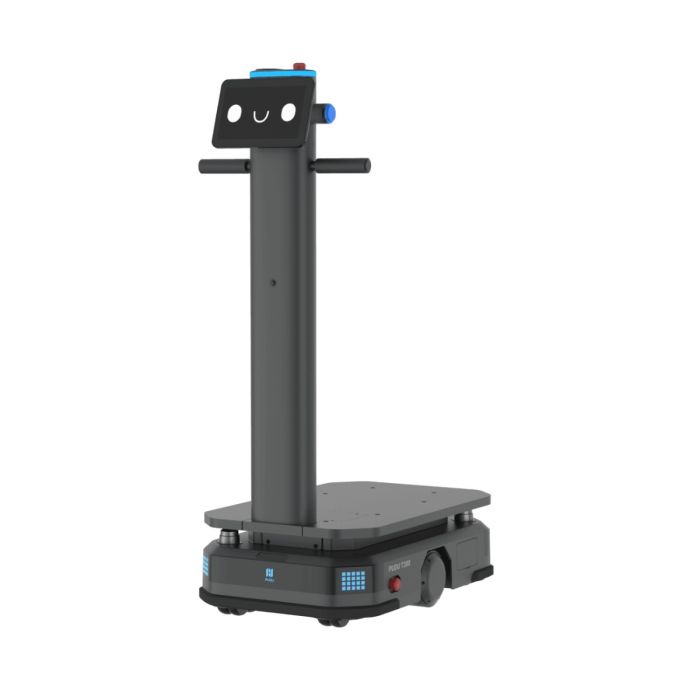
PUDU T300 Standard Industrial Delivery Robot
In stock
- BRAND:
- PUDU ROBOTICS
- MODEL:
- T300 STANDARD
- ORIGIN:
- China
- AVAILABILITY:
- SUBJECT TO AVAILABILITY
- SKU:
- PUDU-T300-Standard
PUDU T300 Standard Industrial Delivery Robot
PUDU T300 Standard Industrial Delivery Robot
The T300 is positioned as a robust, load-bearing platform with an “open architecture” that can be expanded with attachments (shelves, lifts, towing modules) while maintaining a common navigation, safety, and fleet foundation.
In its Standard Version, the T300 is typically configured as a flat-top load carrier intended for bins, totes, and pallet-like carriers—supporting up to 300 kg payload and designed for human–robot cohabited spaces where narrow aisles, thresholds, and grooves are common.
Design and Features
Heavy-duty load-bearing chassis (Standard platform)
The Standard Version is built around a load-bearing chassis and a top loading platform intended for flexible cargo handling (e.g., large boxes, material bins, trays, or custom fixtures). Pudu’s documentation characterizes the T300 as “versatile” for industrial transport and “heavy-load delivery,” emphasizing durability and a design that can be adapted to different workflows.
“Power-assist” manual push mode
A distinguishing operational feature is Power-assist Mode, described as an electric assist system that helps with hand-pushing when manual intervention is needed—such as during specific tasks or map generation. This feature targets real deployments where staff may need to reposition a robot quickly or handle exceptional situations without fully disabling operations.
Expandable attachments and role conversion
Pudu presents the T300 family as a platform that can be expanded via external modules, commonly illustrated as:
-
Standard Mode (flat-top carrier)
-
Shelf Mode (multi-level carrying space)
-
Lifting Mode (vertical lift interface)
-
Towing Mode (carrier/tug workflows)
While this article focuses on T300 Standard, the broader attachment ecosystem matters because many buyers choose the Standard version as a base platform before adding application-specific structures.
Multi-modal interaction for factory floors
Pudu highlights “multi-modal interaction” components that improve visibility and coordination in busy industrial areas, including:
-
high-brightness indicator lights to show position,
-
traffic-signal-style intent lighting,
-
customizable buttons, and
-
audible alerts.
Technology and Specifications
Navigation: VSLAM+ and LiDAR SLAM
The T300 is described as using Pudu’s VSLAM+ positioning alongside LiDAR SLAM, allowing free navigation without relying on fixed physical path markers typical of traditional AGVs. This is positioned as enabling faster reconfiguration when production layouts change.
Pudu’s brochure claims VSLAM+ supports operation in high-ceiling environments up to 30 meters and extra-large scene mapping up to 200,000 m², framing the T300 for expansive industrial sites.
Safety: ISO 3691-4 and multi-sensor protection
Pudu states the T300 is compliant with ISO 3691-4, a safety standard commonly referenced for driverless industrial trucks/AMRs, and describes a safety stack including LiDAR sensors, depth cameras, collision protection sensors, and emergency stop buttons. The robot is also described as recognizing low-lying or suspended obstacles and identifying yellow safety lines on the floor (a common factory safety marking).
Mobility in tight spaces and across floor discontinuities
The T300 is marketed as optimized for narrow “human-robot cohabited” spaces with:
-
≥ 60 cm path clearance (aisle passability)
-
20 mm threshold overcoming height and 35 mm groove crossing width (for typical factory floor joints, ramps, and cable channels)
These figures are central to procurement because small discontinuities and aisle constraints are frequent reasons AMR deployments fail without site preparation.
Standard Version specifications (commonly published)
Pudu’s T300 brochure includes a specification table with a dedicated line for the Standard Version:
-
Machine weight (Standard): 65 kg
-
Loading capacity: 300 kg
-
Max speed: 1.2 m/s
-
Path clearance: ≥ 60 cm
-
Threshold overcoming height: 20 mm
-
Groove crossing width: 35 mm
-
Run-time (no load): 12 h
-
Run-time (full load): 8 h
-
Dimensions: 835 × 500 × 1350 mm
-
Charging time: 2 h (0% to 90%)
-
Navigation methods: VSLAM & LiDAR SLAM
The brochure also highlights a 30 Ah swappable battery and auto charging as core platform features.
24/7 operations and fleet scaling
Pudu describes the T300 as designed for round-the-clock operations, citing fast charging and options such as automatic recharging and battery replacement to reduce downtime.
The brochure further references dispatching up to 20 robots in one environment, aligning T300 deployments with fleet-scale line-side delivery and multi-route logistics.
IoT and facility integrations
A recurring theme in T300 materials is “industrial connectivity,” including:
-
elevator control,
-
e-gate access,
-
remote paging/calling, and
-
software API interfaces for integration with existing systems.
These features are particularly relevant where material transport spans production zones or requires access through controlled doors and interlocks.
Applications and Use Cases
Factory line-side delivery
One of the most common AMR use cases is line-side replenishment—moving components and bins from storage or kitting areas to production lines and returning empties. The T300’s 300 kg payload and narrow-path positioning are designed for these repetitive routes.
Work-in-progress transport
In multi-stage manufacturing, moving work-in-progress items between stations is often time-consuming for staff. Pudu’s materials explicitly frame the T300 around industrial delivery processes such as WIP transfer and production-area movement.
Warehouse and internal logistics
Warehouses and logistics facilities commonly use AMRs for predictable internal routes (e.g., receiving → QA → storage → packing). The T300’s floor discontinuity specs (thresholds/grooves) and 60 cm clearance address frequent real-world building constraints.
Heavy-load commercial back-of-house
Beyond factories, the brochure notes use in “heavy-load delivery in commercial settings,” which can include large venues with back corridors (airports, hospitals, campuses) where wheeled carts are common and automation targets repetitive internal moves.
Advantages / Benefits
High payload in a narrow-path AMR
A 300 kg payload combined with ≥60 cm path clearance is positioned as a practical balance: enough capacity for heavy bins and carts while remaining maneuverable in shared spaces.
Faster layout changes versus fixed-path AGVs
By emphasizing VSLAM+ and markerless navigation, Pudu positions the T300 for factories that frequently change line layouts or storage zones—reducing the need for physical track/marker rework.
Industrial safety posture (ISO 3691-4) and multi-sensor stack
ISO 3691-4 compliance and multi-sensor protection (LiDAR, depth cameras, collision sensors, e-stops) are core to deploying AMRs alongside people, especially where safety lines and mixed traffic are common.
Integration readiness (elevators, gates, APIs)
Facility integration capabilities can be decisive in ROI. Elevator/gate integration and API interfaces reduce the need for manual handoffs and enable deeper orchestration with MES/WMS workflows.
FAQ
What is the PUDU T300 Standard?
The PUDU T300 Standard is the baseline configuration of Pudu’s T300 industrial delivery AMR, designed to transport materials indoors with up to 300 kg payload using VSLAM and LiDAR SLAM navigation.
How does the PUDU T300 Standard work?
It navigates autonomously using VSLAM+ and LiDAR SLAM, avoids obstacles with sensors such as LiDAR and depth cameras, and can integrate with facility systems like elevators and e-gates for end-to-end internal delivery routes.
Why is the PUDU T300 Standard important?
It targets a common industrial bottleneck—repetitive internal transport—by combining heavy payload capacity with narrow-path maneuverability, fast charging, and safety features aligned with ISO 3691-4 requirements.
What are the benefits of the PUDU T300 Standard?
Commonly cited benefits include 300 kg load capacity, ≥60 cm path clearance, 20 mm threshold / 35 mm groove handling, fast charging (0–90% in ~2 h), and elevator/gate/API integration options.
Summary
The PUDU T300 Standard is a heavy-load industrial AMR designed to automate indoor material transport with a focus on 300 kg payload, narrow-aisle maneuverability (≥60 cm), and practical site tolerance for thresholds (20 mm) and grooves (35 mm). Built on VSLAM+ and LiDAR SLAM navigation with safety features positioned for ISO 3691-4 environments, the T300 Standard is commonly evaluated for factory line-side delivery, WIP transport, and large-facility logistics where integration with elevators, gates, and software systems is part of the deployment roadmap.