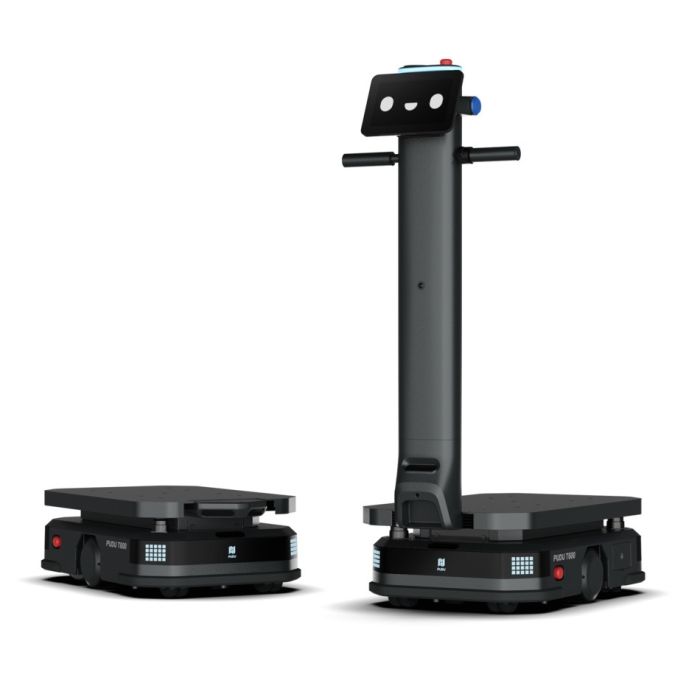
PUDU T600 Heavy-Payload Industrial Delivery Robot
In stock
- BRAND:
- PUDU ROBOTICS
- MODEL:
- T600
- ORIGIN:
- China
- AVAILABILITY:
- SUBJECT TO AVAILABILITY
- SKU:
- PUDU-T600
PUDU T600 Heavy-Payload Industrial Delivery Robot
PUDU T600 Heavy-Payload Industrial Delivery Robot
Pudu describes the T600 series as targeting “heavy-payload industrial delivery,” emphasizing high-capacity transport, autonomous navigation, and fleet-scale efficiency features such as narrow-aisle traffic strategies and elevator scheduling.
Pudu markets the T600 as part of a broader industrial logistics line that complements its 300-kg class platforms, with the T600 series emphasizing higher per-trip capacity to reduce delivery frequency and alleviate congestion in high-volume facilities. A closely related variant, the T600 Underride, is optimized for under-rack lifting; the standard T600 focuses on heavy payload delivery with a taller body and operator interface.
Design and Features
Heavy-load chassis for 600 kg payload class
The signature design characteristic is the T600’s 600 kg maximum load class. This payload rating positions it for transporting consolidated loads such as bulk materials, heavy carts, or large containers that would require multiple trips on lower-capacity platforms. The design intent is to improve per-trip efficiency and reduce the number of transport runs needed across long routes.
Operator-facing interface and industrial usability
In Pudu’s T600 series flyer, the standard T600 is depicted as a taller, handle-equipped AMR compared with the low-profile underride model. This indicates an operator-friendly design for manual intervention, on-site interaction, and quick status checks, including a built-in screen interface (listed as a 10.1-inch touchscreen).
Narrow-aisle traffic strategy for dense facilities
Pudu emphasizes a narrow-aisle intelligent traffic strategy, which dynamically selects single-lane or dual-lane behaviors based on aisle width and load dimensions. In large facilities, aisle behavior and congestion control are central to realized throughput; heavy-payload robots, in particular, benefit from intelligent routing because they may occupy more space and require smoother turning profiles when fully loaded.
Elevator scheduling for multi-floor logistics
The T600 is marketed with idle elevator priority scheduling, calling idle elevators first and monitoring status in real time to reduce waiting and improve cross-floor delivery efficiency. This is aimed at multi-floor sites where elevators become shared bottlenecks for people, carts, and robots.
Disaster avoidance module for resilience and safety
Pudu states the T600 series includes a dedicated disaster avoidance module designed to respond to events such as fire alarms and earthquakes by executing avoidance plans (e.g., relocating to safer areas, stopping in predefined safe zones). This is a facility-resilience feature aligned with 24/7 operations where robots must respond predictably to emergency signals.
VDA 5050 interoperability (fleet orchestration)
Pudu’s T600 series (including the Underride model) is promoted as supporting the VDA 5050 protocol, a widely referenced interface standard for integrating AMRs into centralized fleet management systems. VDA 5050 support can be particularly relevant for enterprises that want interoperability across multi-vendor fleets or standardized orchestration and traffic control.
Technology and Specifications
Navigation and localization: VSLAM + LiDAR SLAM (standard T600)
In Pudu’s comparison materials, the standard PUDU T600 is listed as using VSLAM + LiDAR SLAM for navigation, while the T600 Underride uses LiDAR SLAM only. This suggests the standard model is designed to benefit from sensor fusion, which can improve robustness across different lighting conditions and feature-poor environments.
Official published specifications (standard T600)
Pudu’s T600 series flyer provides a specification table for the standard PUDU T600:
-
Dimensions (L×W×H): 835 × 500 × 1350 mm
-
Weight: 105 kg
-
Maximum load: 600 kg
-
Battery capacity: 30 Ah
-
Charging time: 2 hours (0% → 90%)
-
Run-time: 12 hours (no load)
-
Cruise speed: 0.2–1.2 m/s
-
Navigation method: VSLAM + LiDAR SLAM
-
Minimum passability: 70 cm
-
Max surmountable height: 10 mm
-
Max surmountable gap: 35 mm
-
Operating environment: 0°C–40°C
These values provide a practical envelope for industrial planning. For example, the 10 mm surmountable height and 35 mm gap are relevant to floor joints, small thresholds, and cable channels; the 70 cm passability indicates the aisle width required for safe navigation and turning with industrial safety margins.
Control, monitoring, and deployment context
Pudu’s comparison sheet and related materials emphasize deployment tooling concepts (such as dashboards and “push-to-deploy” style positioning in platform comparisons). In practice, heavy-payload AMRs require thorough commissioning: map creation, speed zoning, traffic rules at intersections, and load handling SOPs to prevent tipping or collisions.
Applications and Use Cases
Warehouse consolidation and heavy internal transport
The T600 is aimed at moving heavy loads across large warehouses, including consolidated inbound/outbound materials, heavy bins, or large containers that would otherwise require manual tugs or forklifts for repeated, predictable routes. High payload capacity can reduce the number of trips needed for a given throughput target.
Factory intralogistics and line-side supply
Manufacturing sites can use the T600 for repetitive line-side delivery loops where heavy material carts or consolidated components must be delivered to production lines and empties returned. The ability to schedule robots and manage narrow-aisle behavior can be particularly valuable in crowded production corridors.
Multi-floor logistics (elevators as transport bottlenecks)
Elevator scheduling features can support cross-floor logistics in multi-story warehouses or factory campuses where vertical movement is unavoidable. This can reduce elevator congestion and improve predictability for both people and robots.
Standards-based fleet orchestration
Facilities operating multi-robot fleets may benefit from VDA 5050 interoperability for centralized job allocation, traffic management, and integration into warehouse management systems (WMS) or manufacturing execution systems (MES).
Advantages / Benefits
Higher per-trip efficiency with 600 kg payload
The most direct benefit is reducing trip frequency: higher payload capacity can reduce the number of runs required to move a given amount of material, improving throughput and potentially reducing aisle congestion.
Practical industrial deployment envelope
Published mobility constraints (70 cm passability, 10 mm surmountable height, 35 mm gaps) provide concrete planning inputs for facility readiness. These values help determine whether a site needs floor remediation or aisle re-spacing before deployment.
Fleet and facility features for 24/7 operations
Narrow-aisle traffic strategies, elevator scheduling, and the disaster avoidance module are aimed at improving uptime and safety in continuous operations—where exceptions and congestion often drive cost more than nominal robot speed.
Interoperability for enterprise-scale integration
Support for VDA 5050 can simplify integration into standardized orchestration frameworks and reduce lock-in risk for enterprises building multi-vendor robotic fleets over time.
FAQ
What is the PUDU T600 Heavy-Payload Industrial Delivery Robot?
The PUDU T600 is a 600 kg-class industrial AMR designed for autonomous indoor delivery of heavy loads in warehouses and factories, using SLAM navigation and fleet features for dense operations.
How does the PUDU T600 work?
The standard T600 navigates using VSLAM + LiDAR SLAM, follows mapped routes, avoids obstacles, and transports heavy loads with fleet-level routing features such as narrow-aisle traffic strategies and elevator scheduling.
Why is the PUDU T600 important?
It targets a major intralogistics bottleneck—repetitive heavy internal transport—by enabling higher per-trip capacity (600 kg), reducing trip frequency, and improving throughput in large facilities.
What are the benefits of the PUDU T600?
Published benefits include 600 kg maximum load, 12-hour no-load runtime, 2-hour fast charge (0–90%), VSLAM + LiDAR SLAM navigation, and fleet-oriented features such as narrow-aisle traffic strategy and elevator scheduling.
Summary
The PUDU T600 Heavy-Payload Industrial Delivery Robot is Pudu Robotics’ 600 kg-class AMR designed for heavy internal transport in warehouses and factories. With official published specs such as 835 × 500 × 1350 mm dimensions, 600 kg payload, 12-hour no-load runtime, 2-hour fast charging, and VSLAM + LiDAR SLAM navigation, it is positioned for high-throughput intralogistics where reducing trip frequency and managing narrow-aisle traffic are central to operational efficiency.