PUDU T600 Underride Heavy-Payload Industrial Delivery Robot
In stock
- BRAND:
- PUDU ROBOTICS
- MODEL:
- T600 UNDERRIDE
- ORIGIN:
- China
- AVAILABILITY:
- SUBJECT TO AVAILABILITY
- SKU:
- PUDU-T600-Underride
PUDU T600 Underride Heavy-Payload Industrial Delivery Robot
PUDU T600 Underride Heavy-Payload Industrial Delivery Robot
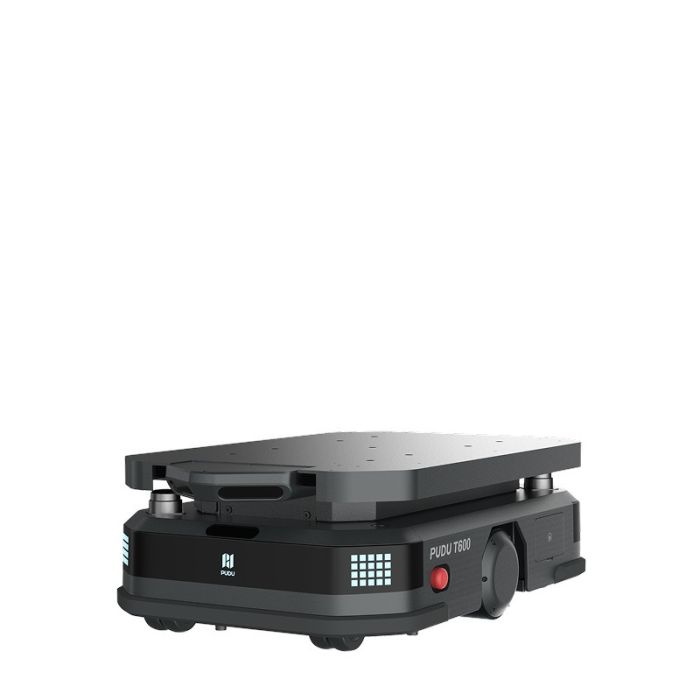
Pudu positions the broader T600 series as a heavy-payload industrial delivery platform with 600 kg maximum load capacity, intended to reduce the number of transport trips required and improve per-trip efficiency. In the series, the standard PUDU T600 uses a taller body with a screen and handle for direct operation, while the Underride version uses a low-profile form factor (table-top/rack-underbody height) for under-rack lifting and transport in tight spaces.
Design and Features
Underride, rack-lifting form factor
The defining design element is the low-profile “underride” chassis, which enables the robot to enter the underside footprint of a rack unit and lift from the center underneath. This allows rack transport with minimal aisle clearance and without requiring a separate forklift for routine intra-facility movements.
In the T600 series flyer, the Underride model is shown as a compact platform designed specifically for moving under rack units for flexible navigation and lifting cargo from below.
Heavy-payload material handling
Pudu markets the T600 series around 600 kg payload capacity, aimed at heavy-duty material transport such as loaded racks, rolling storage systems, and consolidated outbound or inbound loads. The goal is to reduce transport frequency and increase throughput per trip.
Rack group recognition and warehouse “pick-and-place” workflows
Pudu describes rack group recognition as a feature of the T600 series, stating that the robot can identify target storage locations and perform autonomous pick-and-place style operations. In warehouse contexts, this typically refers to automated identification of rack targets and correct positioning to lift, move, and place racks as part of a larger flow.
Narrow-aisle traffic strategies and fleet coordination
In high-density warehouses, multiple robots must coordinate in constrained aisles. Pudu describes a narrow-aisle intelligent traffic strategy that selects single-lane or dual-lane modes based on path width and load dimensions and dynamically adjusts routing strategies for improved space utilization and multi-robot efficiency.
Elevator scheduling for cross-floor logistics
For multi-floor operations, Pudu highlights idle elevator priority scheduling, where the system calls idle elevators first and monitors elevator status in real time to reduce congestion and improve cross-floor delivery efficiency.
Disaster avoidance module (safety response automation)
Pudu states the T600 series includes a dedicated disaster avoidance module designed to receive signals such as fire alarms and earthquakes and automatically execute avoidance plans (e.g., navigating to a safer area or stopping/parking at a safe location).
VDA 5050 interoperability
The T600 series is promoted as supporting the VDA 5050 standard communication protocol, enabling collaborative scheduling with compliant robots and systems—relevant for facilities operating multi-vendor fleets or integrating AMRs into a centralized orchestration layer.
Technology and Specifications
Published specification highlights (Underride model)
From Pudu’s official flyer specification table, the PUDU T600 Underride is listed with:
-
Dimensions: 845 × 500 × 255 mm
-
Weight: 94 kg
-
Maximum load: 600 kg
-
Battery capacity: 30 Ah
-
Charging time: 2 hours (0% → 90%)
-
Run-time: 12 hours (no load)
-
Cruise speed: 0.2–1.2 m/s
-
Navigation method: LiDAR SLAM only
-
Minimum passability: 65 cm
-
Max surmountable height: 10 mm
-
Max surmountable gap: 35 mm
-
Operating environment: 0°C–40°C
These figures define the operational envelope for deployments: the robot is engineered for indoor industrial floors where small thresholds (10 mm) and floor gaps (35 mm) may exist, but major surface discontinuities would still require site preparation.
Navigation and perception
Pudu emphasizes that the T600 series is powered by advanced navigation/perception systems and can detect low obstacles for safe operation.
The official comparison sheet for the T600 series indicates that the Underride uses LiDAR SLAM only, while the standard T600 combines VSLAM + LiDAR SLAM. This distinction reflects a common design pattern: low-profile under-rack platforms often favor laser-based localization to maintain robustness in environments where under-rack sightlines, lighting, or visual features are inconsistent.
Control and deployment model
Pudu describes “push-to-deploy” and operational tooling such as dashboards and PUDU Link in its broader comparisons material (platform-level capability references). In real-world implementation, commissioning typically includes mapping, rack definitions, traffic rules in narrow aisles, and safety validation at intersections and pickup/drop points.
Applications and Use Cases
High-density warehouse rack transport
The flagship application is rack movement in storage-dense environments: the robot can travel under racks, lift them, and relocate them for picking, replenishment, or consolidation. The low-profile underride approach is especially common in “shelf-to-person” or “rack-to-station” workflows, where racks are moved to fixed work areas rather than workers walking long distances.
Factory intralogistics and line-side supply
In manufacturing facilities, under-rack robots can move staged materials (components, subassemblies, WIP bins) on standardized carts/racks from supermarkets or kitting areas to production lines, and return empties for reloading. The 600 kg payload capacity supports heavier consolidated loads and fewer trips compared with lighter AMR classes.
Multi-floor internal logistics
Where sites include elevators and controlled access, T600-series features like elevator scheduling can support cross-floor transport of racks or consolidated loads, improving throughput in buildings where vertical movement is a bottleneck.
Mixed-fleet, standards-based orchestration
VDA 5050 support enables deployments in facilities where a unified orchestration layer schedules robots from multiple vendors. This is increasingly relevant for large operations that want to avoid vendor lock-in and standardize fleet-level traffic and job allocation.
Advantages / Benefits
High payload with minimal footprint
A key advantage is the combination of 600 kg payload with a low 255 mm height and 65 cm minimum passability, enabling heavy rack transport in narrow aisles where traditional forklifts or larger AMRs may be constrained.
Reduced trip frequency and improved per-trip efficiency
Pudu’s positioning centers on reducing delivery frequency: moving more per mission can increase effective throughput and reduce traffic congestion in busy facilities.
Faster automation adoption using existing racks
Underride systems can often be deployed with standardized rack units rather than requiring custom top modules on robots. When a facility already uses consistent rack footprints, the robot’s value increases because it can integrate into established material-handling patterns.
Safety and resilience features for industrial environments
Features such as dynamic obstacle avoidance, low-obstacle detection, and the described disaster avoidance module are aimed at improving safety and operational continuity in environments where conditions can change quickly (temporary obstacles, alarms, or route closures).
FAQ
What is the PUDU T600 Underride heavy-payload industrial delivery robot?
It is a low-profile underride AMR that can navigate beneath racks, lift them from underneath, and transport up to 600 kg for warehouse and factory intralogistics.
How does the PUDU T600 Underride work?
It uses LiDAR SLAM navigation and autonomous obstacle detection to drive under a rack, lift from the center underneath, and move the rack along mapped routes to a destination.
Why is the PUDU T600 Underride important?
It targets heavy, repetitive internal transport in dense facilities by combining 600 kg payload with narrow-aisle passability, reducing trip frequency and improving throughput per mission.
What are the benefits of the PUDU T600 Underride?
Published benefits include 600 kg payload, 65 cm minimum passability, 2-hour charging (0–90%), 12-hour no-load runtime, and standards-based fleet integration support such as VDA 5050.
Summary
The PUDU T600 Underride is a 600 kg-class underride industrial AMR engineered to move heavy racks in dense warehouse and factory environments. With a low-profile chassis (845 × 500 × 255 mm), narrow passability (65 cm), LiDAR SLAM navigation, and fleet-oriented features such as VDA 5050 interoperability and elevator scheduling, it is positioned as a flexible platform for rack-based intralogistics and high-throughput internal transport.