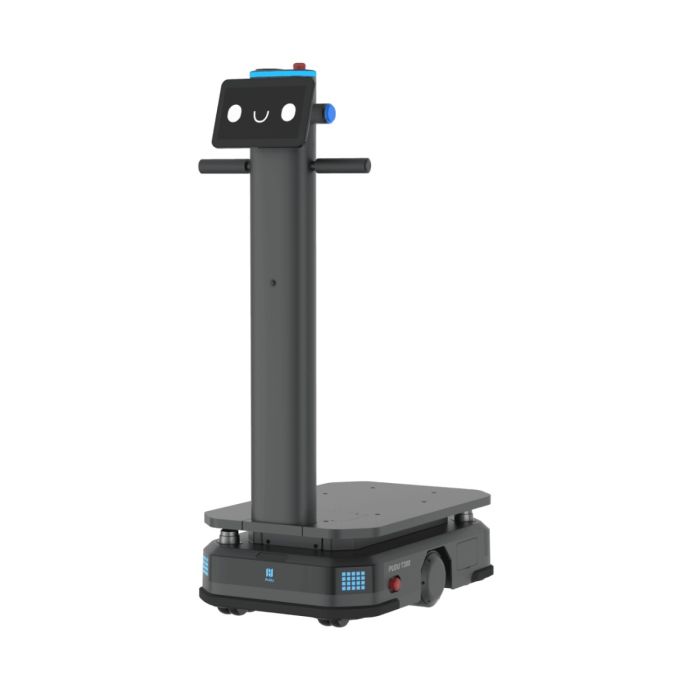
PUDU T150 Light-Payload Industrial Delivery Robot
In stock
- BRAND:
- PUDU ROBOTICS
- MODEL:
- T150
- ORIGIN:
- China
- AVAILABILITY:
- SUBJECT TO AVAILABILITY
- SKU:
- PUDU-T150
PUDU T150 Light-Payload Industrial Delivery Robot
PUDU T150 Light-Payload Industrial Delivery Robot
In Pudu’s product framing, the T150 targets workflows such as intralogistics loop delivery, component/parts delivery, inter-line handling, replenishment and retrieval, and warehouse picking and distribution—use cases common in electronics manufacturing, parts staging, and small-item warehousing where speed and consistency matter.
Design and Features
Rapid deployment and “no site modification” positioning
A core claim of the T150 is rapid deployment, with Pudu stating “setup and launch in 60 mins or less” and “no site modification required,” supported by onboard mapping and multi-robot self-networking without local servers or network deployment. This messaging aligns the T150 with facilities that want to pilot and scale AMRs quickly without major infrastructure projects.
Precision navigation and stability in dynamic environments
Pudu states the T150 uses VSLAM + LiDAR localization to adapt in real time to dynamic environments, with the goal of stable operation even when people, carts, and temporary obstacles change the scene.
Aerospace-grade unibody design
Pudu describes the T150 as using high-strength aerospace materials and an unibody design to improve impact resistance and durability for intensive duty cycles, with marketing language indicating a “5 years” reliability intent in industrial use.
Intuitive operation and integration options
The T150 includes an onboard touchscreen and a proprietary OS for task dispatching, configuration, and mode switching. Pudu also advertises compatibility with button pagers, PUDU Link, and API integration, reflecting an intent to support both frontline operators (simple dispatch) and systems integrators (software-driven workflows).
Sensors and obstacle avoidance for mixed traffic
Pudu highlights a perception stack combining dual RGBD cameras and 360° dual LiDAR, with AI-driven multi-level navigation and obstacle avoidance for complex industrial spaces (including narrow aisles and mixed human-robot traffic).
24/7 continuous operation power ecosystem
Pudu positions the T150 for continuous operation through a flexible power approach that includes rapid battery swapping, automatic charging, and wired power/charging options, intended to maximize uptime and throughput in shift-based operations.
IoT integration (e-gates, elevators, paging)
The product page highlights IoT integration capabilities such as e-gate control, elevator control, “call with pager,” and PUDU Link. In practical deployments, these integrations can reduce manual handoffs at controlled access points and support multi-zone routes.
Technology and Specifications
Pudu publishes two T150 configurations—T150 Standard and T150 Lifting—with shared navigation and mobility characteristics but different machine weight due to the lifting mechanism.
Product Overview: T150 Standard (official)
According to Pudu’s product overview section:
-
Machine dimensions: 835 × 500 × 1350 mm
-
Machine weight: 65 kg
-
Maximum payload: 150 kg
-
Battery capacity: 30 Ah
-
Charging time: 2 h (0%–90%)
-
Operating time: 12 h (no-load)
-
Max operating speed: 0.1–1.2 m/s
-
Navigation method: VSLAM + LiDAR
-
Minimum passable width: 60 cm
-
Step-climbing capability: 20 mm
-
Gap-crossing capability: 35 mm
-
Operating environment: 0°C–40°C
Product Overview: T150 Lifting (official)
Pudu lists the lifting configuration as:
-
Machine dimensions: 835 × 500 × 1350 mm
-
Machine weight: 81 kg
-
Maximum load: 150 kg
-
Battery capacity: 30 Ah
-
Charging time: 2 h (0%–90%)
-
Operating time: 12 h (no-load)
-
Max operating speed: 0.1–1.2 m/s
-
Navigation method: VSLAM + LiDAR
-
Minimum passability: 60 cm
-
Step-climbing capability: 20 mm
-
Gap-crossing capability: 35 mm
-
Operating environment: 0°C–40°C
Industrial safety and certification posture
Pudu states the T150 meets ISO 3691-4 and holds industrial-specific CE certification, positioning it for professional-grade compliance and safety assurance in industrial settings.
Applications and Use Cases
Intralogistics loop delivery
The T150 is positioned for “loop” routes—repeatable, cyclic transport tasks such as moving bins between staging areas and work cells. Loop delivery is a common ROI case because it reduces the time workers spend walking and pushing carts.
Material replenishment and retrieval
Replenishment workflows include delivering components to lines and retrieving empties or returns. The T150’s 150 kg payload class is suited to tote-based and bin-based replenishment where throughput depends on frequency rather than single-trip mass.
Inter-line material handling
In multi-line factories, the T150 can support movement of WIP and components between adjacent lines or between assembly/test/packaging zones—routes where aisle congestion and short cycle times are key constraints.
Component and parts delivery
Parts delivery includes scheduled drops to stations, kitting cells, or maintenance points. The T150’s integration options (pager, PUDU Link, API) are relevant when parts runs must be triggered by production events rather than manual dispatch.
Warehouse picking and distribution
For small-item warehousing and distribution, T150-style AMRs are commonly used to move picked totes to consolidation or packing stations, supporting higher pick rates by reducing travel time. Pudu explicitly lists “warehouse picking & distribution” among T150 scenarios.
Advantages / Benefits
“Right-sized” payload for high-frequency routes
At 150 kg payload, the T150 targets a common middle ground: heavier than many indoor service robots, but lighter and more maneuverable than rack-moving or 600 kg-class platforms. This can be advantageous in facilities where loads are moderate but trips are frequent.
Practical passability for real buildings
The published 60 cm minimum passable width, 20 mm step-climbing, and 35 mm gap-crossing help define real-site compatibility and reduce surprises during commissioning.
Multiple uptime pathways (swap, dock, wired)
A flexible power ecosystem—battery swap, docking, and wired options—supports different operational styles (continuous operation, peak window coverage, or fixed-route “always on” corridors).
Integration readiness for production environments
The stated support for e-gates, elevators, pagers, PUDU Link, and APIs reflects industrial reality: navigation alone is not enough; successful deployment often depends on connecting robots to facility access points and digital workflows.
FAQ
What is the PUDU T150 Light-Payload Industrial Delivery Robot?
The PUDU T150 is a 150 kg payload industrial AMR designed for high-frequency internal logistics in factories and warehouses, with VSLAM + LiDAR navigation and rapid deployment positioning.
How does the PUDU T150 work?
It maps and navigates using VSLAM + LiDAR, detects obstacles with dual RGBD cameras and dual LiDAR, and runs routes that can be dispatched from its onboard touchscreen or integrated tools (pager, PUDU Link, API).
Why is the PUDU T150 important?
It targets a common automation gap: facilities with moderate loads but frequent internal deliveries, where fast deployment and stable navigation in mixed traffic can improve throughput and reduce walking labor.
What are the benefits of the PUDU T150?
Published benefits include 150 kg payload, 12 hours no-load operation, 2-hour fast charging (0–90%), 60 cm passability, and industrial safety positioning under ISO 3691-4.
Summary
The PUDU T150 is a light-payload (150 kg) industrial delivery AMR designed for rapid adoption in factories and warehouses, combining VSLAM + LiDAR navigation, dual RGBD + dual LiDAR perception, and practical mobility specs (60 cm passability, 20 mm step, 35 mm gap). With an emphasis on “setup and launch in ~60 minutes,” multiple uptime options (swap, dock, wired), and integration hooks for gates, elevators, and software workflows, the T150 is positioned as a scalable solution for high-frequency intralogistics where consistency and deployment speed drive ROI.