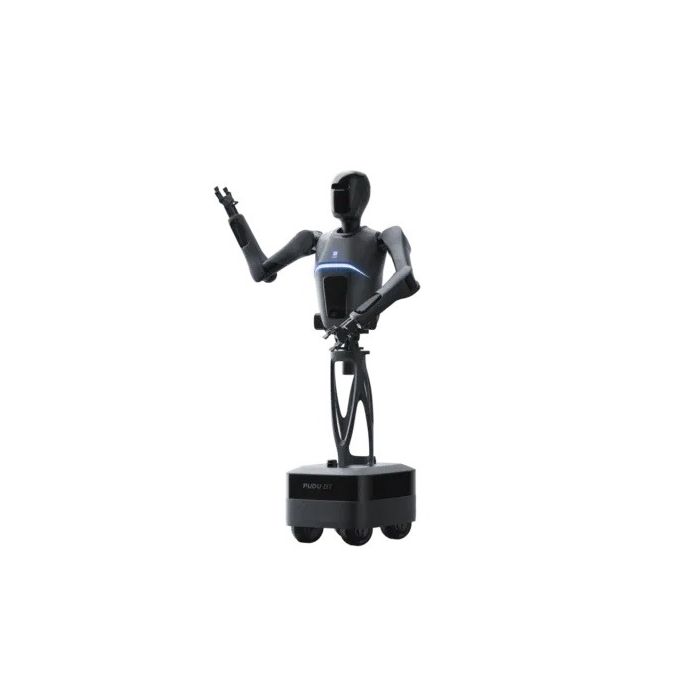
PUDU D7 Wheeled Humanoid Robot
In stock
- BRAND:
- PUDU ROBOTICS
- MODEL:
- D7
- ORIGIN:
- China
- AVAILABILITY:
- SUBJECT TO AVAILABILITY
- SKU:
- PUDU-D7
PUDU D7 Wheeled Humanoid Robot
PUDU D7 Wheeled Humanoid Robot
Pudu introduced the D7 publicly in September 2024, describing it as its first “semi-humanoid” embodied intelligent robot. Published specs and press materials commonly cite a height of 165 cm and weight of 45 kg, with an arm reach of 65 cm and 30 degrees of freedom (DOF) in the upper body expandable to 50 DOF when paired with a dexterous hand attachment.
The D7 is positioned for tasks that benefit from both mobility and manipulation, such as operating elevators, handling items, and sorting or transferring objects in service and light industrial contexts scenarios where wheeled navigation alone is not sufficient because the robot must interact with buttons, handles, carts, or work surfaces.
Design and Features
Semi-humanoid “upper body + omnidirectional base” architecture
The D7’s core design is a human-like torso with arms mounted on a 360° omnidirectional chassis, allowing the robot to translate sideways, rotate in place, and maneuver in tight indoor spaces while keeping a stable base for manipulation. This architecture is sometimes described as “wheeled humanoid” or “semi-humanoid” because it prioritizes efficiency and stability over bipedal walking.
Bionic arms and manipulation reach
Pudu’s product prospect and third-party summaries describe a single-arm reach of 65 cm and DOF figures that enable complex arm motion. This reach is particularly relevant for interacting with human-scale infrastructure (elevator panels, door hardware, shelves) and for handling objects from carts or workstations.
Expandable dexterity via hand attachment
A notable design concept is that the D7’s DOF can expand from 30 DOF to 50 DOF with a dexterous hand attachment, reflecting a modular approach to end-effectors. In practice, this means facilities can evaluate the base arm platform for simpler pick-and-place and then upgrade dexterity when tasks demand fine grasping and more nuanced contact.
High-throughput indoor mobility
Pudu positions the D7 for high-frequency indoor operation with a published maximum linear speed of up to 2 m/s and an omnidirectional drive system. This combination is intended to enable the robot to move efficiently between tasks—an important factor when the “time spent traveling” is a major component of total task time.
Embodied AI framing and task adaptability
In Pudu’s framing (and in industry coverage), the D7 is part of a broader push toward embodied intelligence: robots that combine perception, motion, and manipulation to perform diverse tasks in real environments. Rather than being limited to pre-scripted delivery routes, the D7 is presented as able to adapt to tasks that involve physical interaction with objects and infrastructure.
Technology and Specifications
Locomotion and chassis capabilities
The D7’s fully omnidirectional chassis enables holonomic movement (movement in any direction without reorienting the body first), which improves maneuverability in narrow corridors, crowded spaces, or around equipment. Several sources also describe obstacle crossing / climbing capability in the ~50 mm range, reflecting a focus on real-world indoor surfaces (thresholds, small ramps, floor transitions).
Degrees of freedom and reach
Core published capability descriptors include:
-
30 DOF (expandable to 50 DOF with dexterous hand)
-
65 cm arm reach
These values are frequently used to characterize whether the robot can operate in human-scale workspaces and perform multi-step manipulation.
Compute, sensing, and control (reported figures)
A widely circulated D7 prospect lists 200 TOPS of computing power as a headline specification, reflecting a design intent to run perception and planning workloads on-device (or at least at the edge) rather than relying entirely on remote compute.
Third-party listings also describe high-precision manipulation capability (often expressed as endpoint precision figures) and emphasize multi-sensor perception typical of service robots, though exact sensor configurations can vary by deployment package.
Payload and endurance
Public materials and listings commonly describe:
-
Payload: often reported as up to 20 kg (headline spec in some product prospects)
-
Runtime: 8+ hours per charge (headline spec)
-
Battery: frequently described as >1 kWh in some databases/lists
As with many emerging embodied-AI platforms, real-world payload and endurance depend on task mix (movement vs. manipulation intensity), speed limits, and duty cycle.
Applications and Use Cases
Elevator and building infrastructure interaction
Pudu’s announcements and industry coverage repeatedly cite elevator operation as a key demonstration use case. The combination of arms and a mobile base enables “complete the route” behaviors in buildings where doors and elevator panels can otherwise stop delivery-only robots unless building IoT integrations are installed.
Item transport and internal logistics
The D7 is positioned for item transport tasks where the robot must not only move between points but also handle the object (pick up, place, pass through constrained areas, or sort items into locations).
Sorting and manipulation in service or light industrial spaces
Pudu’s messaging and third-party summaries emphasize sorting and “versatile tasks” enabled by bionic arms and dexterous-hand options. These scenarios include moving items between bins, staging areas, or workstations—especially in environments where space is human-centric and layouts change.
Multi-industry service scenarios
Coverage highlights suitability for diverse environments, spanning service and industrial settings, which aligns with the “universal embodied service robot” idea: a platform flexible enough to be adapted through software workflows and end-effector options.
Advantages / Benefits
Practical autonomy without full building retrofits
A wheeled humanoid can potentially reduce reliance on custom elevator/door integrations by using arms to interact with existing infrastructure. This is a major selling point in buildings where IT/OT integration is slow, expensive, or restricted.
Efficient mobility paired with manipulation
Compared with bipedal humanoids, a wheeled base generally supports longer duty cycles and simpler stability control while still enabling complex manipulation via arms and dexterous hands. The D7’s omnidirectional chassis supports high maneuverability for indoor operations.
Modular dexterity scaling
The “30 DOF expandable to 50 DOF” framing suggests a modular pathway: deployments can start with simpler manipulation and upgrade to more dexterous hands as task requirements increase, helping control cost and integration complexity.
Endurance suited to shift-based operations
Headline endurance claims (8+ hours) align with operational needs in service and logistics contexts, where robots must provide meaningful coverage during peak windows or across long routes.
FAQ
What is the PUDU D7 Wheeled Humanoid Robot?
The PUDU D7 is a semi-humanoid wheeled robot with a human-like upper body and bionic arms on an omnidirectional base, designed for embodied intelligence tasks such as elevator operation, item transport, and sorting.
How does the PUDU D7 work?
It combines omnidirectional wheeled mobility with robotic arm manipulation (30 DOF, expandable to 50 DOF with a dexterous hand attachment) and uses onboard computing (reported at 200 TOPS) to support perception and task execution.
Why is the PUDU D7 important?
It targets a common barrier for delivery robots—physical interaction with human infrastructure—by pairing efficient indoor mobility with manipulation capabilities aimed at real buildings and mixed workflows.
What are the benefits of the PUDU D7?
Commonly cited benefits include 165 cm height, 45 kg weight, 65 cm arm reach, 8+ hour battery life, omnidirectional mobility, and modular expansion from 30 DOF to 50 DOF with dexterous hand options.
Summary
The PUDU D7 Wheeled Humanoid Robot is a semi-humanoid embodied-AI platform that combines omnidirectional wheeled mobility with bionic arms and modular dexterity options to perform tasks that require both navigation and physical interaction. With widely cited specs such as 165 cm height, 45 kg weight, 65 cm arm reach, 30–50 DOF, and 8+ hours of runtime, the D7 is positioned for service and light industrial workflows where delivery-only robots face “last-step” barriers like elevator panels, doors, and object handling.