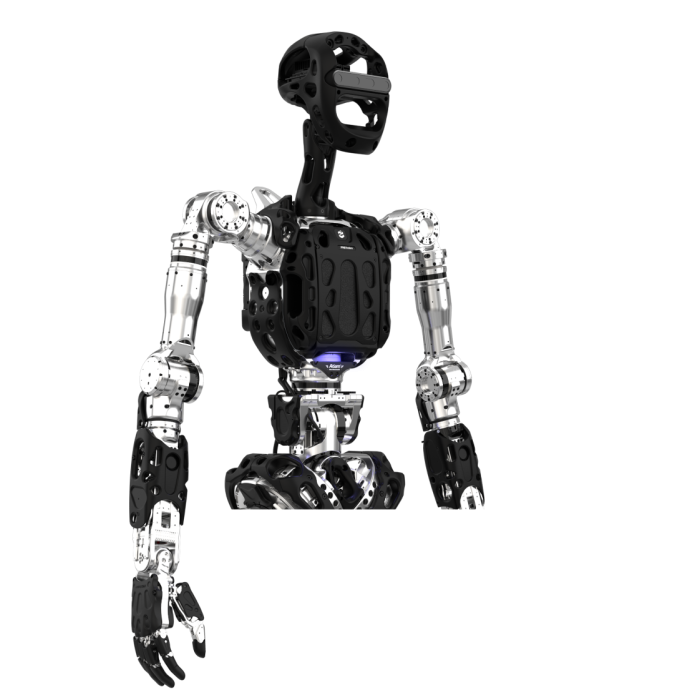
As a torso-class humanoid, it integrates a head module for perception and human–robot interaction (HRI), two multi-degree-of-freedom arms, and dexterous hands, while leaving mobility (benchtop pedestal or third-party mobile base) to the integrator’s choice.
Positioned between classroom-oriented kits and full bipedal humanoids, Adam-U Pro Max targets teams that want advanced bimanual capability without the cost, risk, and infrastructure demands of legged locomotion. Typical buyers include universities, R&D centers, start-ups, and solution integrators exploring embodied AI.
Design and Features
Form factor and mechanics
Adam-U Pro Max follows a head–torso–two-arm layout engineered for countertop and workstation tasks. The arms use modular joint actuators for repeatable installation and service, with internal sensing for position and torque control. The head module consolidates cameras, status indicators, microphones/speakers, and compute interfaces for telepresence and HRI.
Key design aims include:
-
Bimanual dexterity for tasks such as sorting, folding, handing over objects, and tool manipulation.
-
Human-centric reach aligned to desks, trolleys, and industrial benches.
-
Serviceability, with quick-swap joints or covers depending on configuration.
End-effectors and hands
Compared with entry variants, Pro Max typically supports upgraded hands—for example, adaptive multi-finger grippers or interchangeable end-effectors—enabling precision pinch, power grasps, and in-hand reorientation. Hands are paired with force/torque sensing and slip detection for guarded moves around people and fragile items.
Perception and HRI
The head unit commonly integrates stereo/RGB cameras (often with depth capability), near-field microphones, and a small speaker array. Visual and auditory cues support operator training, demo scripting, and public engagement. LED or screen-based indicators allow quick state introspection (idle, active, error).
Technology and Specifications
Actuation and control
-
Arms & joints: multi-DoF serial arms with high-resolution encoders and joint-level torque control.
-
Control loops: synchronized motion with velocity/torque limits, guarded compliance for human-proximate work, and trajectory playback for demonstrations.
-
Safety: emergency-stop circuitry, software watchdogs, and configurable speed/force ceilings.
Sensing
-
Vision: RGB (and commonly depth) cameras for object detection, pose estimation, and grasp point selection.
-
Proprioception: joint position/velocity and estimated torque for low-latency contact response.
-
Optional range sensing: short-range LiDAR or structured-light sensors (bundle-dependent) to improve hand-eye coordination around clutter.
Compute and connectivity
-
Edge compute: an onboard AI module (varies by configuration) for perception inference and closed-loop control.
-
Networking: Ethernet and Wi-Fi for teleop, over-the-air updates, and logging; USB/serial expansion for external peripherals.
-
APIs/SDKs: Python/C++ bindings, ROS/ROS 2 compatibility (commonly provided), and examples for teleop capture, imitation learning, and scripted behaviors.
Software stack
-
Teleoperation: out-of-the-box support for motion-capture suits and/or VR controllers to mirror human arm/hand motions and record demonstrations.
-
Policy training: pipelines for imitation learning; optional integration of vision-language-action (VLA) policies enables instruction-following and multi-step task execution.
-
Skill library: primitives for reach, grasp, hand-off, drawer/door interaction, and tool use; users can compose higher-level routines with behavior trees or task graphs.
Applications and Use Cases
Research and education
Adam-U Pro Max is widely suited to manipulation research, grasping benchmarks, human–robot interaction studies, and learning-from-demonstration. The teleop pipeline accelerates dataset creation, allowing teams to author skills in hours and iterate policies without writing extensive low-level code.
Pilot services and public engagement
With expressive arms and HRI, the robot supports brand activations, reception, guided demos, and retail counters. Bimanual capability enables hand-over interactions, simple packaging tasks, and prop/tool handling under supervision.
Light industrial and lab workflows
At benches or carts, Pro Max can sort parts, organize trays, operate fixtures (e.g., latches, buttons, drawers), or hand items to technicians. In laboratories, it can assist with sample logistics and repetitive pick-place routines that do not require cleanroom-rated hardware.
Healthcare and assistive research (non-clinical)
In non-clinical research contexts, an upper-body humanoid is appropriate for ADL (activities of daily living) studies, assistive handover, and rehabilitation-adjacent manipulation when locomotion is not required. Clinical deployment would require regulatory pathways beyond standard research use.
Advantages / Benefits
-
Manipulation-first economics: By omitting legged mobility, Pro Max concentrates budget and complexity on hands, arms, and perception, where value is most visible to end users.
-
Rapid skill authoring: Teleoperation + imitation learning compresses the cycle from idea to working skill, enabling fast A/B testing of grippers, trajectories, and policies.
-
Bimanual capability: Two coordinated arms allow stabilize-and-manipulate behaviors (opening containers, folding items, two-handed tool use) difficult for single-arm systems.
-
Human-centered HRI: A head module and expressive arms improve communication and safety in public spaces compared with non-anthropomorphic manipulators.
-
Modularity and integration: Standard interfaces and ROS/ROS 2 compatibility reduce integration time with vision stacks, mobile bases, and external sensors.
FAQ
What is the PNDbotics Adam-U Pro Max?
It is a high-performance upper-body humanoid robot—head, two arms, and dexterous hands—focused on manipulation, HRI, and rapid skill development.
How does Adam-U Pro Max work?
The robot combines joint-level torque control with vision-guided grasping. Operators teach skills via teleoperation (mocap or VR), then refine them with imitation learning or vision-language-action policies.
Why is the Pro Max variant important?
Compared with entry configurations, Pro Max emphasizes greater dexterity, stronger actuation, and richer sensing, enabling two-handed tasks and more reliable handovers in public-facing or research settings.
What are the benefits of an upper-body humanoid over a full humanoid?
A torso platform delivers fast deployment, lower cost/complexity, and longer runtime, while retaining humanlike arm/hand capability for counter-height tasks.
Does it support ROS/ROS 2 and custom development?
Yes. Pro Max commonly ships with SDKs, ROS/ROS 2 interfaces, and sample code for teleop, perception, and policy training, allowing custom behaviors and integrations.
Can it be mounted on a mobile base?
Yes. Many integrators pair the torso with a holonomic or differential mobile base, creating a mobile manipulator for broader workflows.
Summary
The PNDbotics Adam-U Pro Max extends the Adam-U line with a manipulation-first, upper-body humanoid optimized for bimanual dexterity, rich perception, and rapid skill authoring. By focusing engineering effort on hands, arms, and the perception-to-action stack—while leaving mobility modular—it provides researchers and integrators a practical, cost-aware path to embodied AI. With standard developer interfaces, teleoperation tooling, and imitation-learning pipelines, Pro Max is positioned as a ready-to-integrate platform for laboratories, pilot services, and public demonstrations where humanlike interaction and reliable grasping are the primary goals.