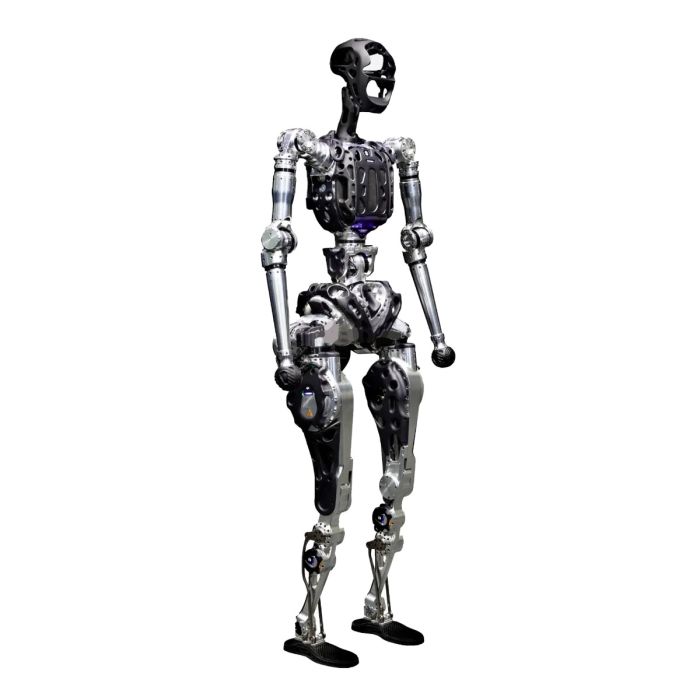
PNDbotics Adam Pro Humanoid Robot
In stock
- BRAND:
- PDNBOTICS
- PART #:
- Adam Pro
- ORIGIN:
- China
- AVAILABILITY:
- SUBJECT TO AVAILABILITY
- SKU:
- PNDbotics-Adam-Pro
PNDbotics Adam Pro Humanoid Robot
Publicly available materials place the Adam series around 1.6–1.67 m in height with a mass of roughly 60–63 kg, depending on variant and configuration. Media and reseller listings describe the Pro as part of PNDbotics’ modular platform strategy that spans developer units through show-grade systems.
Design and Features
Humanoid layout and chassis
Adam Pro follows the familiar head–torso–two arms–two legs anthropomorphic layout, enabling use of human tools, switches, and doors at standard heights. The chassis is designed for human-proximate operation, balancing structural rigidity with back-drivable joints for safe interaction and disturbance rejection.
Actuation philosophy
Across the Adam family, PNDbotics emphasizes quasi-direct-drive (QDD) or comparable high-bandwidth actuation with force/torque control to support precise foot placement, compliant contacts, and whole-body balance. This approach—combined with motion policies learned in simulation—underpins demonstrations of agile gait and coordinated upper-body gestures seen in Adam variants.
Modularity and ecosystem
The platform is marketed as modular, with swappable components (actuators, end-effectors, compute) and support for developer tooling. Directory and reseller pages highlight an ecosystem that includes Lite, Standard/Standard Plus, Pro, and higher-end (e.g., “Pro Max”) tiers, each trading off dexterity, cost, and readiness for specific use cases.
Human–robot interaction (HRI)
Adam Pro’s head/torso assemblies typically incorporate vision sensors and expressive motion for demonstrations, public events, or concierge-style interactions. While specific sensor SKUs vary by build, coverage of the broader Adam line references multi-camera vision and depth sensing for scene understanding and grasp selection during showcases.
Technology and Specifications
PNDbotics publishes specifications across the Adam lineup; figures below summarize commonly cited ranges for Adam-class builds and Pro-tier market positioning.
-
Height & mass (family range): ~1.6–1.67 m; ~60–63 kg reported for full-size Adam variants.
-
Degrees of freedom: Listings for related Adam variants note 25–41+ DoF, reflecting configuration differences (arms/hands/head). Pro-tier units are typically on the higher end to support dexterous demos.
-
Joint performance: Media reports for Adam family highlight up to ~340 N·m torque at major leg joints, enabling robust balance on irregular terrain. (Variant-dependent.)
-
Control stack: Whole-body control with reinforcement-learning (RL) or imitation-learning policies; sim-to-real transfer for gait, balance, and gesture sequences observed across Adam showcases.
-
Compute & sensing: Public demos across the lineup cite multi-camera vision and depth; some Adam family press mentions Jetson-class edge AI, VLA (vision-language-action) policy integrations, and dataset-assisted skill learning (especially on Adam-U/Ultra variants). Pro sits in this ecosystem and benefits from shared components and training workflows.
Note on configurations. PNDbotics offers multiple trims. “Pro” typically denotes greater dexterity and showcase readiness than entry configurations. Exact sensor SKUs, hands, and compute options should be confirmed at quotation time.
Applications and Use Cases
Robotics R&D and higher education
Adam Pro suits labs exploring legged locomotion, whole-body manipulation, state estimation, and HRI. The combination of back-drivable joints and an RL-friendly stack lowers the barrier to sim-to-real experiments and reproducible benchmarks on a human-scale platform.
Public showcases and brand activations
With human-like proportions and expressive motion, Adam Pro is frequently positioned for exhibitions, live demos, and attraction content, where reliable gait and coordinated gestures are more critical than industrial throughput. The broader Adam line’s recent showcases underscore this use pattern.
Pilot deployments in service environments
While large-scale production deployments of any biped remain emergent industry-wide, Pro-tier builds are evaluated for reception, guided tours, and light fetch/hand-over where staff remain in the loop, and safety perimeters are enforced. Lessons and datasets from these pilots inform future autonomy.
Advantages / Benefits
-
Human-environment reach: Anthropomorphic kinematics allow Adam Pro to navigate human fixtures—handles, switches, tables—without re-architecting the space.
-
Force-aware actuation: High-bandwidth, torque-controlled joints support compliance, improving safety and enabling contact-rich skills (steps, bracing, tool use).
-
Developer orientation: The Adam family is framed as developer-friendly, with documentation and third-party directories emphasizing experimentation and rapid iteration.
-
Evolving AI stack: PNDbotics’ work on RL, VLA policies, and dataset-assisted skill learning across the platform offers a growth path from scripted routines toward adaptable task sequences. (Most visible on Adam-U/Ultra; relevant to Pro via shared stack.)
FAQ
What is the PNDbotics Adam Pro humanoid robot?
Adam Pro is a full-size bipedal humanoid in PNDbotics’ Adam lineup, positioned for research, demonstrations, and early service pilots that require human-scale mobility and dexterous upper-body motion.
How does Adam Pro work?
It combines force-controlled actuators with whole-body control and learning-based policies (e.g., reinforcement learning). The broader Adam stack uses sim-to-real training and multi-sensor perception to execute gait, balance, and coordinated manipulation.
Why is Adam Pro important?
Adam Pro demonstrates how developer-oriented humanoids can bridge lab research and real-world pilots, offering a modular path from locomotion studies to public showcases and concierge-style tasks.
What are Adam Pro’s dimensions and capabilities?
Adam-class builds are reported around 1.6–1.67 m tall and ~60–63 kg. Higher-tier variants increase degrees of freedom for dexterity; family reports cite up to ~340 N·m leg torque supporting robust balance. (Exact Pro specs vary by order.)
How does Adam Pro compare with Adam Lite or SP?
Pro targets dexterous demos with richer hands/DoF; Lite focuses on locomotion with simpler wrists; SP is listed with ~41 DoF and a slightly taller/lighter build. Choose based on manipulation needs, budget, and integration scope.
Summary
PNDbotics Adam Pro extends the Adam platform into a higher-spec, showcase-ready humanoid for research groups and early adopters. Within a family that spans Lite/Standard to flagship variants, Pro emphasizes dexterity, whole-body control, and developer tooling, leveraging the company’s broader investments in RL/VLA policies and modular hardware. Market-facing pages indicate mid-six-figure pricing with configuration-dependent options and regional availability, reinforcing the need for direct quotation and support planning when evaluating pilots or lab deployments.