Pndbotics Adam Lite Humanoid Robot
In stock
- BRAND:
- PDNBOTICS
- PART #:
- Adam Lite
- ORIGIN:
- China
- AVAILABILITY:
- SUBJECT TO AVAILABILITY
- SKU:
- PNDbotics-Adam-Lite
Adam Lite Humanoid Robot (Adam Lite)
Company materials describe a modular, stable, and integration-ready platform for labs and enterprise pilots, while third-party coverage and technical papers document the Lite variant’s drivetrain and control approach.
Design and Features
Form factor and structure
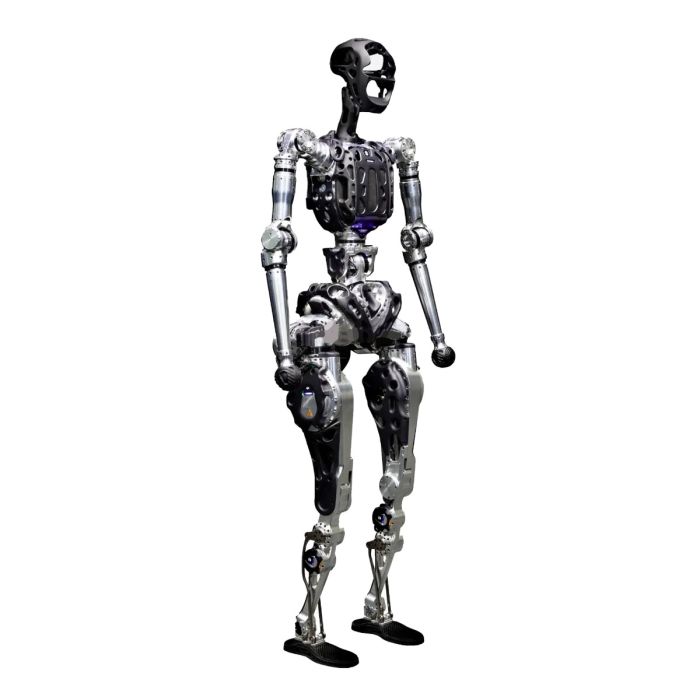
Adam Lite follows a conventional head–torso–two arms–two legs layout to maximize compatibility with human environments (stairs, handrails, doors, switches). The platform’s stated goal is to provide human-scale reach and gait with sufficient payload for tools and sensors, while keeping mechanical complexity manageable for developers.
Actuation and drivetrain
Core to the Lite variant is PNDbotics’ use of quasi-direct-drive (QDD) actuators with force control across the body. Peer-reviewed work employing Adam(Lite) reports 25 QDD actuators, 1.6 m height, ~60 kg mass, and up to 340 N·m maximum leg joint torque—figures that help explain its dynamic balance and stair/obstacle capabilities.
Modularity and serviceability
PNDbotics markets the Adam family as modular and standardized, enabling component-level maintenance and upgrades (e.g., actuators, end-effectors, and compute). This approach is intended to shorten mean time to repair (MTTR) and lower lifecycle costs for R&D and pilot deployments.
Human–robot interaction (HRI)
Demonstrations focus on human-proximate motion—stable walking, coordinated arm gestures, and staged performances—supported by perception and high-bandwidth motor control. While “Lite” typically ships with simplified end-effectors (e.g., ball or paddle-style wrists) versus dexterous multi-finger hands, it remains suitable for navigation, carrying, and basic tool use once integrated with appropriate grippers.
Technology and Specifications
Specifications below consolidate figures explicitly published for Adam(Lite) in academic and trade sources; options can vary by configuration and production batch.
-
Height: ~1.6 m
-
Mass: ~60 kg
-
Actuators: 25 QDD, force-controlled (full body)
-
Leg torque (max): up to 340 N·m (per leg actuator class)
-
Kinematics: bipedal lower body; 5-DoF arms reported in Lite trials
-
Hands: simplified end-effectors on Lite; dexterous hands shown on non-Lite/other Adam variants
-
Software: developer-oriented SDK with reinforcement-learning (RL) and imitation-learning workflows
-
Target use: locomotion research, navigation, basic manipulation/tooling, demonstration tasks
Control and autonomy
Adam Lite is typically operated with a layered stack: whole-body control (balancing, footstep planning), trajectory generation for arms and torso, and policy learning for complex skills. Public demonstrations and reports highlight reinforcement learning and sim-to-real methods for achieving agile gait and coordinated motions in hours to days of training on the broader Adam platform.
Perception
While the Lite documentation focuses on mechanics, PNDbotics showcases for the Adam series frequently include RGB/Depth vision and sensor fusion for scene understanding, object pose estimation, and waypoint navigation—capabilities necessary for service and event demonstrations.
Applications and Use Cases
Research and higher education
Adam Lite’s mechanical transparency (QDD + force control) and documented specs make it suitable for locomotion control, state estimation, and whole-body planning research. Labs can benchmark gait robustness, stair traversal, and recovery strategies using repeatable hardware with known torque/DoF budgets.
Enterprise pilots and demonstrations
Trade coverage has showcased the Adam series in public performances and pilot scenarios, emphasizing stable gait, coordinated gestures, and repeatable sequences for brand activations and technology showcases. Lite’s simpler end-effectors favor navigation, carrying, and scripted interactions, with upgrades available on other Adam variants for fine manipulation.
Developer ecosystems
Listings position the Adam line as developer-friendly with open or open-leaning SDKs and support for common RL environments, enabling rapid prototyping of embodied-AI behaviors without constructing hardware from scratch.
Advantages / Benefits
-
Quasi-direct-drive force control: QDD actuators provide back-drivability and fine torque regulation, improving disturbance rejection and contact-rich behaviors (e.g., stairs, ramps).
-
Documented baseline specs: The Lite variant’s height, mass, actuator count, and torque capacity are covered in academic literature, aiding reproducibility for research.
-
Modular platform: PNDbotics’ emphasis on standardization and integration supports maintenance, upgrades, and adaptation to task-specific end-effectors.
-
Developer tooling: Availability of SDKs and RL workflows shortens time-to-first-prototype for labs and startups exploring humanoid applications.
FAQ
What is the Pndbotics Adam Lite humanoid robot?
Adam Lite is a 1.6 m, ~60 kg bipedal humanoid from PNDbotics that uses 25 QDD force-controlled actuators as a developer-friendly platform for locomotion and embodied-AI research.
How does Adam Lite work?
It combines quasi-direct-drive actuators with whole-body control and learning-based policies (e.g., RL) to produce stable walking, balance, and coordinated motions; perception stacks can be added for navigation and interaction.
Why is Adam Lite important?
The Lite variant provides documented, reproducible hardware for legged-robotics research and developer trials, lowering barriers to entry and accelerating sim-to-real development for humanoid applications.
What are Adam Lite’s key specifications?
Published figures report 1.6 m height, ~60 kg mass, 25 force-controlled QDD actuators, and up to 340 N·m leg torque in Lite trials; arm DoF and end-effector options vary by configuration.
How does Adam Lite differ from other Adam variants?
Lite prioritizes locomotion research with simpler wrists; other Adam versions (e.g., SP or U) add more DoF, dexterous hands, or wheeled upper-body formats and VLA-assisted autonomy for manipulation-heavy tasks.
Summary
The Pndbotics Adam Lite is a baseline bipedal humanoid platform emphasizing force-controlled QDD actuation, documented specs, and developer-oriented tooling. Its published dimensions and actuator design, reinforced by academic use, make it a reliable choice for legged-locomotion research, whole-body control studies, and early-stage service pilots. For full manipulation capability and advanced hands, organizations may consider other Adam variants; however, Adam Lite’s reproducibility, modularity, and SDK support position it as a practical entry point into human-scale embodied AI.