Noetix DORA Universal Humanoid Robot (DORA)
In stock
- BRAND:
- NOETIX
- PART #:
- DORA
- ORIGIN:
- China
- AVAILABILITY:
- SUBJECT TO AVAILABILITY
- SKU:
- Noetix-DORA
Noetix DORA Universal Humanoid Robot (DORA)
DORA Universal Humanoid Robot (DORA)
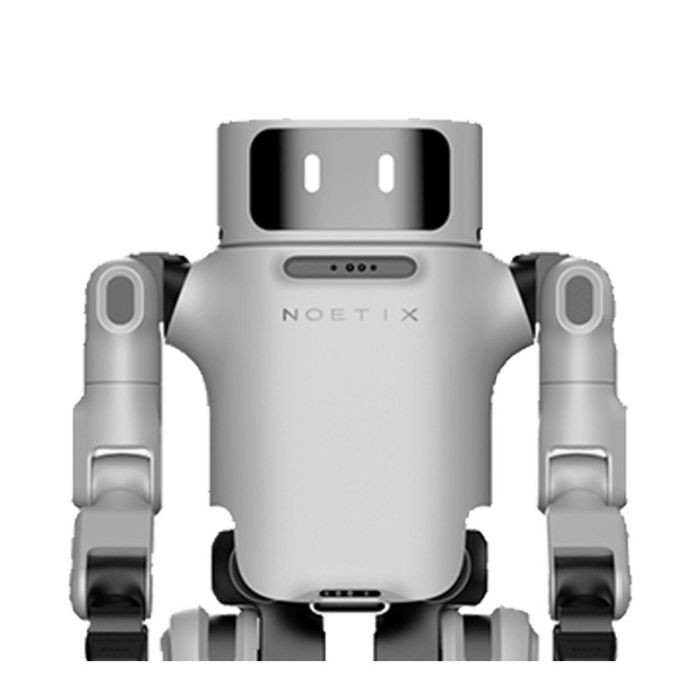
In Noetix’s lineup, DORA is presented as a productized lightweight general-purpose humanoid that supports conversational interaction and vision-based perception, aiming to make humanoid experimentation more accessible for labs, classrooms, and early-stage deployments.
Design and Features
Compact humanoid form factor
Noetix’s English product listing describes DORA with a product size of 100 × 50 × 25 cm and a weight of 20 kg, placing it in a smaller class than full-height industrial humanoids and making it easier to transport, stage indoors, and operate in controlled environments.
Third-party summaries similarly describe DORA as roughly 1 meter tall and lightweight, though exact dimensions can vary by listing and configuration.
“Universal humanoid” interaction hardware
Noetix’s DORA page emphasizes built-in interaction elements, including a 7-inch screen, a 6-microphone array, and a speaker, supporting voice and UI-driven demonstrations and basic human–robot interaction workflows.
Degrees of freedom and optional dexterous hands
Noetix describes DORA as an electrically driven humanoid with:
-
Arm DOF: 4 × 2
-
Leg DOF: 6 × 2
-
Optional dexterous hands: 11 × 2
-
Total: 20–26 DOF depending on configuration
This configuration aligns with DORA’s role as a general-purpose platform: enough articulation for legged motion and basic arm positioning, with optional hands for richer manipulation experiments.
Technology and Specifications
Locomotion and payload (as published)
Noetix’s English product listing includes the following performance-oriented specifications:
-
Peak torque: 120 N·m
-
Maximum movement speed: 1 m/s
-
Payload: 5 kg
These figures position DORA as a practical indoor humanoid for controlled navigation and light object handling in demos or lab settings, rather than a high-speed athletics-focused robot.
3D perception and sensing
DORA is described as having 3 depth cameras for 3D visual perception, supporting tasks such as obstacle detection, basic mapping, and interaction awareness.
Depth-camera-centric perception stacks are common in compact humanoids because they provide useful scene geometry without the cost, power, or mechanical complexity of some higher-end sensor suites.
Edge computing (as published)
Noetix’s English product listing references “8GB of GPU” under edge computing power, indicating an onboard compute capability oriented toward real-time perception and interaction workloads.
Some third-party catalogs describe DORA as using a Jetson Orin-class edge AI module, but those entries are sometimes explicitly marked as “not verified,” so they should be treated as indicative rather than definitive unless confirmed in the specific purchase configuration.
“Embodied intelligence” positioning
Noetix frames DORA as a carrier for embodied intelligence—AI systems that connect perception (vision, audio) to real-world action (locomotion, gestures, manipulation). This “platform” framing is also reflected by partner pages that describe DORA as a lightweight productized general humanoid capable of chat companionship and care-oriented interaction scenarios.
Applications and Use Cases
Education and classroom humanoid robotics
DORA’s size, published payload rating, and integrated interaction hardware make it suitable for:
-
introductory humanoid robotics demonstrations (walking, turning, posture control),
-
AI + robotics teaching (perception-to-control pipelines),
-
student projects involving HRI (voice interaction, on-screen UI behaviors).
Research and development testbed
In R&D environments, compact humanoids are often used to prototype:
-
perception modules using depth cameras,
-
basic whole-body control and gait tuning,
-
task scripts that combine navigation, simple arm motions, and interaction prompts.
Where optional hands are included, DORA can also serve as a stepping stone into dexterous-manipulation experiments, though real-world capability depends heavily on gripper/hand design, control software, sensing, and safety constraints.
Service-style demos and interactive deployments
Noetix and its partners position DORA as a general humanoid that can support chat companionship and care/assistance-themed demonstrations. These deployments are typically early-stage (proof-of-concept and controlled pilots), but they are important for gathering user feedback and validating human-facing interaction design.
Advantages / Benefits
Lightweight, productized humanoid platform
Partner descriptions frame DORA as a lightweight and productized general humanoid, which matters because many humanoid robots remain prototype-only or require significant engineering support to operate consistently.
Integrated interaction stack
A built-in screen, microphone array, and speaker reduces integration work for voice/UI demos—useful for education, exhibitions, and early service pilots.
Configurable DOF for different budgets and goals
The 20–26 DOF range and optional dexterous hands allow buyers to choose a configuration aligned to their needs—locomotion and interaction first, manipulation later.
Practical performance envelope for indoor work
With a published 1 m/s max speed and 5 kg payload, DORA targets a pragmatic indoor envelope: stable motion, safe demonstrations, and light handling tasks.
FAQ Section
What is the Noetix DORA Universal Humanoid Robot?
Noetix DORA is a compact bipedal humanoid robot positioned as a “universal humanoid” and a carrier for embodied intelligence, designed for education, R&D, and interactive demonstrations.
How does the Noetix DORA robot work?
DORA combines electrically driven joints (20–26 DOF depending on configuration) with depth-camera-based 3D perception and onboard compute, plus built-in interaction hardware (screen, microphone array, speaker) to support perception, motion, and human-facing demos.
Why is Noetix DORA important?
DORA reflects the push toward productized, lightweight humanoids that can be deployed in classrooms, labs, and early pilots without the cost and operational complexity of full-size humanoids, enabling faster iteration for embodied AI and HRI.
What are the benefits of Noetix DORA?
Key benefits cited in published materials include a compact footprint (100 × 50 × 25 cm), 20 kg weight, configurable 20–26 DOF, 3 depth cameras for 3D perception, and integrated interaction hardware (screen + mic array + speaker), supporting education and prototyping workflows.
Summary
The Noetix DORA Universal Humanoid Robot (DORA) is a compact, product-oriented humanoid designed to bridge the gap between research prototypes and deployable platforms. With 20–26 DOF, a published 5 kg payload, 1 m/s max speed, 3 depth cameras for 3D perception, and built-in interaction hardware (screen, microphone array, speaker), DORA is positioned as a practical carrier for embodied intelligence, education, and early-stage interactive deployments.