
MagicLab MagicBot Z1 Development Edition Humanoid Robot
In stock
- BRAND:
- MAGICLAB
- MODEL:
- MAGICBOT Z1 DEVELOPMENT EDITION
- ORIGIN:
- China
- Warranty:
- 12 MONTHS
- AVAILABILITY:
- SUBJECT TO AVAILABILITY
- SKU:
- MagicLab-MagicBot-Z1-Dev
MagicLab MagicBot Z1 Standard Humanoid Robot
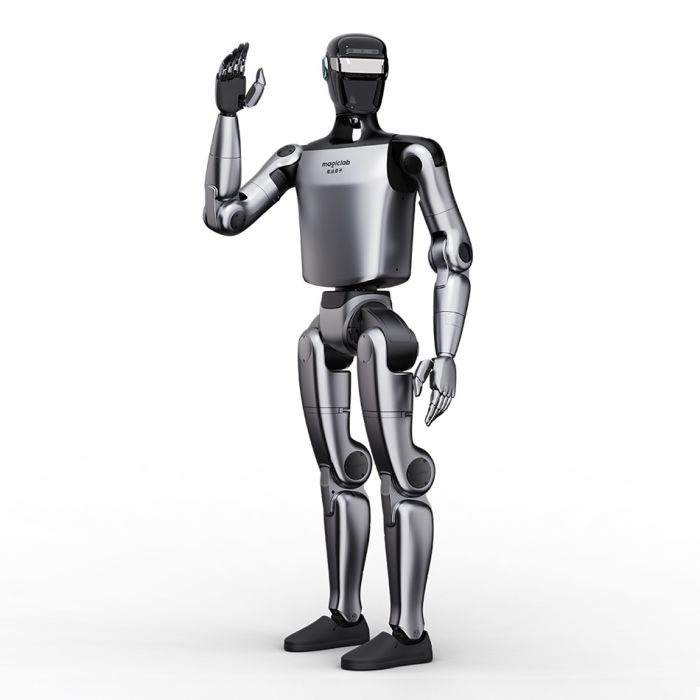
MagicLab positions the Z1 family as an agile humanoid robot built around open frameworks, autonomous navigation, multimodal perception, and embodied AI development. The company’s official launch materials describe the Z1 as combining high performance, an open AI ecosystem, and broad deployment potential across research, commercial service, and interactive scenarios. Within that lineup, the Development Edition is the configuration intended for users who need deeper secondary development and more advanced hardware flexibility than the standard model.
This makes the MagicBot Z1 Development Edition relevant to universities, robotics labs, system integrators, and commercial teams evaluating a humanoid platform for research, education, demonstrations, and application prototyping. That characterization is partly an inference, but it is strongly supported by MagicLab’s own application categories and by the configuration differences shown between the Z1 and Z1 Development Version.
Design and Features
Compact Humanoid Form Factor
The MagicBot Z1 Development Edition uses the same compact body envelope as the base Z1. MagicLab lists standing dimensions of 1369 × 422 × 200 mm and folded dimensions of 730 × 422 × 395 mm. Weight is listed as approximately 40 kg+ with battery, indicating that the development configuration may vary slightly depending on optional components.
That size puts the Z1 Development Edition in a smaller class than many full-size industrial humanoids while still preserving a humanlike bipedal form. In practical terms, this makes it easier to use in labs, classrooms, exhibitions, and controlled commercial environments than larger humanoids that need more space or heavier-duty logistics. This final point is an inference based on the official dimensions and MagicLab’s application framing.
Expandable Degrees of Freedom
A defining feature of the Development Edition is expandability. MagicLab lists the standard Z1 at 24 total degrees of freedom, while the Development Version is listed at 24–50 DoF. The base arm configuration is 5 DoF per arm, and the Development Version can optionally add 2 extra wrist degrees of freedom. It can also be fitted with an 11-DoF tactile dexterous hand.
This matters because it shifts the robot from a primarily locomotion-and-interaction platform into a more capable manipulation and research system. The optional wrist joints and dexterous hands are especially important for users exploring grasping, teleoperation, embodied AI, and more complex human-robot interaction tasks. That interpretation is an inference from the published hardware options and MagicLab’s open-development positioning.
Open and Developer-Oriented Architecture
MagicLab’s official Z1 page emphasizes that the robot is “Open and Shared” and describes it as being under the user’s control “from open-source frameworks to every robot movement.” The site also highlights autonomous perception, route planning, obstacle avoidance, multimodal interaction, and a “Super Embodied AI Agent” concept.
For developers, this is one of the Z1 Development Edition’s most important characteristics. The official positioning suggests that the platform is meant not just to demonstrate humanoid movement, but to support custom behavior development, sensor-driven applications, and integration with broader embodied AI workflows.
Technology and Specifications
Core Mechanical Specifications
MagicLab’s specification table lists the Z1 Development Version with 6 DoF per leg, 1 DoF in the head, 1 DoF in the waist, and 5 DoF per arm, plus optional wrist and dexterous-hand expansion. The shank plus thigh length is listed at 0.6 m, and arm span is listed at approximately 0.5 m. Range of motion figures include ±40° for the head Z-axis, ±160° for the lumbar Z-axis, and 0–152° for the knee joint.
MagicLab also lists the robot’s hip joint range as pitch ±160°, roll -30° to +110°, and yaw ±160°. These are unusually broad motion ranges for a compact humanoid and help explain MagicLab’s claims around dynamic locomotion and expressive movement.
Actuation, Torque, and Load
The Development Edition uses low-inertia, high-speed, high-overload permanent magnet synchronous motors with a 25 kHz control frequency, according to MagicLab’s official specifications. Joint output bearing is listed as an industrial-grade high-rigidity roller bearing capable of withstanding 8.7 kN impact force.
Compared with the base Z1, the Development Edition has higher published strength figures. MagicLab lists maximum knee torque at 130 N·m for the Development Version, versus 100 N·m for the base model, and maximum arm load at 3 kg versus 2 kg. These upgraded figures reinforce the Development Edition’s role as the more capable configuration for manipulation-heavy or research-oriented use.
Perception, Audio, and Connectivity
MagicLab lists the Development Edition’s perception package as 3D LiDAR + depth camera + binocular fisheye camera + head tactile sensor. It also includes Wi-Fi 6, Bluetooth 5.2, a microphone array, and a 5W speaker.
These components support the robot’s positioning as a multimodal humanoid rather than a pure locomotion machine. The mix of spatial sensing, audio I/O, and tactile input is especially relevant for navigation, interaction, and experimental embodied-AI tasks in real environments. That conclusion is an inference from the official sensor list and MagicLab’s product-page descriptions.
Compute, Power, and Runtime
The Development Edition ships with an 8-core high-performance CPU as its basic compute platform, and MagicLab specifies that a high-computing-power module is optional for this version, while the base Z1 lists none. Power is supplied by a 15-cell battery, with a 10000 mAh smart quick-release battery, 62V 5A charger, and approximately 2 hours of battery life.
This combination suggests a robot intended for field demonstrations, lab sessions, and prototyping rather than full-day untethered operation. The quick-release battery design also indicates a workflow built around iterative testing and recharge cycles rather than permanent fixed installation. That is an inference based on the official battery and runtime specifications.
Optional Dexterous Hand System
MagicLab’s in-house MagicHand S01 is the dexterous hand option associated with the Z1 Development platform. The official hand page lists 11 DoF per hand, 5 tactile sensors, 0.1 N tactile resolution, 2.5 kg single-finger gripping force, 9.1 kg four-finger gripping force, 5 kg whole-hand maximum payload, and 0.2 mm end-position repeatability.
These figures matter because they move the Development Edition beyond demonstration-grade humanoid motion and into more serious manipulation territory. For researchers working on grasp planning, tactile interaction, or dexterous manipulation, the optional hand system is one of the platform’s most significant upgrades over the standard Z1 configuration.
Applications and Use Cases
Scientific Research and Education
MagicLab explicitly lists Scientific Research and Education as one of the MagicBot Z1 application scenarios on its official product page. That makes the Development Edition particularly suitable for universities, robotics departments, AI labs, and advanced teaching environments where sensor access, motion control, and hardware expandability matter.
Exhibition, Cultural Tourism, and Interactive Experiences
The official Z1 page also lists Exhibition and Cultural Tourism and Commercial Performances and Entertainment as application areas. Those categories align well with a compact humanoid that can navigate autonomously, interact through voice and multimodal sensing, and perform expressive or attention-grabbing behaviors.
Developer Prototyping and Embodied AI
Because the Development Edition adds optional dexterous hands, optional wrist joints, and optional high-compute modules, it is especially relevant to teams building prototypes for embodied AI, teleoperation, manipulation, or custom task libraries. MagicLab’s wording around open frameworks, route planning, and environment perception supports this interpretation, even though the site does not publish a single exhaustive workflow list for all developer use cases.
Advantages / Benefits
One of the Development Edition’s biggest advantages is expandability. The jump from 24 DoF to as many as 50 DoF, together with optional dexterous hands and extra wrist joints, gives users a broader development runway than the standard Z1.
A second advantage is its balanced size-to-capability ratio. At roughly 40 kg and 1369 mm tall, it is compact enough for many indoor research and demo environments, while still offering industrial-style components such as high-rigidity roller bearings, a 3D LiDAR-based perception stack, and meaningful joint torque.
A third advantage is its open development orientation. MagicLab’s own language emphasizes control, open frameworks, and embodied AI, which makes the platform attractive to users who want a humanoid robot they can shape rather than a closed appliance.
FAQ Section
What is the MagicLab MagicBot Z1 Development Edition Humanoid Robot?
The MagicLab MagicBot Z1 Development Edition is the expandable developer-focused version of the Z1 humanoid platform, offering 24–50 DoF, optional dexterous hands, optional wrist expansion, and optional high-computing-power modules.
How does the MagicLab MagicBot Z1 Development Edition work?
It combines bipedal locomotion hardware, industrial-grade joint components, multimodal perception sensors such as 3D LiDAR and depth cameras, onboard computing, and optional manipulation hardware to support navigation, interaction, and developer-defined tasks.
Why is the MagicLab MagicBot Z1 Development Edition important?
It is important because it offers a compact humanoid form with meaningful expandability for research and secondary development, bridging the gap between a fixed demo robot and a more configurable humanoid development platform.
What are the benefits of the MagicLab MagicBot Z1 Development Edition?
Its main benefits include a compact humanoid footprint, higher torque than the base Z1, optional dexterous hands, richer expansion options, and an open development-oriented design.
Does the MagicLab MagicBot Z1 Development Edition support dexterous hands?
Yes. MagicLab’s official Z1 specification lists an optional 11-DoF tactile dexterous hand for the Development Version, and MagicLab’s MagicHand S01 page provides the detailed specifications for that hand system.
Summary
The MagicLab MagicBot Z1 Development Edition Humanoid Robot is a compact, expandable humanoid platform aimed at developers, researchers, and advanced educational users. Its strongest differentiators are 24–50 DoF expandability, optional 11-DoF tactile dexterous hands, 130 N·m knee torque, 3D LiDAR-based perception, and an open development-oriented architecture. For teams seeking a smaller humanoid robot with more flexibility than a fixed standard model, the Z1 Development Edition stands out as one of MagicLab’s most configurable current offerings.