Developer-first humanoid platform
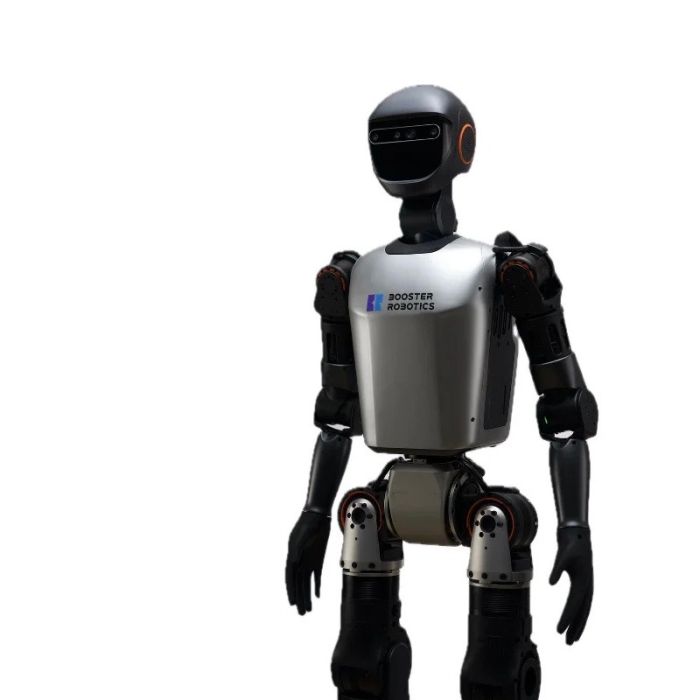
A central feature of the Booster T1 platform is its developer-first design philosophy. Booster Robotics emphasizes open tools, API access, and a framework intended for secondary development. Generation Robots likewise describes the platform as an open-source humanoid robot oriented toward research and education, with low-level joint and sensor APIs as well as advanced motion-control interfaces.
This matters because many humanoid robots are closed systems built mainly for demonstration. The Booster T1, by contrast, is openly presented as something users are expected to program, simulate, test, and adapt. That makes it especially relevant to robotics labs, AI researchers, university teams, and developers building custom workflows for locomotion, perception, and manipulation. This interpretation follows directly from the product’s official “Made for Developers” positioning and distributor descriptions of open APIs and ROS 2 support.
Compact, lightweight humanoid body
Booster Robotics’ official materials and multiple distributor listings describe the T1 as a lightweight humanoid, with public specifications placing it at approximately 118 cm in height and 30 kg in weight. This is a notable design choice because it makes the robot easier to ship, set up, reset after falls, and use in constrained indoor environments than much larger humanoids.
The compact form factor also supports a wider range of development scenarios. Smaller humanoids are often easier to power, safer to test, and less demanding in terms of lab infrastructure. Booster’s emphasis on flexibility and durability reinforces the idea that the T1 is built not just to look humanoid, but to be practical for iterative development and competition use.
Dexterous hand configuration
The defining characteristic of this version is its dexterous hands. Public listings describe the with-Dexterous-Hands model as a 41-DoF configuration, which makes it substantially more capable in hand-based interaction than the 31-DoF gripper version or the 23-DoF basic model. This higher DoF count strongly suggests that much of the added capability lies in the hand system and upper-body manipulation architecture.
Although the retrieved official Booster page does not publish a detailed finger-by-finger hand breakdown in the search snippet, retailers consistently frame this version as the most advanced manipulation-oriented T1 model. That makes it especially relevant for users studying grasping, dexterous object handling, embodied AI, teleoperation, and fine motor control. This is an inference supported by the published DoF counts and product naming.
Competition-tested durability
Booster Robotics also highlights the T1’s durability and competitive credibility. Its official page describes the T1 as the RoboCup 2025 champion robot and says it is used by 50+ top global robotics teams and research institutes. Those claims position the platform as something proven in demanding dynamic environments rather than merely a showroom concept.
Technology and Specifications
Degrees of freedom and mechanical structure
The clearest public technical distinction of the dexterous-hands version is its 41 DoF configuration. Generation Robots, RBTX, and retail listings all agree on the T1 family structure: 23 DoF for the base model, 31 DoF for the gripper version, and 41 DoF for the dexterous-hands version. This makes the dexterous-hands model the most mechanically capable T1 configuration currently publicized in mainstream distribution channels.
This higher DoF count matters for more than marketing. In humanoid robotics, extra upper-body and hand degrees of freedom can translate into richer manipulation, more humanlike gesture range, and more advanced whole-body coordination experiments. The T1 with Dexterous Hands therefore appears aimed at users who need a more expressive manipulation platform than simple grippers can provide. This is an inference grounded in the published configuration hierarchy.
Actuation and joint performance
Public technical summaries describe the Booster T1 as using dual encoder force actuators with up to 130 N·m torque. Those figures appear in distributor and technical marketplace descriptions and align with Booster’s positioning of the T1 as a high-performance bipedal robot trusted by competition teams and researchers.
That level of torque is significant for a compact humanoid because it supports balance recovery, dynamic locomotion, and more demanding motion-control research. While the snippets do not provide a complete per-joint torque map, the published headline figure is enough to show that the T1 is not merely a low-power educational platform.
Compute platform and AI processing
The T1 family is also notable for its onboard compute. Generation Robots lists NVIDIA AGX Orin with 200 TOPS of AI compute, while US Robot Store specifies the dexterous-hands variant as 41 DoF with NVIDIA Jetson AGX Orin 32GB. These are substantial embedded AI capabilities for a robot of this size.
This level of onboard processing is relevant because humanoid robotics often depends on real-time perception, control, mapping, and AI inference. The inclusion of AGX Orin-class hardware suggests the T1 is intended for modern robotics workflows involving simulation, embodied AI, perception stacks, and possibly multimodal experiments that go beyond pre-scripted motion playback. This is an inference based on the published compute hardware and developer positioning.
Sensors and interaction hardware
Public product descriptions list the T1 with a depth camera, 9-axis IMU, microphones, and a speaker. These components are standard but important for humanoid robotics because they support environmental perception, orientation and balance sensing, audio input, and feedback or human-robot interaction.
The sensor package suggests that the robot is designed for more than locomotion testing alone. It is also prepared for multimodal research, interactive demos, and embodied AI experiments in which the robot must perceive and respond to its surroundings. This is an inference supported by the listed sensors and Booster’s developer-oriented framing.
Software ecosystem and connectivity
Booster T1 is widely described as supporting ROS 2, simulation environments, and low-level and high-level control APIs. Generation Robots explicitly references API, ROS 2, and simulation environments, while Booster’s own site stresses a complete development ecosystem and open tools. Public listings also mention Wi-Fi 6, Bluetooth 5.2, optional 5G, USB, and Ethernet connectivity for the broader T1 family.
For developers, this is one of the robot’s strongest selling points. A humanoid robot is only as useful as its software accessibility, and the T1’s public positioning indicates that Booster is trying to reduce the barrier to entry for serious robotics development.
Battery life and practical runtime
Booster Robotics’ official T1 page states around 2 hours of walking and 4 hours of standing endurance. Generation Robots publishes the same runtime figures. These are realistic lab and demo durations for a compact electric humanoid, particularly one carrying high-performance compute and multiple sensing systems.
Applications and Use Cases
Robotics research and university development
The Booster T1 with Dexterous Hands is especially well suited to research and education. Both Booster Robotics and its distributors consistently position the platform for developers, researchers, and advanced educational teams. Its compact size, open APIs, ROS 2 support, and simulation compatibility make it well aligned with university and lab workflows.
For researchers, the dexterous-hands version is especially attractive because it extends the robot from locomotion and posture control into manipulation research. That makes it a better candidate for projects involving grasping, object transfer, humanlike hand control, and embodied task learning than the simpler T1 variants. This is an inference based on the configuration hierarchy and product naming.
Embodied AI and manipulation experiments
The dexterous-hand configuration appears tailored for embodied AI and more complex action learning. A robot with 41 DoF, onboard AGX Orin compute, camera and IMU sensing, and ROS 2 support is well matched to experiments where perception and action must be coupled in real time.
This does not mean the T1 with Dexterous Hands is a turnkey household robot or industrial worker. Rather, it is best understood as a developer platform for experimentation in how humanoids move, perceive, and manipulate. That interpretation is directly supported by Booster’s “Made for Developers” messaging and the technical stack visible in public listings.
Competitions and RoboCup-style environments
Booster strongly ties the T1 platform to RoboCup and competition robotics. Its official page calls it the RoboCup 2025 champion robot and highlights its use by leading teams. For competition environments, a balance of durability, manageable size, and software openness is especially valuable, and the T1 appears to have been designed with that use case in mind.
Advanced demonstrations and public-facing research showcases
Because of its humanoid form, onboard audio, perception hardware, and dexterous hands, the robot is also well suited to public-facing demos, research exhibitions, and advanced educational showcases. This is not the only or main use case, but it follows naturally from the platform’s compact size and rich sensor/compute stack.
Advantages / Benefits
One of the main advantages of the Booster T1 with Dexterous Hands is its size-to-capability balance. At about 118 cm and 30 kg, it is small enough to be practical in labs and classrooms, yet powerful enough to offer 41 DoF, serious onboard AI compute, and advanced manipulation capability.
A second advantage is its open software and developer support. Booster Robotics explicitly markets the T1 for developers, and third-party distributors reinforce that by listing APIs, ROS 2 support, and simulation compatibility. This is a meaningful differentiator in a market where many humanoid platforms remain partially closed or difficult to integrate.
A third benefit is the dexterous-hand upgrade path itself. Compared with the gripper version, the dexterous-hands model offers richer manipulation potential for labs that need more than simple pick-and-place action. That makes it a stronger candidate for advanced research in hand control, fine manipulation, and humanlike motion planning.
A fourth advantage is that the platform appears to be competition-tested and durable. Booster’s RoboCup-related claims and wide team adoption suggest the robot is not only theoretically capable but operationally robust enough for repeated dynamic use.
FAQ Section
What is the Booster T1 with Dexterous Hands humanoid robot?
The Booster T1 with Dexterous Hands is the most advanced public version of Booster Robotics’ T1 humanoid platform. It is a compact developer-focused humanoid robot with 41 degrees of freedom, designed for research, education, AI development, and advanced manipulation tasks.
How does the Booster T1 with Dexterous Hands work?
It combines bipedal locomotion hardware, dexterous hands, onboard AI compute based on NVIDIA AGX Orin, sensing such as a depth camera and 9-axis IMU, and software support including ROS 2 and simulation environments. Together, these systems allow it to move, perceive, and interact with objects in research and development contexts.
Why is the Booster T1 with Dexterous Hands important?
It is important because it offers an unusually compact and open humanoid development platform with advanced manipulation capability. That makes it useful for labs and developers who need a research humanoid that goes beyond locomotion into dexterous interaction.
What are the benefits of the Booster T1 with Dexterous Hands?
Its main benefits include 41 DoF, dexterous manipulation capability, compact size, open APIs, ROS 2 compatibility, strong onboard AI compute, and a platform design already associated with leading research teams and RoboCup use.
Summary
The Booster T1 with Dexterous Hands Humanoid Robot is a compact, developer-centered humanoid platform built for advanced robotics work. Its most important strengths are 41 DoF, dexterous-hand manipulation, NVIDIA AGX Orin-class onboard compute, ROS 2 compatibility, and a research-friendly open ecosystem. For teams working on embodied AI, humanoid locomotion, and advanced manipulation, it stands out as one of the more accessible compact humanoid research platforms currently available on the market.