
Agilex TRACER 2.0 (TRACER 2.0)
In stock
- BRAND:
- AGILEX
- PART #:
- TRACER 2.0
- ORIGIN:
- China
- AVAILABILITY:
- SUBJECT TO AVAILABILITY
- SKU:
- AgileX-TRACER-2.0
Agilex TRACER 2.0 (TRACER 2.0)
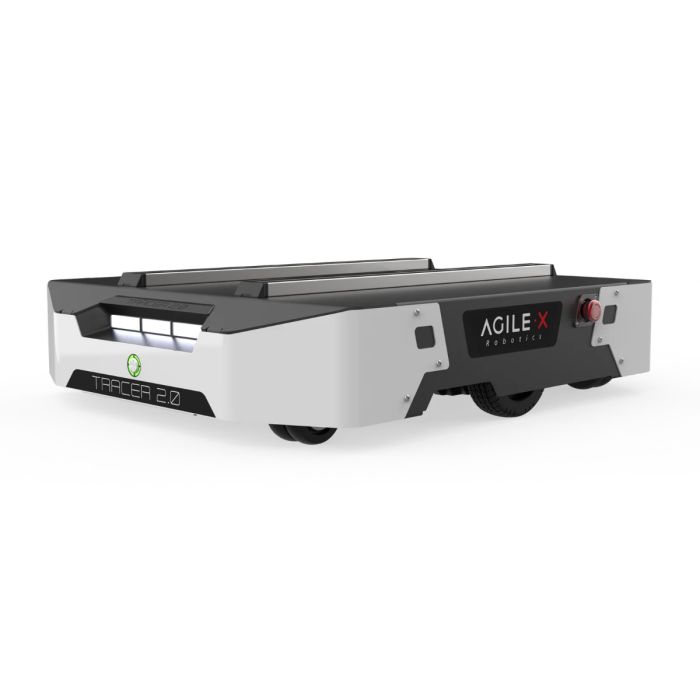
TRACER 2.0 is typically used as a development-ready drive platform rather than a fully autonomous robot. The manufacturer documentation emphasizes that integrators are responsible for building the complete system (including risk assessment and any safety functions needed for the final application).
Design and Features
Chassis layout and payload architecture
TRACER 2.0 uses a two-wheel differential drive configuration that enables turning in place (zero-radius style maneuvering), which is especially relevant for tight warehouse aisles, labs, and indoor corridors.
The platform is marketed with a high payload capacity for its footprint—commonly listed as 150 kg rated payload—to support carrying totes, fixtures, sensor masts, or manipulation payloads.
Note: some operating/safety guidance in the user manual references a 100 kg maximum load in a usage context; in practice, integrators often treat payload limits as dependent on configuration, center of mass, speed, and application risk assessment.
Environmental durability and indoor mobility
TRACER 2.0 is generally described as suited for flat indoor ground and factory logistics use. Its ingress protection is typically cited as IP22 unless customized, meaning it is not intended for wet or dusty environments without additional protection.
For typical indoor obstacles, the product information cites the ability to negotiate small steps (about 10 mm) and gaps (about 25 mm), reflecting common transitions such as floor seams, elevator thresholds, or minor ramps.
Expansion and mounting provisions
TRACER 2.0 is designed for “secondary development” (i.e., integrator customization). The platform is described as offering mounting rails (e.g., aluminum T-slot rails) and support for external sensors and accessories such as LiDAR, stereo/depth cameras, RTK, and onboard compute modules.
Technology and Specifications
Drive, steering, and motion control
TRACER 2.0’s motion comes from two brushless hub motors (commonly listed as 2 × 400 W) with encoder feedback, using differential steering for movement control.
Its maximum speed is commonly stated as up to 2.0 m/s (often described at full load in datasheets), with a listed maximum gradeability around 8° in typical reference material.
Power system and endurance
Documentation commonly describes a 24V 30Ah lithium battery system with an approximate 3-hour charging time and a stated endurance range that may be described either in time (e.g., “6 hours” in some marketing summaries) or distance (often up to 80 km under specified conditions).
Because endurance depends heavily on payload mass, driving profile, floor condition, and added compute/sensors, published figures are best treated as reference values rather than guarantees.
Interfaces and development stack
TRACER 2.0 commonly provides CAN bus as a primary system interface for command and telemetry, and is positioned as supporting developer workflows (including software resources/SDK references and ROS-oriented examples in documentation).
The user manual also notes practical integration details such as expansion power considerations and recommended operating environments.
Key specifications (commonly published)
| Parameter | Typical published value |
|---|---|
| Drive | Two-wheel differential (turn-in-place) |
| Motors | 2 × 400W brushless |
| Battery | 24V 30Ah lithium battery |
| Max speed | Up to 2.0 m/s |
| Rated payload | Often listed as 150 kg (usage guidance may vary) |
| Dimensions | ~702 × 610 × 169 mm |
| Weight | ~54–56 kg |
| Ingress protection | IP22 (unless customized) |
| Operating temperature | Often cited around -10°C to 40°C |
Applications and Use Cases
TRACER 2.0 is commonly used as a foundation for:
-
Indoor logistics and material transport prototypes, such as tote delivery, line-feeding, and lab sample handling, where turning-in-place and payload capacity are valuable.
-
Robotics R&D mobile base projects, including navigation algorithm testing, sensor fusion experiments, and autonomy research using LiDAR or vision modules installed by integrators.
-
Education and training in mobile robotics development, where a repeatable hardware base supports ROS2 learning, CAN communication exercises, and systems integration.
-
Security or inspection concepts (typically indoors or in controlled environments), where integrators add safety sensing and application software.
Advantages / Benefits
In published positioning, TRACER 2.0 is often chosen for:
-
Compact maneuverability: differential drive with turn-in-place behavior for constrained indoor layouts.
-
High payload-to-footprint ratio: frequently marketed with a 150 kg class payload capability.
-
Development friendliness: CAN-based control, expansion options, and documentation that targets integrators building custom autonomy stacks.
-
Modular integration path: compatibility with common robotics sensors and onboard compute modules, depending on the integrator’s configuration.
FAQ
What is AgileX TRACER 2.0?
AgileX TRACER 2.0 is a two-wheel differential AGV/UGV mobile robot chassis designed for indoor logistics prototyping and robotics R&D, intended to be expanded with sensors, compute, and application payloads.
How does TRACER 2.0 work?
TRACER 2.0 uses two brushless hub motors with differential steering to move and rotate in place. It is commonly controlled via CAN bus commands and can be integrated with external sensors and onboard computing for navigation or autonomy.
Why is TRACER 2.0 important?
It provides a repeatable hardware base for mobile robotics development, enabling research teams and integrators to test navigation, perception, and logistics workflows on a platform designed for payload handling and indoor maneuverability.
What are the benefits of TRACER 2.0?
Commonly cited benefits include turn-in-place maneuverability, a high payload capacity for indoor logistics tasks, and integration-oriented interfaces (e.g., CAN) that support custom autonomy and sensor stacks.
Summary
AgileX TRACER 2.0 is a compact, two-wheel differential mobile robot chassis designed for indoor logistics and robotics R&D, emphasizing turn-in-place maneuverability, CAN-based integration, and published specifications such as 2.0 m/s class speed and 24V battery power. As a development platform, it is typically deployed as part of a larger system—paired with sensors, compute, and application software—built by integrators to meet the safety and performance requirements of real-world use.
Specifications
| PART # | TRACER 2.0 |
|---|---|
| BRAND | AGILEX |