
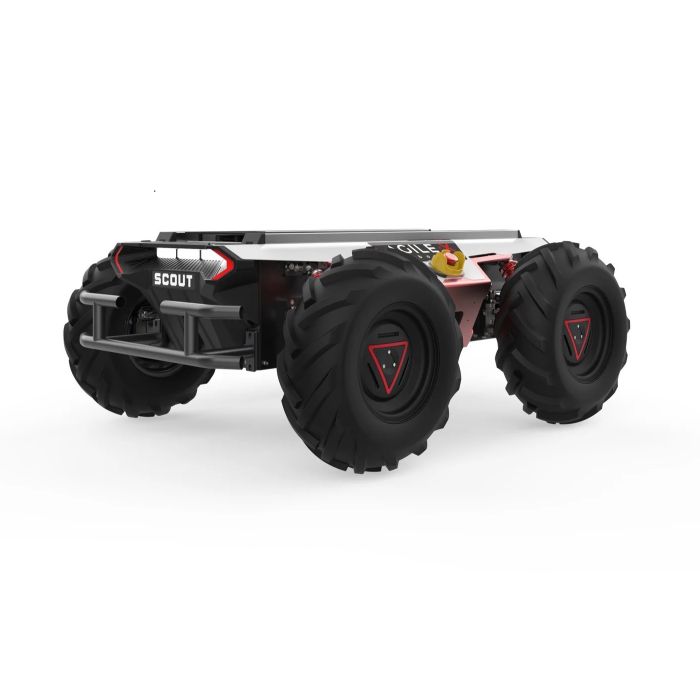
Agilex SCOUT 2.0 (SCOUT 2.0)
In stock
- BRAND:
- AGILEX
- PART #:
- SCOUT 2.0
- ORIGIN:
- China
- AVAILABILITY:
- SUBJECT TO AVAILABILITY
- SKU:
- AgileX-SCOUT-2.0
Agilex SCOUT 2.0 (SCOUT 2.0)
SCOUT 2.0 is positioned as an outdoor-capable chassis with an emphasis on independent suspension, expansion interfaces, and common robotics integration methods such as CAN bus and serial interfaces. Published documentation lists a 50 kg payload class, 1.5 m/s maximum speed (no load), and an IP22 baseline rating with upgrade paths (depending on configuration).
Design and Features
Four-wheel drive with independent suspension
SCOUT 2.0 uses a 4WD drivetrain and is marketed with a double-wishbone suspension and shock absorbers to improve stability on uneven ground. AgileX describes each wheel being driven independently by brushless servo motors, supporting off-road mobility on common outdoor surfaces.
Modular top deck and mounting rails
The chassis is designed for payload integration, including aluminum T-slot rails for mounting sensors, compute enclosures, manipulators, or custom superstructures. This “platform-first” layout is intended to shorten prototyping cycles by providing a robust base with standardized mounting patterns.
Expansion interfaces for power and communications
SCOUT 2.0 documentation and third-party manuals describe expansion interfaces intended to provide both power output and CAN communications for external devices. This approach supports typical robotics builds where a LiDAR, depth camera, or embedded PC needs both stable power and a low-latency control/telemetry link.
Safety-oriented chassis layout
User manuals emphasize safe operation practices and describe the chassis as a steer-by-wire system capable of accepting commands over CAN while reporting system state back to a host controller. Documentation also references onboard status feedback frames and control message cycles—features commonly used for safety monitoring and closed-loop control.
Technology and Specifications
Key published specifications (typical configuration)
While configurations and accessory bundles can differ by distributor, commonly published baseline specifications include:
-
Dimensions: 930 × 699 × 349 mm
-
Weight: 68 kg
-
Payload: 50 kg
-
Maximum speed (no load): 1.5 m/s
-
Maximum climbable slope (no load): 30°
-
Max obstacle height (no load): 150 mm
-
Ground clearance (minimum): 135 mm
-
Operating temperature: 0°C to 40°C
AgileX also describes SCOUT 2.0 as handling obstacles around 10 cm in its product overview text, which may reflect conservative “typical” marketing guidance versus the higher “no load” test value reported in specifications pages.
Power system and charging
A widely referenced specifications page lists a 24V 30Ah battery (with an upgrade option to 24V 60Ah), with listed charge times of ~3.5 hours (30Ah) and ~7 hours (60Ah).
Such published figures are commonly used for planning lab schedules and deployment windows, though real runtime varies with payload mass, terrain resistance, and driving profile.
Communications and control
Documentation lists CAN and serial interfaces as the primary communications methods for chassis control and telemetry, aligning with common robotics architectures where a companion computer runs autonomy while a low-level controller exposes motion and system state through a deterministic bus.
Manuals further describe the chassis accepting commands via CAN and returning real-time status feedback frames, which is helpful for logging, fault detection, and integration into ROS/ROS2 nodes.
IP rating and ruggedization options
SCOUT 2.0 is listed as IP22 in baseline specifications, with upgrade paths to IP44 or IP64 depending on the configuration/kit.
This matters for outdoor deployments: IP22 may be suitable for controlled environments, while higher IP variants can be better matched to dust and splash exposure scenarios.
Applications and Use Cases
Robotics research and development
SCOUT 2.0 is commonly used as a development base for autonomy stacks such as mapping, localization, obstacle avoidance, and waypoint navigation. AgileX highlights “secondary development” and open resources/SDK concepts, and a distributor datasheet frames the chassis as a standardized platform that can be installed with different upper loads and navigation systems.
Education and higher-ed robotics labs
Vendors selling into academia describe SCOUT 2.0 as suitable for higher education robotics programs, where students learn mobile robot kinematics, control, perception integration, and field testing practices.
Inspection, transportation, and prototyping payload carriers
Distributor materials describe usage scenarios including inspection and transportation prototypes, reflecting common industry patterns for mobile bases: carry a sensor mast for site scanning, transport tools in industrial campuses, or serve as a test vehicle for perception and planning algorithms.
Outdoor sensor integration (LiDAR/camera/GNSS)
Because SCOUT 2.0 is built as a chassis with expansion interfaces and mounting rails, it is frequently used as a carrier for perception sensors and navigation modules. Manuals emphasize the availability of power and CAN connections for expanded devices, supporting practical field builds.
Advantages / Benefits
Key benefits commonly associated with SCOUT 2.0 include:
-
Platform modularity: T-slot rails and standardized interfaces simplify payload mounting and iterative hardware changes.
-
Off-road-oriented mobility: 4WD with independent suspension is designed to improve stability on rough ground.
-
Integration-friendly control: CAN + serial interfaces, plus documented status feedback, support robotics middleware integration and telemetry logging.
-
Upgrade path for ruggedization: baseline IP22 with listed options up to IP44/IP64 can help teams choose an appropriate configuration for the operating environment.
-
Payload headroom for research builds: published payload of 50 kg enables substantial sensor/computer stacks compared with smaller indoor platforms.
FAQ Section
What is AgileX SCOUT 2.0?
AgileX SCOUT 2.0 is a 4WD UGV chassis used as a modular robotics platform for building autonomous or remotely operated mobile robots, with published 50 kg payload-class specs.
How does SCOUT 2.0 work?
SCOUT 2.0 provides the drivetrain, suspension, battery/power distribution, and chassis control interfaces (CAN/serial). Developers add sensors and computing to run navigation or teleoperation software, while the chassis reports system status via documented feedback frames.
Why is SCOUT 2.0 important?
It reduces the engineering effort required to build an outdoor-capable mobile base, allowing teams to focus on autonomy software, perception, payload design, and field validation rather than designing the chassis from scratch.
What are the benefits of SCOUT 2.0?
Benefits include independent suspension for rough terrain, aluminum T-slot mounting rails, CAN-based integration for control and telemetry, and published options for higher IP protection levels.
Summary
AgileX SCOUT 2.0 is a modular 4WD UGV chassis built for robotics development where payload capacity, outdoor mobility, and integration flexibility matter. With published 50 kg payload specifications, CAN/serial control interfaces, independent suspension, and mounting rails for sensors and payloads, it is widely used as a practical base for research, education, and field prototypes in inspection, navigation, and mobile autonomy experimentation
Specifications
| PART # | SCOUT 2.0 |
|---|---|
| BRAND | AGILEX |