Agilex PIKA (PIKA)
In stock
- BRAND:
- AGILEX
- PART #:
- PIKA
- ORIGIN:
- China
- AVAILABILITY:
- SUBJECT TO AVAILABILITY
- SKU:
- AgileX-PIKA
Agilex PIKA (PIKA)
Agilex PIKA (PIKA)
In typical deployments, a human operator uses a handheld unit to perform natural grasping and movement motions while the system records synchronized pose, vision, and inertial data; the same sensing stack can also be mounted to a robot arm as an end effector for execution and evaluation.
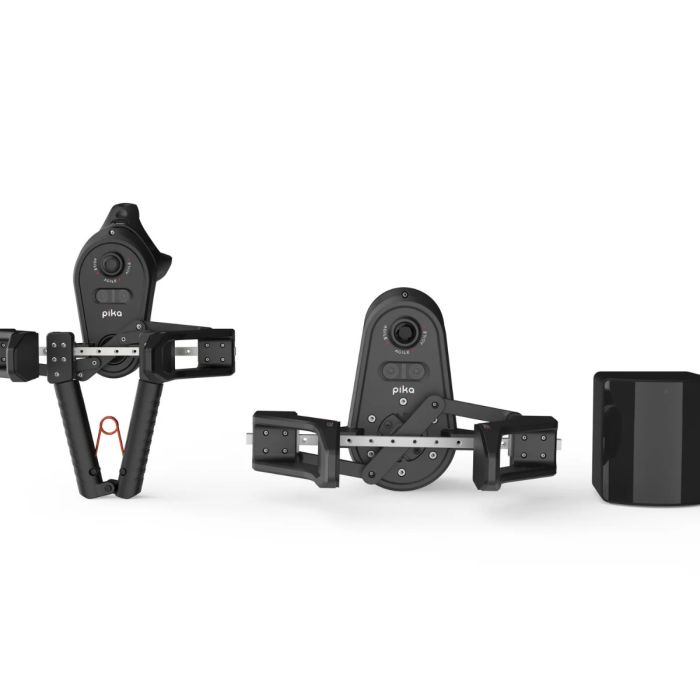
PiKA is commonly described as a modular kit with three core elements—PiKA Sense, PiKA Gripper, and PiKA Station—and may also be offered as a bundled package for field-ready use. AgileX positions PiKA as a lightweight, rapid-deployment tool intended to reduce the friction of collecting manipulation datasets in both lab and real-world environments.
Design and Features
Modular system components
PiKA is composed of several interoperable modules:
-
PiKA Sense (handheld collector): a lightweight, ergonomically designed handheld unit intended for manual operation and data capture. AgileX lists the handheld unit at 460 g on its product page, while a published user manual also documents a 550 g class device depending on configuration and accessory set.
-
PiKA Gripper (end effector): a two-finger robotic gripper designed to mount on standard robot-arm interfaces and capture synchronized multimodal data during grasping and manipulation.
-
PiKA Station (positioning base): a high-precision base station used to support consistent spatial positioning and repeatable data acquisition (particularly helpful for dataset consistency and calibration-like workflows).
Retail bundles often include two stations for improved coverage and flexibility in larger capture spaces.
Data-centric feature set
PiKA’s feature set emphasizes synchronized multi-sensor capture and practical usability:
-
Millimeter-level spatial capture: the system is described as supporting ~1.5 mm spatial positioning accuracy in typical use.
-
Multimodal outputs: the platform is described as collecting 6-DoF pose data, RGB and wide-angle imagery, depth data, inertial measurements (IMU), and gripping-related signals.
-
Ergonomic long-duration operation: the user manual explicitly frames PiKA as a “friendly interaction” design intended to reduce fatigue over longer sessions.
Technology and Specifications
Sensor and perception stack
PiKA is designed to capture the kind of signals typically used to train or validate manipulation policies:
-
Wide-angle / fisheye camera: documentation describes a field of view near 200° (useful for two-arm tasks and wider situational context).
-
Depth sensing: the kit includes depth capture; a retail spec lists a depth camera with 87° × 58° FOV and up to 90 FPS, with stated depth accuracy behavior at short range (e.g., around 50 cm).
-
IMU: the gripper module is listed with a 9-axis IMU at 100 Hz in one published technical specification summary.
Manipulation hardware
PiKA’s gripper is a two-finger design meant for both demonstration capture and robot-arm mounting:
-
Grip force: commonly listed as up to 2 kg of gripping force (often presented as a force-equivalent rating in reseller summaries).
-
Jaw range: an example technical listing specifies a 0–95 mm gripper range.
-
Form factor: one published listing provides gripper dimensions of 215 × 191 × 143 mm and a weight of ~690 g.
Positioning and station system
PiKA Station is positioned as a portable positioning and support subsystem:
-
Wide field of view for tracking/positioning: an example spec lists approximately 110° × 150° coverage.
-
Field usability: published retail descriptions mention up to ~30 hours of station battery life and up to 1 TB of onboard storage, supporting longer capture sessions away from fixed lab infrastructure.
-
Tripod integration: example listings cite a tripod with up to 2.1 m height and tilt adjustment.
Operating modes
The user manual outlines multiple ways to use PiKA, including:
-
Sense + Station for data collection,
-
Gripper alone for inference/execution,
-
Sense + Station + Gripper for teleoperation data collection, and
-
Use of an optional package to support data collection workflows.
Applications and Use Cases
Embodied AI and dataset generation
A common use case is building datasets for imitation learning, behavior cloning, and related embodied AI methods where synchronized 6-DoF pose + visual + depth + IMU signals are valuable for training and validation. Retail descriptions explicitly position PiKA for “data collection for AI model training and validation.”
Robotic manipulation R&D
PiKA is used in research settings to prototype and evaluate grasping and manipulation behaviors, including pick-and-place tasks, tool use, and interaction with varied object geometries. Because the gripper module can be mounted on robot arms (including AgileX and third-party platforms), PiKA can support rapid iteration between human demonstration and robot execution.
Teleoperation demonstrations (ROS ecosystem)
A public ROS community post highlights a demonstration of remote teleoperation with PiKA on Universal Robots arms (UR7e/UR12e), framing PiKA as a portable teleoperation gripper system that supports “natural human-to-robot skill transfer and rich multimodal data collection.”
Field and real-environment testing
Because PiKA Station is described with onboard power/storage and tripod-based deployment, PiKA is marketed for experiments beyond controlled labs—such as warehouses, mock apartments, retail-like environments, or outdoor test areas where quick setup is needed.
Advantages / Benefits
Commonly cited benefits in PiKA documentation and technical summaries include:
-
High-precision spatial capture (millimeter-class) suitable for repeatable dataset collection.
-
Rich, synchronized multimodal sensing (pose + wide-angle + depth + IMU + gripper signals).
-
Reduced post-processing burden: the user manual emphasizes direct position output and efficiency improvements versus approaches that require heavy post-synchronization.
-
Portability and ergonomics for longer capture sessions and rapid redeployment.
FAQ Section
What is AgileX PiKA (PIKA)?
AgileX PiKA is a portable teleoperation and data-collection system that combines a handheld capture unit, a robotic gripper end effector, and a positioning station to record multimodal manipulation data for robotics R&D and embodied AI.
How does AgileX PiKA work?
A user operates PiKA Sense by hand to perform grasping and motion demonstrations while PiKA records synchronized 6-DoF spatial data, visual/depth data, IMU measurements, and gripper signals. The PiKA Gripper can also be mounted on a robot arm for execution or teleoperation workflows.
Why is AgileX PiKA important?
High-quality manipulation datasets are a key input for modern embodied intelligence methods (e.g., imitation learning). PiKA is designed to streamline dataset collection with millimeter-level pose capture and a multimodal sensor stack, reducing the operational overhead of running repeated demonstrations.
What are the benefits of AgileX PiKA?
Commonly cited benefits include millimeter-class spatial capture, synchronized multimodal sensing (wide-angle, depth, IMU, gripper signals), portability for field use, and reduced post-processing due to direct position output.
Summary
AgileX PiKA (PIKA) is a modular, portable teleoperation and data-collection platform built around a handheld collector, a robot-arm-compatible gripper, and a positioning station to capture synchronized, multimodal manipulation data. By combining millimeter-class spatial capture with vision, depth, inertial, and gripper signals, PiKA is positioned to support reproducible dataset generation and rapid experimentation for embodied AI and robotic manipulation research