
Design and Features
Anthropomorphic kinematics
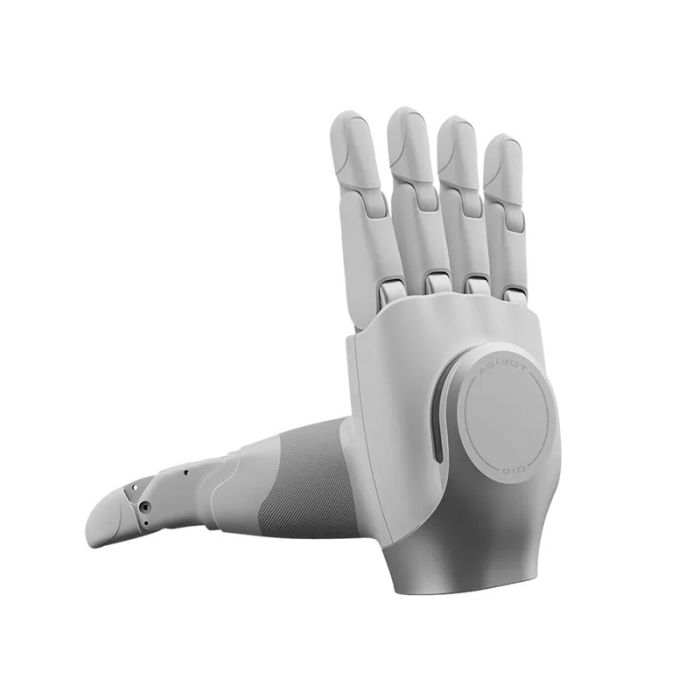
OmniHand 2025 follows a human-inspired layout: independent thumb with opposition, three identical central fingers (index/middle/ring) optimized for precision and wrap grasps, and a supportive little finger for lateral stabilization. Digit lengths and joint centers are tuned for everyday objects (cups, cartons, knobs, utensils) at countertop height.
Tendon-driven compliance with differential routing
The hand uses tendon transmission and low-backlash pulleys. Key joints are underactuated via differentials, distributing force across phalanges so the fingers conform to irregular geometries without complex joint-by-joint programming. Where dexterity matters (thumb, index distal), independently driven DOFs provide fine pose control for picking thin or deformable items.
Integrated tactile sensors and slip detection
Each fingertip features multi-cell pressure taxels (standard density) with an option for high-density gel pads. The controller fuses:
-
Normal pressure for contact onset and grip force estimation,
-
Shear/slip cues from micro-vibration signatures, and
-
Joint torque/position for proprioceptive context.
A palm 6-axis force–torque (F/T) module is available to stabilize heavier objects, measure interaction forces, and support whole-hand manipulation.
Interactive haptics and operator guidance
“Interactive” denotes bi-directional feedback. OmniHand 2025 exposes status LEDs (contact, slip, overload) and—when used with supported teleop interfaces—vibrotactile or force cues to the human operator. These help tune grip force, confirm stable contact, and prevent over-tightening during data collection or supervised tasks.
Serviceable, modular hardware
Finger shells employ shock-resistant polymers; tendon paths are color-coded and accessible behind gasketed covers for in-field replacement. Snap-in fingertips (high-friction rubber, ESD-safe silicone, textured polymer) and screw-in inserts (studs, hooks, stylus tips) let teams reconfigure grasp surfaces within minutes.
Technology and Specifications
-
Degrees of Freedom (typ.):
-
Thumb: 4 DoF (including opposition)
-
Index/Middle/Ring: 3 DoF each
-
Little: 3 DoF
-
Total controllable DoF: up to 16–19 (mix of independent and underactuated joints)
-
-
Actuation: compact BLDC/coreless micro-drives with tendon routing; elastic elements emulate series compliance for safer human-proximate use.
-
Fingertip force (per digit): 15–25 N peak (configuration-dependent).
-
Aggregate power grasp: 35–60 N sustained.
-
Position fidelity: sub-degree joint sensing; fingertip repeatability <0.5 mm within calibrated workspace.
-
Tactile sensing:
-
Standard: multi-cell pressure arrays on all fingertips; slip detection from micro-vibration and shear proxies.
-
Optional: high-density gel pads for higher spatial resolution on precision tasks.
-
-
Palm sensing: optional 6-axis F/T.
-
Materials: aluminum sub-frame; polymer/fiber-reinforced shells; ESD-safe fingertips available.
-
Ingress protection: IP42–IP54 options (light dust/splash resistance).
-
Mass: ~650–950 g (hand-only, by sensor loadout).
-
Power: 24 VDC nominal; <80 W peak during firm power grasps.
-
Thermal: passive heat-spreading; on-board temperature monitoring.
-
Interfaces: EtherCAT or CAN-FD for real-time control; USB-C service; industrial M12 harnessing optional.
-
Software: ROS 2 drivers, C++/Python SDK, URDF meshes, grasp planners, example reflex policies (grip tighten, micro-roll, re-grasp).
-
Mounting: ISO-style wrist flanges for common cobots/arms; optional quick-change coupler.
Control and reflexes
A supervisory controller fuses tactile and proprioceptive signals to trigger reflex behaviors:
-
Grip-tighten on incipient slip,
-
Micro-roll to seat a grasp without increasing force,
-
Re-grasp when shear exceeds a threshold.
These are deliberately simple, allowing higher-level policies (teleop, learned controllers) to remain stateless and portable across objects and scenes.
Applications and Use Cases
Manipulation research and robot learning
OmniHand 2025 is suited for imitation learning from teleoperation, reinforcement learning in simulation-to-real loops, and contact-rich benchmarks such as in-hand rotation, cap unscrewing, and bimanual assembly. Tactile signals improve reward shaping and transfer by detecting stable holds vs. slip.
Logistics and light manufacturing pilots
On collaborative arms and mobile manipulators, tactile sensing enables gentle handling of deformable packages, film-wrapped goods, and condensation-wet bottles. Underactuated compliance accommodates irregular SKUs without bespoke jaws.
Service robotics and humanoids
Human-like geometry supports appliance knobs, drawer pulls, door handles, utensils, and handover to people. LED states and haptic cues assist supervised public demos and semi-autonomous household trials.
Education and skills training
Universities and institutes use the platform to teach grasp taxonomies, tactile fusion, reflex design, and ROS 2 manipulation. Modular fingertips and clear maintenance procedures reduce lab downtime.
Healthcare and assistive R&D (non-clinical)
For research on activities of daily living (ADL), tactile sensing aids safe handovers and fragile-object manipulation under supervision (not a medical device).
Advantages / Benefits
-
Contact-aware dexterity: Tactile arrays with slip detection deliver gentle, stable grasps on soft, glossy, or irregular items.
-
Faster skill authoring: Interactive LEDs and haptic cues shorten teleop training loops and reduce operator error.
-
Practical robustness: IP-rated covers, serviceable tendons, and shock-tolerant shells balance lab-grade sensing with field durability.
-
Developer-ready stack: ROS 2 drivers, grasp libraries, and real-time buses speed integration with cobots, AMRs, and humanoids.
-
Modular fingertips: Rapidly tailor friction, ESD behavior, or texture without redesigning tooling.
FAQ
What is the AgiBot OmniHand 2025 with tactile sensors?
It’s a five-finger, tendon-driven robotic hand with multi-zone tactile sensing and slip detection, built for contact-rich, human-like manipulation.
How does OmniHand 2025 work?
Tendons and differentials give compliant finger motion; tactile arrays + joint sensing feed a controller that triggers reflexes (tighten, micro-roll, re-grasp) to stabilize objects.
Why is tactile sensing important in robot hands?
Tactile feedback lets the robot measure contact and slip, enabling gentle, stable grips on soft, glossy, or irregular items—tasks that defeat force-only control.
What are the benefits over standard grippers?
A far wider grasp repertoire, in-hand manipulation, better handling of deformables, and faster skill authoring using interactive feedback.
Does it support ROS 2 and real-time buses?
Yes. OmniHand 2025 ships with ROS 2 drivers, C++/Python SDKs, and EtherCAT/CAN-FD options for low-latency control.
Can I change fingertips for different tasks?
Yes. Snap-in pads and screw-in inserts let you switch friction, ESD properties, and textures within minutes.
Summary
The AgiBot OmniHand 2025 Interactive Dexterous Hand with Tactile Sensors pairs human-like geometry with contact-aware intelligence to address real-world manipulation—from research labs to service and logistics pilots. Through tendon-driven compliance, multi-zone tactile arrays, and reflex control, it stabilizes tricky objects that challenge conventional grippers. With a developer-centric stack (ROS 2, real-time interfaces, grasp libraries) and modular hardware, OmniHand 2025 offers a practical route to robust, touch-informed behaviors on collaborative arms, mobile manipulators, and humanoid platforms.