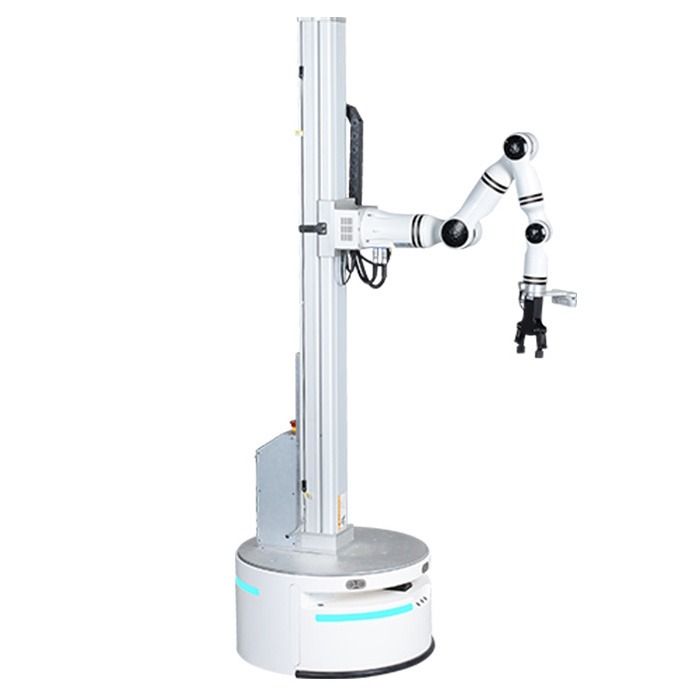
Realman Robotics Dual Arm Compound Robot (RMC-DA)
In stock
- BRAND:
- REALMAN
- PART #:
- RMC-DA
- AVAILABILITY:
- SUBJECT TO AVAILABILITY
- SKU:
- Realman Robotics-RMC-DA
Realman Robotics Dual Arm Compound Robot (RMC-DA)
Dual Arm Compound Robot (RMC-DA)
In RealMan’s product taxonomy, “compound robot” refers to integrated systems that extend beyond a standalone arm by adding mobility, autonomy, cooperation, and a more complete embodied-robot configuration (arms + chassis + sensors + interaction modules). RealMan describes itself as an ultra-lightweight humanoid robotic arm company with in-house development of key components including controllers, drivers, servo motors, and harmonic reducers—capabilities that inform how its mobile dual-arm platforms are packaged and integrated.
Design and Features
Dual-arm humanoid form factor
RMC-DA integrates two 7-axis robotic arms, enabling bimanual manipulation (two-handed actions) such as coordinated grasping, transfer, and alignment tasks. In RealMan’s catalog brochure, each arm is specified as 7-DOF, 610 mm reach, and 5 kg payload, highlighting its intent for human-like dexterity rather than single-tool automation alone.
Integrated mobile base (“compound” platform)
Unlike fixed-base collaborative arms, RMC-DA is built on a mobile chassis designed for navigation and repositioning across a workspace. The brochure describes an 8-wheel configuration (including mecanum wheels) with differential driving and active suspension, and lists endurance figures such as ~20 hours standby and ~11 hours runtime at 0.7 m/s with no load.
Multi-sensor safety and obstacle avoidance
The platform emphasizes layered safety and perception. RealMan’s brochure and third-party listings describe laser scanning obstacle avoidance, visual obstacle avoidance, force sensors, and an emergency stop function.
Human–robot interaction modules
RMC-DA is presented as an “embodied” learning and interaction system, integrating modules such as depth vision and an audio/voice module. The published specification set references a 4-microphone linear array and a Linux-based control environment in some catalog listings.
In marketplace descriptions of the platform, RealMan highlights “openness” and multiple ways to extend the system through secondary development—an emphasis consistent with its use in education and research settings.
Technology and Specifications
Platform-level specifications (RMC-DA)
RealMan’s dual-arm brochure lists the following platform parameters:
-
Model: RMC-DA
-
Platform size: Height 1350 mm, Arm reach (max span) 2070 mm
-
Weight: ~80 kg
-
Charging power supply: Single-phase three-wire ~220 V ±10% 50 Hz
-
Operating voltage: DC 24 V
-
Positioning accuracy (navigation): < ±5 cm
-
Moving speed: 1 m/s
-
External interfaces: Ethernet, USB, HDMI
-
Working environment: -10°C to +40°C, relative humidity ≤85% (25°C), altitude <4000 m
-
Safety protection: laser scanning obstacle avoidance, visual obstacle avoidance, force sensor, emergency stop
Robotic arms (per-arm specification in the brochure)
The catalog identifies the integrated arms as 7-DOF units with 610 mm reach and 5 kg payload, with ±0.05 mm repeatability and 180°/s max joint speed listed in the same parameter block.
This payload/reach class is often marketed for high-flexibility handling and research, rather than heavy industrial palletizing.
Mobile chassis and navigation stack
The brochure describes a chassis configuration including:
-
8 wheels (including mecanum wheels), differential driving + active suspension, with 250 W hub servo motors (x2)
-
A sensing stack including 10 m laser ranging radar (LiDAR), depth camera, and ultrasonic distance sensors
-
Published endurance estimates: ~20 hours standby, ~11 hours operation at 0.7 m/s with no load
Vision sensor (depth camera module)
For depth vision, the brochure lists an ideal usage range of 0.3 m to 3 m, USB 3.0 communication, and a 1280×720 @ 90 fps depth stream reference.
Five-finger dexterous hand (optional/featured configuration)
RMC-DA is shown as supporting a five-finger dexterous hand configuration. The brochure provides hand-level parameters including 12 joints, 6 active axes, ~530 g weight, 0.5 N force resolution, and grip strength ranges (four-finger and thumb).
On-board computing (main controller module)
RealMan’s brochure lists an NVIDIA-based compute module featuring a 384-core NVIDIA Volta GPU with 48 Tensor Cores, a 6-core NVIDIA Carmel ARM v8.2 CPU, 8 GB LPDDR4x, and Ubuntu 18.04 as the operating system, along with USB and GPIO-class interfaces.
Applications and Use Cases
Education and embodied-AI training platforms
RealMan’s own ecosystem descriptions and third-party catalogs repeatedly position RMC-DA as a training and innovation platform for education—where dual-arm coordination, perception, and interaction can be taught as an integrated robotics system rather than as isolated modules.
Bimanual manipulation research and prototyping
With two 7-axis arms, the platform supports classic bimanual robotics tasks such as two-handed grasping, handoffs, synchronized tool use, and cooperative alignment. Its mobile base further enables workflows where the robot must navigate to a station, perform manipulation, then relocate—a common pattern in embodied AI and mobile manipulation research.
Service and demonstration automation
RealMan’s “compound robot” category is presented as suitable for complex environments requiring mobility, autonomy, and cooperation. This makes RMC-DA relevant for show-floor demonstrations, guided interactions, and proof-of-concept deployments where a dual-arm system can illustrate human-like task capability.
Advantages / Benefits
Dual-arm coordination in a compact system
RMC-DA is marketed as compact and flexible while still providing a full dual-arm workspace (notably the 2070 mm max arm span reference). This combination is valuable in labs and classrooms where space is limited but bimanual tasks are a priority.
Integrated mobility for end-to-end workflows
By combining a mobile chassis with manipulation, RMC-DA reduces the need for separate AMR + stationary arm integration in early projects. Its published navigation and obstacle-avoidance features support safer movement in mixed environments (when configured and validated appropriately).
Strong compute and I/O for perception-driven automation
The inclusion of an NVIDIA-based compute module and external interfaces (Ethernet/USB/HDMI) aligns with perception-driven applications such as depth sensing, AI inference, and human–robot interaction—common requirements for “embodied intelligence” demonstrations.
Openness for development and curriculum design
RealMan’s positioning highlights openness and secondary development paths, matching the needs of research teams and educators who require extensibility rather than a fixed-function appliance.
FAQ Section
What is the RealMan Robotics Dual Arm Compound Robot (RMC-DA)?
The RMC-DA is a dual-arm mobile manipulation platform that integrates two 7-axis robotic arms on a mobile chassis with sensing, computing, and safety features for coordinated bimanual tasks.
How does the RMC-DA work?
RMC-DA navigates using a mobile chassis and perception sensors (including a LiDAR-based obstacle-avoidance stack) and performs manipulation using two integrated arms that can operate independently or cooperatively. The system includes on-board computing and common external interfaces (Ethernet/USB/HDMI) for control, perception, and application integration.
Why is the RMC-DA important?
Dual-arm mobile manipulators are a key category in embodied AI and advanced automation because they combine movement and two-handed dexterity, enabling workflows that resemble human task execution more closely than fixed-base, single-arm systems.
What are the benefits of the RMC-DA?
Key benefits include two 7-axis arms for bimanual manipulation, a mobile base with obstacle-avoidance and navigation sensors, integrated computing for perception-driven applications, and a platform positioning that supports education and secondary development.
Summary
The RealMan Robotics Dual Arm Compound Robot (RMC-DA) is a dual-arm mobile robot designed to bring bimanual dexterity and autonomous mobility into a single, integrated platform. With published specs including two 7-DOF arms (5 kg payload each), a platform height of 1350 mm, max arm span of 2070 mm, and a multi-sensor safety stack (laser scanning + visual obstacle avoidance, force sensing, E-stop), it is positioned as a practical system for education, research, embodied AI prototyping, and advanced automation demonstrations where coordinated two-handed manipulation is essential.