
SIASUN Conveyor-Type Mobile Robot (Transporting Type Mobile Robot)
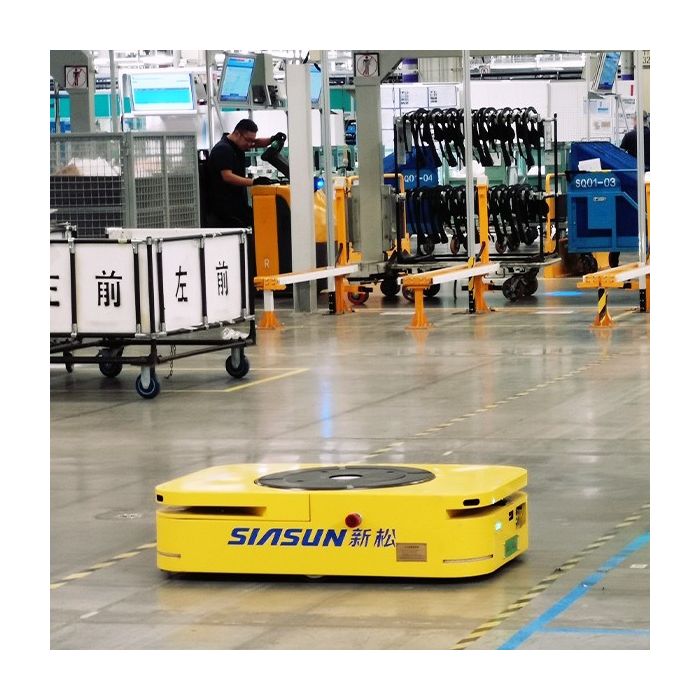
In stock
- BRAND:
- SIASUN
- PART #:
- Transporting Type Mobile Robot
- ORIGIN:
- China
- AVAILABILITY:
- SUBJECT TO AVAILABILITY
- SKU:
- SIASUN-Transporting-Type-Mobile-Robot
SIASUN Conveyor-Type Mobile Robot (Transporting Type Mobile Robot)
In SIASUN’s product taxonomy, these robots are positioned as a way to integrate conveyor handling directly into mobile logistics, improving line connectivity and reducing manual transfer steps in production and intralogistics environments.
Conveyor-type mobile robots are typically deployed where facilities require repeated, predictable material handoffs—for example, transferring totes, cartons, trays, or pallets between workstations, buffer areas, inspection points, packaging lines, and shipping zones. By combining mobile navigation with conveyor transfer, a single platform can automate both transport and load exchange, supporting higher throughput and fewer bottlenecks in mixed manual/automated operations.
Design and Features
Conveyor integration and load transfer
A defining feature of the transporting/conveyor-type mobile robot is the integrated conveyor module mounted on the chassis (e.g., roller conveyor, belt conveyor, or push–pull transfer mechanism). SIASUN’s product family includes variants such as single roller conveyor, double roller conveyor, and push–pull configurations, each suited to specific load types and transfer interfaces.
Chassis and industrial mobility
These robots generally use a low-profile industrial chassis engineered for:
-
Stable load handling during acceleration, deceleration, and turning
-
Docking repeatability at conveyor stations and handoff points
-
Sensor coverage to support obstacle detection, slow-down zones, and safe navigation in shared spaces
In SIASUN’s single-roller conveyor example, the platform is described with a rated load of 1000 kg, indicating suitability for heavier intralogistics loads when configured appropriately.
Fleet and task workflow (typical deployment model)
In many facilities, conveyor-type robots operate as part of a fleet, coordinating tasks such as:
-
Station-to-station delivery (line feeding)
-
Buffer staging (WIP inventory movement)
-
“Milk run” loops between production cells and storage
While implementations vary, these systems commonly integrate with warehouse management (WMS), manufacturing execution (MES), or line control systems so robot dispatch aligns with real-time production demand.
Technology and Specifications
Because “conveyor-type mobile robot” describes a category rather than a single fixed model, specifications vary by configuration. However, SIASUN’s published examples illustrate representative performance parameters for this class.
Navigation and positioning
One SIASUN conveyor-type configuration lists magnetic navigation as a guidance method.
Positioning accuracy for docking and handoff is commonly emphasized for conveyor transfer; the single-roller conveyor example lists ±10 mm positioning accuracy.
Load capacity and speed (example values)
From SIASUN’s example pages:
-
Rated load: 1000 kg (single roller conveyor configuration)
-
Maximum speed: up to 1.8 m/s (single roller conveyor configuration)
-
Maximum speed: up to 1.5 m/s (push–pull configuration example)
These figures suggest SIASUN positions some transporting-type robots for heavy-load movement at practical intralogistics speeds, subject to facility safety rules and site configuration.
Transfer mechanism and handling interfaces
Transporting-type robots are selected based on how loads must be exchanged:
-
Roller conveyor tops for pallet/tote transfers to/from fixed rollers
-
Push–pull modules for controlled sliding transfer between robot and station fixtures
SIASUN explicitly labels these variants within its transporting-type lineup.
Sensing and obstacle handling (example values)
SIASUN’s single-roller conveyor configuration lists obstacle-related parameters including:
-
Obstacle avoidance distance: 3 m
-
Obstacle stop distance: 1 m
Such parameters typically reflect how the robot’s perception stack and safety logic define slow/stop thresholds in a given operating mode and environment.
Safety and standards context
In deployments where mobile robots share space with people or other vehicles, integrators often reference safety frameworks for driverless industrial trucks and industrial robots. For example, EN ISO 3691-4 is widely used for driverless industrial trucks and their systems (including many AGV/AMR safety requirements).
(Exact compliance details are system- and region-dependent and should be verified in project documentation.)
Applications and Use Cases
Manufacturing intralogistics
Conveyor-type mobile robots are commonly applied to:
-
Line-side feeding (delivering components or subassemblies)
-
Work-in-process (WIP) movement between cells
-
Inter-process transport (e.g., machining → inspection → packaging)
Conveyor integration can reduce manual steps at stations, especially when loads must be transferred onto or off of fixed conveyors.
Warehousing and distribution
In distribution settings, transporting-type robots can support:
-
Buffer replenishment at packing lanes
-
Carton/tote movement between zones
-
Sortation support when paired with conveyor nodes
High-mix environments
Where product mix changes frequently, mobile conveyor platforms can be configured as flexible movers, shifting tasks through software dispatch rather than fixed conveyor reroutes.
Advantages / Benefits
Reduced manual handling
By enabling mobile-to-station conveyor transfer, these robots can reduce repeated lifting, pushing, or pallet-jack movement—particularly useful for heavy or frequent transfers.
Improved line connectivity
SIASUN describes the transporting/conveyor class as a way to improve line connectivity, avoid bottlenecks, and optimize logistics efficiency through conveyor integration.
Scalable automation
Compared with fixed conveyors alone, fleets of mobile conveyor robots can add capacity incrementally—deploying more robots as throughput requirements grow, without fully rebuilding material routes.
FAQ Section
What is the SIASUN Conveyor-Type Mobile Robot?
The SIASUN Conveyor-Type Mobile Robot is an industrial transporting-type AMR/AGV that combines autonomous movement with an integrated conveyor mechanism to transport and transfer goods between stations.
How does a conveyor-type mobile robot work?
A conveyor-type mobile robot navigates to a pickup or drop-off point and uses its onboard conveyor (such as rollers or a push–pull module) to transfer loads to or from a station interface. SIASUN lists configurations such as single roller conveyor and push–pull variants for different transfer needs.
Why are transporting-type mobile robots important in factories?
They help automate repetitive material movement while improving production line connectivity and reducing bottlenecks by linking processes with mobile, conveyor-enabled transfer.
What are the benefits of a conveyor-type mobile robot?
Common benefits include less manual handling, faster station-to-station transfers, and more flexible layouts than fixed conveyor-only routes. SIASUN also positions the transporting/conveyor class as improving line connectivity and logistics efficiency.
Summary
The SIASUN Conveyor-Type Mobile Robot (Transporting Type Mobile Robot) represents a conveyor-integrated approach to industrial mobile automation, aiming to connect production and logistics nodes with autonomous movement and automated load transfer. SIASUN’s documented variants—such as roller conveyor and push–pull configurations—illustrate how this category targets higher-efficiency intralogistics by improving line connectivity, reducing bottlenecks, and enabling scalable, flexible material flow in modern factories and warehouses.