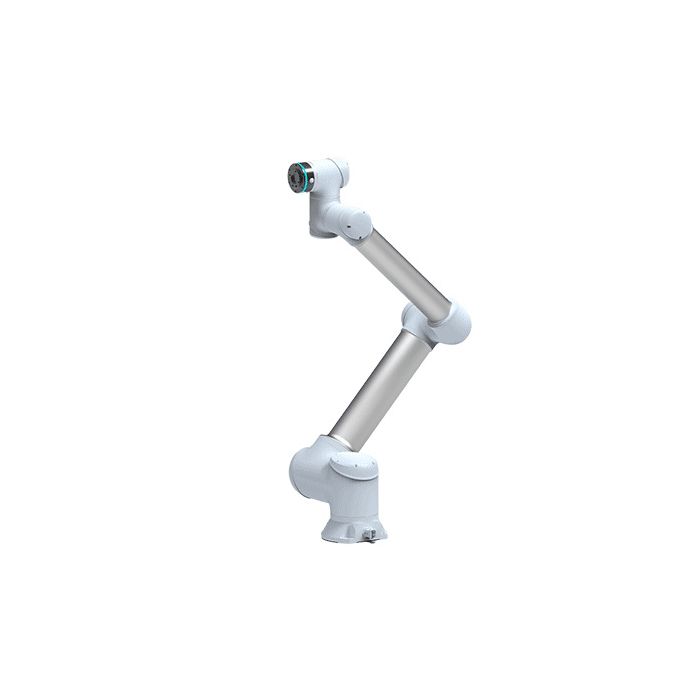
SIASUN Collaborative Robot Arm (GCR10-1300)
In stock
- BRAND:
- SIASUN
- PART #:
- GCR10-1300
- ORIGIN:
- China
- AVAILABILITY:
- SUBJECT TO AVAILABILITY
- SKU:
- SIASUN-GCR10-1300
SIASUN Collaborative Robot Arm (GCR10-1300)
Collaborative robot Collaborative Robot Arm (GCR10-1300)
Marketed as part of SIASUN’s DUCO collaborative robot lineup, the GCR10-1300 combines a 10 kg payload, 1300 mm reach, and 6-axis articulation in a mid-size form factor intended for common factory and lab workflows such as machine tending, assembly, packaging, and process operations (including cobot welding packages in some deployments).
Collaborative robots are typically engineered to reduce integration friction by emphasizing simpler commissioning, safety-oriented features (often including collision detection and force/torque limiting concepts), and broad compatibility with end-of-arm tooling (EOAT) and industrial communications. While safety compliance depends on the full system risk assessment (robot + tool + workpiece + speed + layout), cobots like the GCR10-1300 are commonly deployed to streamline automation in high-mix, low-to-medium volume production environments where frequent changeovers matter.
Design and Features
Mechanical architecture and motion
The GCR10-1300 is a 6-degree-of-freedom articulated arm, a configuration widely used for dexterous positioning and orientation tasks in manufacturing. The model is specified with a reach of 1300 mm and a body mass around 37.8 kg, supporting installation in a variety of orientations (“mounting type in any direction”).
Safety-oriented collaborative concepts
As a cobot-class arm, the GCR10-1300 is positioned around human-robot collaboration, typically emphasizing integrated safety behaviors such as collision detection and graded safety strategies. The product listing highlights collision detection and “human-robot interaction” positioning, along with multiple safety certifications.
In real-world deployments, collaborative operation is usually implemented through a combination of robot safety functions, workspace layout, speed limits, and a documented risk assessment aligned with industrial robot safety standards such as ISO 10218 and collaborative guidance commonly associated with ISO/TS 15066.
Integrated I/O and system integration
The platform includes control cabinet digital I/O as well as end-joint tool I/O, supporting typical EOAT integration such as grippers, vacuum generators, sensors, or welding/dispensing triggers.
It also specifies common industrial networking and fieldbus options, including TCP/IP, MODBUS/TCP, Profinet, EtherCAT, CAN, and RS-485, enabling integration into PLC-based production lines and OT networks.
Vision and monitoring (deployment-oriented features)
The product description highlights optional/packaged capabilities such as integration of 2D/3D camera workflows and cloud-oriented monitoring features (fault alarms, diagnosis, remote fault management), which align with typical cobot deployments where uptime tracking and rapid troubleshooting are important.
Technology and Specifications
Core performance specifications
Key published specifications for the GCR10-1300 include:
-
Payload: 10 kg
-
Reach: 1300 mm
-
Degrees of freedom: 6
-
Repeatability: ±0.05 mm
-
Max TCP speed: 3.8 m/s
-
IP rating: IP54
-
Operating temperature: -10 °C to 45 °C
-
Typical power consumption: 400 W
-
Power supply: 100–240 VAC, 47–63 Hz, 10 A
Tool mounting and end-effector compatibility
The robot’s tool interface is specified as ISO 9409-1 compatible (a common mechanical flange standard for end-effectors), which helps simplify interchangeability across grippers, tool changers, force/torque sensors, dispensing heads, and other EOAT.
Communication and controls
With multiple protocol options, the GCR10-1300 is positioned to support:
-
Direct TCP/IP integration for custom applications and middleware
-
Industrial fieldbuses (e.g., Profinet, EtherCAT) for PLC-driven lines
-
MODBUS/TCP and serial interfaces for legacy equipment and simpler I/O expansions
This breadth is particularly relevant in mixed-vendor factories where robotics must connect cleanly to existing conveyors, safety controllers, machine tools, and SCADA/MES systems.
Applications and Use Cases
Assembly and kitting
A 10 kg payload cobot with moderate reach is commonly used for multi-step assembly, screwdriving assistance, fixture loading, and kitting (picking components into trays). Repeatability in the ±0.05 mm class supports consistent placement in well-defined fixtures when paired with appropriate tooling and calibration.
Machine tending
Machine tending is a frequent cobot use case because it benefits from relatively compact robot cells and predictable motion cycles. The GCR10-1300’s reach and payload support tasks such as loading/unloading parts for CNC machines, presses, test rigs, and packaging machinery, especially when combined with vision or compliant gripping.
Packaging, labeling, and end-of-line handling
Cobots in this class are often applied to carton packing, case loading, and simple pallet staging (within payload limits), as well as labeling or barcode-scanning tasks where flexible placement and redeployment are valuable.
Welding and process operations
The listing references a rapid-deployment welding application package for welding scenarios, reflecting a common industry trend: cobots can simplify arc-welding or related processes when safety, fixturing, and fume control are engineered appropriately.
Inspection and test automation
Integrated communications and the possibility of 2D/3D vision workflows make cobot arms suitable for camera-guided inspection, gauging, test probe positioning, and sorting based on measurement outcomes.
Advantages / Benefits
Faster changeovers and flexible automation
Cobots are frequently selected for production lines that change products often. The GCR10-1300 is explicitly positioned for quick implementation/changeover and “easy to use,” which typically reduces time-to-value when compared with fully fenced industrial robot cells for smaller projects.
Lower power consumption for many tasks
A published 400 W power consumption is notable for many common pick-and-place and tending jobs, particularly when compared to higher-powered industrial robot cells, depending on duty cycle and payload usage.
Integration-friendly connectivity
Support for multiple industrial protocols (Profinet, EtherCAT, MODBUS/TCP, etc.) improves compatibility with PLC ecosystems and reduces the need for custom gateways in many deployments.
Deployment in collaborative settings (with proper safety engineering)
Collaborative robots are designed to support workcells where humans and robots operate in proximity. However, safe collaboration still requires a risk assessment and appropriate safety functions aligned with industrial safety standards such as the ISO 10218 series and collaborative guidance associated with ISO/TS 15066.
FAQ Section
What is the SIASUN GCR10-1300 collaborative robot?
The SIASUN GCR10-1300 is a 6-axis collaborative robot arm designed for industrial automation tasks, specified with 10 kg payload and 1300 mm reach for applications such as assembly, machine tending, and packaging.
How does the GCR10-1300 work in a factory setting?
It operates as a programmable robotic arm that moves tools or parts through defined paths. It integrates with production systems using industrial communications such as TCP/IP, Profinet, EtherCAT, and MODBUS/TCP, and connects to grippers or sensors via built-in digital I/O.
Why are collaborative robots like the GCR10-1300 important?
Collaborative robots help manufacturers automate tasks with faster changeovers and potentially simpler deployment than traditional robot cells. Safe collaboration still depends on proper risk assessment and alignment with safety standards used for industrial robots and collaborative operation.
What are the benefits of the GCR10-1300 cobot?
Key published benefits include 10 kg payload, 1300 mm reach, ±0.05 mm repeatability, IP54 protection, ~400 W power consumption, and broad protocol support (e.g., Profinet, EtherCAT, MODBUS/TCP) for integration into industrial environments.
Summary
The SIASUN Collaborative Robot Arm (GCR10-1300) is a mid-class industrial cobot combining 10 kg payload, 1300 mm reach, 6-axis motion, and ±0.05 mm repeatability, with industrial connectivity options and an integration-oriented design aimed at flexible automation. Its published specifications and protocol support make it a relevant option for manufacturers seeking collaborative robot applications such as machine tending, assembly, packaging, inspection, and process operations—subject to appropriate system engineering and safety validation.