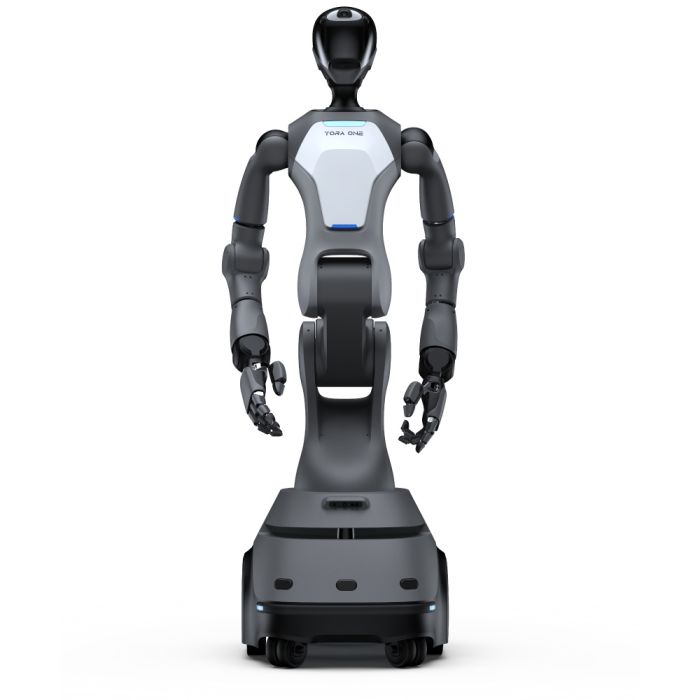
Paxini TORA ONE Multi-Dimensional Tactile Wheeled Humanoid Robot
In stock
- BRAND:
- PAXINI
- PART #:
- TORA-ONE
- ORIGIN:
- China
- AVAILABILITY:
- SUBJECT TO AVAILABILITY
- SKU:
- Paxini-TORA-ONE
Paxini TORA ONE Multi-Dimensional Tactile Wheeled Humanoid Robot
Paxini TORA ONE Multi-dimensional Tactile Humanoid Robot
Developed by PaXini Technology (Shenzhen) Co., Ltd., the platform is commonly positioned as a next-generation “embodied intelligence” system that integrates vision + touch (visual-tactile perception) for more reliable interaction with real-world objects and environments.
Unlike traditional industrial arms that remain bolted to fixed stations, TORA-ONE combines a mobile base with humanoid upper-body manipulation and four-fingered dexterous hands, enabling it to move between work areas and perform tasks such as object picking, handling, and light-duty operational workflows. The robot has been showcased in industrial and service demonstrations, including autonomous task sequences that require fine tool and object handling.
Developed by PaXini Technology (Shenzhen) Co., Ltd., the platform is commonly positioned as a next-generation “embodied intelligence” system that integrates vision + touch (visual-tactile perception) for more reliable interaction with real-world objects and environments.
Unlike traditional industrial arms that remain bolted to fixed stations, TORA-ONE combines a mobile base with humanoid upper-body manipulation and four-fingered dexterous hands, enabling it to move between work areas and perform tasks such as object picking, handling, and light-duty operational workflows. The robot has been showcased in industrial and service demonstrations, including autonomous task sequences that require fine tool and object handling.
Design and Features
Wheeled humanoid configuration
TORA-ONE uses a wheel-driven chassis rather than bipedal legs, a design choice often associated with improved energy efficiency, payload stability, and reliable indoor mobility. The chassis supports autonomous navigation using laser-based mapping and localization, enabling deployments in structured environments such as factories, warehouses, hospitals, and commercial venues.
Adjustable height and modular structure
A notable feature is its foldable / height-adjustable structure, allowing operation in both compact and extended postures. Official specifications describe a waist-folded height of 1.46 m and an extended height of 1.86 m, which helps match different workstation heights and human-facing service scenarios.
TORA-ONE is also described as having a modular design intended to support customization and development for specific application needs.
Multi-dimensional tactile + AI vision dexterous hands
The robot’s core differentiator is its visual-tactile manipulation stack, centered on four-finger bionic dexterous hands with integrated sensing. This configuration aims to improve stability when grasping objects with varying textures, shapes, and fragility, supporting tasks that require “soft” handling rather than rigid gripping.
Technology and Specifications
Degrees of freedom (DOF) and dexterity
TORA-ONE is commonly listed with 47 total degrees of freedom (DOF), combining the humanoid upper body and dexterous hands:
-
21 DOF (body, excluding hands)
-
32 DOF (two hands combined)
-
16 DOF per hand (typically 13 active + 3 passive)
-
4 fingers per hand
This DOF layout is intended to support complex wrist and finger postures, allowing pinch-like grasps and multi-contact handling patterns used in sorting, stocking, and light assembly.
Tactile sensing architecture
Official materials describe 2280 ITPU multi-dimensional tactile sensing units and 6840 tactile signal channels, designed to support high-resolution contact sensing across the hands.
Independent profiles and listings also reference large tactile arrays (often described as “nearly 2,000” tactile elements), reflecting the emphasis on dense tactile coverage for fine manipulation.
Visual perception (multi-camera system)
TORA-ONE integrates multiple cameras for perception and manipulation alignment. A typical configuration includes:
-
5 RGB cameras (3 on the head + 1 on each hand)
-
2 RGBD depth cameras (1 on the head + 1 on the chassis)
This sensor arrangement supports object perception, scene understanding, and hand-eye coordination for grasp planning.
Navigation and mobility
The robot uses laser SLAM autonomous navigation, often paired with a lidar-based environment mapping pipeline for indoor routing and localization.
Key mobility specifications commonly listed include:
-
Max movement speed: ~0.6 m/s
-
Charging time: ~6 hours
-
Battery capacity: 40 Ah
-
Endurance: up to 8 hours (depending on workload)
Manipulation performance indicators
Performance metrics used for deployment planning often include arm positioning repeatability and rated payload:
-
Arm repeat positioning accuracy: listed as ±0.5 mm (official profile)
-
Single-arm rated load (including hand): 5 kg (official profile)
Precision force control and 6D pose handling
In industry reporting tied to TORA-ONE’s public debut, the system has been described with high-precision force control and the ability to perform 6D object pose recognition and flexible grasping, enabled by tactile sensing and a dedicated tactile processing architecture.
Applications and Use Cases
Logistics and warehousing
TORA-ONE is frequently associated with warehouse workflows such as sorting, shelf-to-cart transfers, tote handling, and point-to-point delivery, combining navigation with manipulation. Official scenario lists commonly include logistics and warehousing as a target domain.
Manufacturing support and light assembly
With high-DOF hands and visual-tactile perception, the robot is positioned for precision handling tasks in light manufacturing—such as part placement, kitting, inspection assistance, and repetitive workstation support.
Healthcare and assisted services
Public product profiles often mention medical, caregiving, and health services as potential scenarios, especially where safe object handoffs and controlled contact are valuable.
Retail, hospitality, and commercial service
TORA-ONE is also shown in service-oriented contexts including reception, guidance, retail assistance, and commercial delivery, where a humanoid upper body supports intuitive interaction and object handling.
Demonstration workflows (e.g., food preparation)
In early 2026 coverage, TORA-ONE was described as performing an ice-cream preparation workflow at a major consumer technology exhibition, demonstrating multi-step manipulation and task sequencing.
Advantages / Benefits
Better real-world grasp stability via tactile perception
For many automation tasks, vision alone can be insufficient due to glare, occlusion, transparent objects, or uncertain friction. Multi-dimensional tactile sensing helps infer contact quality and improves control during grasping, especially for delicate objects.
Mobile manipulation in space-constrained facilities
A wheeled humanoid can move between stations, making it suitable for environments where installing multiple fixed arms is impractical. This supports more flexible “robot-as-a-worker” deployments in mixed-use indoor spaces.
Adjustable geometry for human-centric environments
Height adjustment (folded vs extended) can help align with workstation heights, counters, shelves, and human interaction zones without requiring custom infrastructure.
Reduced risk exposure for hazardous or repetitive tasks
Product and award descriptions emphasize using humanoid robots to assist or replace humans in hazardous environments and reduce repetitive strain and safety risks.
FAQ Section
What is Paxini TORA-ONE?
Paxini TORA-ONE is a multi-dimensional tactile wheeled humanoid robot designed for mobile manipulation tasks in industrial and service environments, using visual-tactile perception and dexterous hands.
How does Paxini TORA-ONE work?
TORA-ONE combines laser SLAM navigation for autonomous movement with a multi-camera perception system and tactile-sensing dexterous hands to detect objects, estimate their pose, and perform controlled grasps and placement.
Why is multi-dimensional tactile sensing important?
Multi-dimensional tactile sensing helps robots detect contact forces and grasp stability, which improves performance on fragile, slippery, or irregular objects where vision alone may be unreliable.
What are the benefits of Paxini TORA-ONE for factories and services?
Key benefits include mobile manipulation, high-DOF dexterous hands, dense tactile feedback for safer grasping, and autonomous navigation, supporting workflows in logistics, light manufacturing, healthcare support, and commercial service.
Summary
Paxini TORA-ONE represents a distinctive class of wheeled humanoid robots built around multi-dimensional tactile sensing and visual-tactile manipulation, aiming to improve reliability for real-world grasping and contact-rich tasks. With 47 DOF, dense tactile arrays, multi-camera perception, and autonomous SLAM navigation, it is positioned for logistics, manufacturing support, healthcare assistance, and commercial service automation where stable mobile manipulation is a priority.