Genisom L1 Ultra Compact Industrial Grade Quadruped Robot Dog

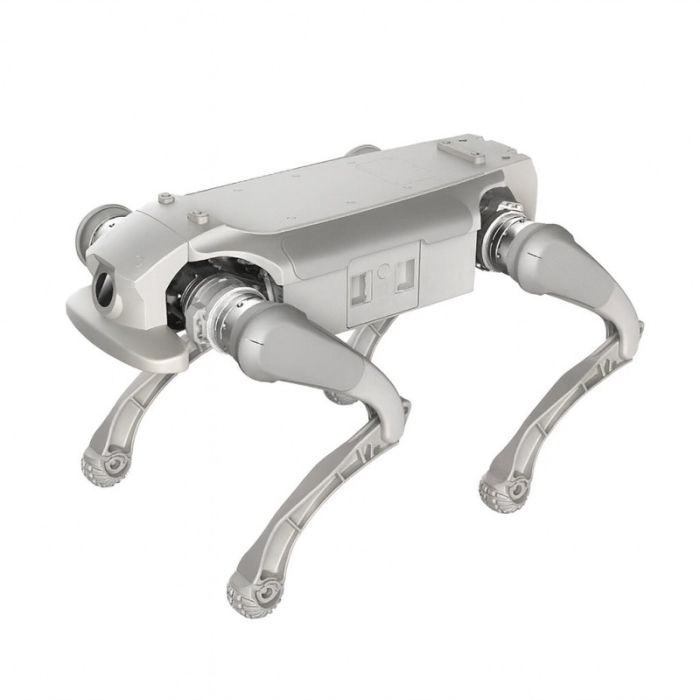
The Genisom L1 is an ultra-compact, industrial-grade quadruped (robot dog) designed for mobile inspection, patrol, and data capture in environments where wheeled platforms can struggle—such as uneven floors, tight industrial aisles, mixed indoor/outdoor sites, and areas with small obstacles or gaps. As a small-format legged robot, the L1 is typically positioned for autonomous or semi-autonomous missions that combine locomotion, onboard compute, and sensor payloads for perception and navigation.

In stock

BRAND:
GENISOM
PART #:
L1
ORIGIN:
China
AVAILABILITY:
SUBJECT TO AVAILABILITY
SKU:
Genisom-L1

Genisom L1 Ultra Compact Industrial Grade Quadruped Robot Dog

Commercial listings describe the L1 as an industrial quadruped capable of operating for up to two hours, reaching a maximum speed of about 3.7 m/s, and carrying payloads up to 8 kg, with an onboard compute rating of 100 TOPS (often used as a shorthand for AI inference capability on edge hardware).

Design and Features

Compact industrial form factor

The L1 is marketed as a compact industrial quadruped with a relatively small footprint and low height for navigating indoor facilities, under equipment, or through constrained corridors. Published dimensions for one configuration are approximately 63.0 cm (H) × 36.0 cm (W) × 41.5 cm (D).

Mobility and terrain handling

Like most quadruped platforms, the L1’s core design goal is stable legged locomotion across surfaces that include small steps, debris, thresholds, and uneven ground. Listings also describe practical mobility characteristics such as the ability to traverse a ~20 cm ditch, climb over ~15 cm obstacles, and handle slopes around 30° (these values can vary by configuration and test conditions).

Perception and navigation sensors

Commercial descriptions commonly pair the L1 with perception components used for autonomous navigation and obstacle avoidance, including 3D LiDAR and depth/vision cameras. Some listings mention wide-angle “4K” cameras and depth sensing as part of an obstacle-avoidance stack intended for autonomous routing and situational awareness.

Autonomy support and development options

The L1 is presented as suitable for secondary development (customization and integration), a common requirement for research labs, systems integrators, and industrial users who need mission workflows, fleet management hooks, or specialized payload control.

Technology and Specifications

Note: specifications can differ by battery choice, sensor package, and revision. Two public listings report different weights; both are included below for transparency.

Core published specifications

  • Robot type: quadruped; marketed for industrial use

  • Runtime: up to 2 hours

  • Maximum speed: up to 3.7 m/s

  • Maximum payload: up to 8 kg

  • Compute rating: 100 TOPS

  • Range: up to 6 km (often interpreted as mission distance under specified conditions)

  • Ingress protection: IP54

  • Operating temperature: 0°C to 40°C

Dimensions and mass (reported)

  • Dimensions (H×W×D): 63.0 × 36.0 × 41.5 cm

  • Weight: one listing reports 15 kg with battery

  • Weight: another listing reports ~12 kg (configuration not specified)

In practice, mass differences like these commonly result from battery capacity, sensor suite, protective housings, or revision changes.

Applications and Use Cases

Industrial inspection and condition monitoring

A compact quadruped platform is often used for routine inspection routes in industrial settings—capturing video, thermal (if equipped), audio, and environmental readings. Typical targets include pump rooms, utility corridors, warehouse aisles, and perimeter pathways where recurring data collection supports predictive maintenance.

Security patrol and situational awareness

Robot dogs are frequently evaluated for patrol workflows: scheduled navigation, anomaly detection, and live teleoperation when an alert triggers. The L1’s marketed obstacle-avoidance and perception stack is aligned with that style of use, particularly in large indoor facilities and mixed terrain sites.

Remote operations and hazardous areas

Quadrupeds are also used to reduce human exposure in areas that are difficult or unsafe to access (e.g., after an incident, in confined spaces, or around equipment where risk is elevated). IP54 suggests some protection against dust and splashing water (but not immersion), which can be relevant in industrial environments.

Research, education, and integration projects

With listings highlighting “secondary development,” the L1 is also positioned for R&D teams building autonomy pipelines, sensor fusion, mapping, or custom payload control—especially when a compact form factor is preferred.

Advantages / Benefits

Mobility where wheels struggle

Quadruped robots can maintain traction and stability across thresholds, uneven surfaces, and small obstacles that commonly interrupt wheeled platforms—especially indoors.

Edge AI capability for onboard perception

A published 100 TOPS compute rating suggests the platform is intended to run AI perception workloads locally (for example, object detection, navigation perception, or anomaly spotting) rather than streaming everything to the cloud.

Payload flexibility

With a published payload capacity up to 8 kg, the platform can potentially carry combinations of cameras, LiDAR, environmental sensors, radios, or customer-specific modules—subject to balance, power, and mounting constraints.

FAQ Section

What is the Genisom L1 Ultra Compact Industrial Grade Quadruped Robot Dog?

The Genisom L1 is a compact industrial quadruped (“robot dog”) designed for mobile tasks such as inspection, patrol, and data collection, with published specs including up to 2 hours runtime, up to 3.7 m/s speed, and up to 8 kg payload.

How does the Genisom L1 work?

The L1 combines legged locomotion with onboard compute and sensors (often described with LiDAR and cameras) to support teleoperation and/or autonomous navigation, including obstacle avoidance in industrial environments.

Why is a compact industrial robot dog important?

Compact quadrupeds are useful where wheeled robots struggle—such as across small obstacles, uneven surfaces, thresholds, and tight spaces—helping organizations collect data and conduct routine checks without sending staff everywhere in person.

What are the benefits of the Genisom L1?

Commonly cited benefits include compact size for indoor routes, legged mobility for obstacles and uneven ground, up to 8 kg payload capacity, and onboard compute rated at 100 TOPS for edge AI workloads.

Summary

The Genisom L1 is marketed as an ultra-compact industrial quadruped robot dog built for inspection, patrol, and research-oriented autonomy projects, with published specifications including up to 2 hours runtime, up to 3.7 m/s speed, up to 8 kg payload, and IP54 protection. Its small form factor, sensor-forward positioning, and edge compute target deployments where legged mobility and onboard perception can reduce manual site checks and expand robotic coverage in constrained industrial spaces.

Specifications

PART # L1
ROBOT TYPE QUADRUPED
ROBOT USE INDUSTRIAL
MAXIMUM SPEED 3.7 METERS / SECOND
MAXIMUM PAYLOAD 8 kg
RANGE UP TO 6 km
RUNTIME UP TO 2 HOURS
GPU 100 TOPS
BRAND GENISOM
OPERATING TEMPERATURE 0°C to 40°C
INGRESS PROTECTION IP 54
HEIGHT 63.0 cm
WIDTH 36.0 cm
DEPTH 41.5 cm
WEIGHT 15 kg WITH BATTERY

What's included

Genisom L1 Ultra Compact Industrial Grade Quadruped Robot Dog (L1)

Product Questions

Your Question:

Downloads

BROCHURES
(Size: 10.8 MB)
Write a Review
You're reviewing: Genisom L1 Ultra Compact Industrial Grade Quadruped Robot Dog
loader
Loading...

You submitted your review for moderation.

Customer Support